08/28/2027
10
min read
.jpg)
A single drain backup can shut down a restaurant kitchen for hours, force a healthcare facility to divert patients, or flood a retail tenant's stockroom with sewage. For facility managers, recurring drain issues aren't just maintenance annoyances: they're operational crises that disrupt revenue, trigger tenant complaints, and expose properties to health code violations. Traditional drain cleaning methods offer temporary relief at best, leaving facility teams trapped in a cycle of emergency calls and escalating costs.
What is commercial hydro jetting, and why does it eliminate recurring drain problems that snaking and chemical treatments can't solve? Commercial hydro jetting uses high-pressure water (typically 3,000–4,000 PSI) delivered through a specialized nozzle to scour drain and sewer lines clean, removing 100% of grease, scale, roots, sediment, and buildup from pipe walls. Unlike snaking, which punches a hole through blockages, or chemical treatments, which dissolve only organic material, hydro jetting restores pipes to near-original diameter and prepares them for long-term service. For facility managers, commercial hydro jetting drain cleaning is the only method that integrates into preventive maintenance schedules, scales across multi-site portfolios, and extends infrastructure lifespan while meeting health and environmental compliance standards. The Plumbing & Drain Services Across the Greater Columbus Area team provides this critical service to commercial facilities throughout the region.
This guide walks through the hydro jetting process, enumerates the operational benefits facility managers rely on, compares lifecycle costs against reactive drain cleaning, and explains how to integrate commercial hydro jetting drain cleaning into Proactive Plumbing Maintenance Built for Business Continuity programs that eliminate surprise downtime.
Hydro jetting is a drain cleaning technology that uses pressurized water (ranging from 3,000 to 4,000 PSI for most commercial applications) to remove buildup from the interior walls of drain and sewer pipes. The system consists of a high-pressure water pump, a reinforced hose capable of withstanding sustained pressure, and a specialized nozzle designed to direct water jets in multiple patterns. Forward-facing jets break through blockages and dislodge debris, while rear-facing jets scour pipe walls as the nozzle advances through the line.
The distinction between residential "drain cleaning" and commercial hydro jetting lies in capability and intent. Residential drain services typically address isolated clogs in small-diameter pipes using handheld augers or low-pressure equipment. Commercial hydro jetting targets 4- to 12-inch main lines, grease interceptor discharge pipes, and high-volume kitchen drain systems where buildup accumulates faster and blockages carry higher operational stakes. According to industry analysis of drain cleaning technology, hydro jetting removes the full scope of pipe-wall buildup, while snaking clears only a portion of the blockage, leaving residual grease and scale that accelerate recurrence intervals.
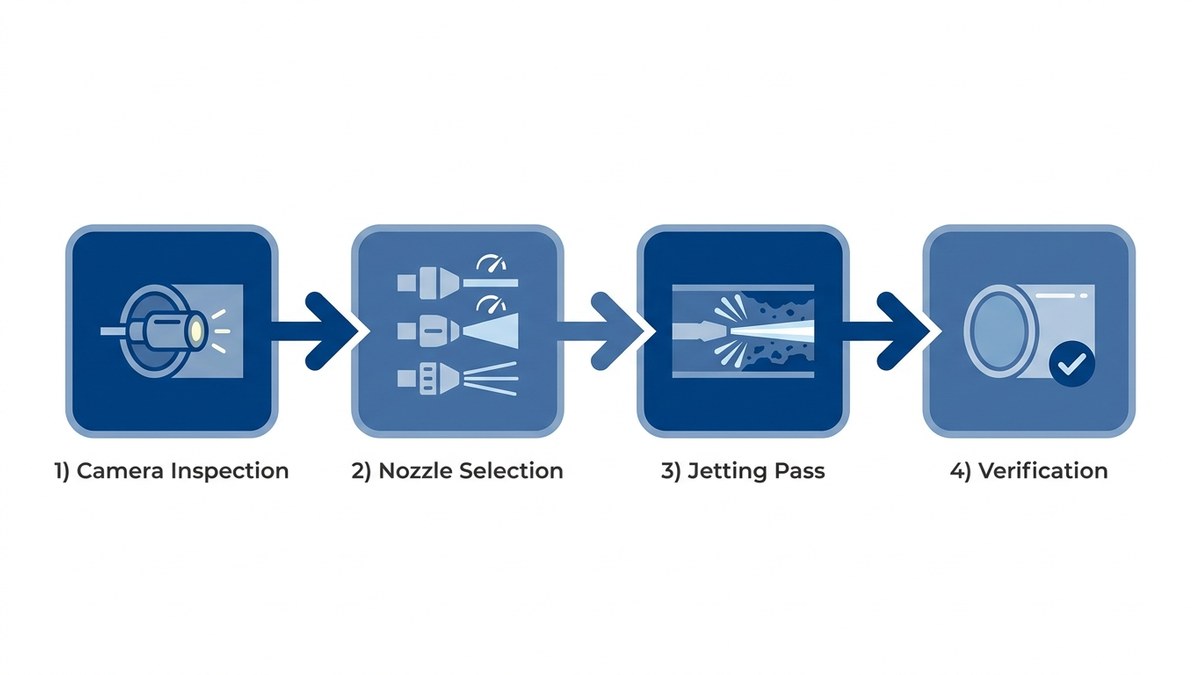
For facility managers, commercial hydro jetting drain cleaning represents infrastructure maintenance, not emergency-only service. A properly executed jetting program extends pipe lifespan, reduces emergency call frequency, and produces documented service records that satisfy health department inspections and compliance audits. The method scales across multi-site portfolios because service protocols remain consistent (camera inspection, nozzle selection, jetting pass, verification) regardless of facility type or pipe configuration.
Commercial hydro jetting drain cleaning follows a documented four-step protocol that ensures thorough cleaning, protects pipe integrity, and produces verifiable results. Each step addresses a specific operational requirement from identifying the problem to confirming its resolution.
Before water pressure enters the pipe, a waterproof camera mounted on a flexible cable travels the full length of the drain line. The inspection locates blockages, identifies buildup type (grease, roots, scale, sediment), and reveals pipe condition. Cracks, root intrusion points, corrosion, and joint separation appear on the camera feed, allowing the operator to adjust PSI settings and nozzle selection to match pipe integrity. For older cast iron systems or deteriorated clay tile lines, the inspection may reveal that hydro jetting requires adjusted pressure or that the pipe needs repair before cleaning can proceed. The camera footage becomes part of the service documentation, providing facility managers with a baseline condition record for future maintenance planning.
Hydro jetting nozzles vary by jet pattern, orifice size, and spray angle. A penetrating nozzle directs high-pressure jets forward to break through grease plugs or root masses. A flushing nozzle balances forward and rear jets to clear debris while scouring walls. A chain flail nozzle (used for heavy scale or mineral deposits) combines water jets with rotating chains that mechanically abrade buildup. The operator selects the nozzle based on camera findings and facility context: a restaurant kitchen drain requires a grease-cutting nozzle, while a healthcare facility laundry line needs a sediment-flushing configuration. PSI calibration follows the same logic (3,000 PSI for PVC and newer ductile iron, 2,500 PSI for older cast iron, and lower settings for fragile clay tile).
The nozzle enters the drain line through a cleanout access point, and high-pressure water flow begins. Forward jets break through blockages and push debris downstream toward the main sewer connection. Rear jets (angled at 15 to 30 degrees) create a scouring action against pipe walls as water pressure propels the nozzle forward. The operator advances the hose at a controlled rate, allowing the jets to dwell on buildup long enough to dislodge it completely. For heavily obstructed lines, the operator may make multiple passes, increasing PSI incrementally or switching nozzles mid-service.
After the jetting pass, the camera re-enters the line to verify results. The post-clean inspection confirms that pipe walls are free of buildup, that debris has cleared the system, and that no new damage occurred during the cleaning process. The camera footage captures the restored pipe diameter and documents the work performed. Service documentation includes cleanout location, pipe material and diameter, blockage type, PSI settings, nozzle selection, and before-and-after camera timestamps. To Book an Appointment With Plumbing & Drain Professionals for a camera inspection and hydro jetting assessment, facility managers receive upfront pricing and same-week availability.
Facility managers adopt commercial hydro jetting drain cleaning because it's the only drain cleaning method that aligns with operational continuity requirements, compliance mandates, and long-term capital planning. Six specific benefits drive the transition from reactive snaking to scheduled hydro jetting programs.
1. Complete Buildup Removal vs. Partial Clearing
Snaking mechanically breaks through a blockage, creating a path for water flow but leaving grease, scale, and sediment adhered to pipe walls. Within weeks or months, residual buildup narrows the pipe diameter again, and the drain slows. Hydro jetting removes wall deposits completely, restoring the pipe to near-original capacity. For a restaurant kitchen where grease accumulates daily, this extends the recurrence interval from months to more than a year. For a healthcare facility laundry where lint and detergent residue coat pipes, complete removal prevents the biofilm growth that accelerates corrosion.
2. Extended Pipe Lifespan and Deferred Replacement Capital
Recurring blockages stress pipe joints, accelerate corrosion, and create pressure differentials that crack older cast iron. NASSCO pipe cleaning guidelines recommend hydro jetting as the preferred maintenance method for ductile iron and PVC commercial drain lines because it removes corrosive buildup without mechanically abrading pipe walls. Facility managers who adopt scheduled hydro jetting programs report extended pipe service life compared to facilities that rely on reactive snaking.
3. Environmental Compliance and Chemical-Free Cleaning
Chemical drain cleaners dissolve organic material but leave inorganic buildup untouched. They also introduce caustic compounds into municipal wastewater systems, creating compliance exposure for facilities in jurisdictions with strict discharge regulations. Commercial hydro jetting drain cleaning uses only water, producing no chemical runoff and meeting the most stringent environmental standards. For food service facilities subject to health department inspections, chemical-free cleaning eliminates the risk of contamination allegations.
4. Scalability Across Multi-Site Portfolios
Property management firms who manage dozens or hundreds of commercial buildings need standardized maintenance protocols that deliver predictable results regardless of facility type. Commercial hydro jetting drain cleaning scales because the service protocol remains consistent: camera inspection identifies the problem, nozzle selection matches the buildup, jetting removes it, and verification documents the outcome. A facility manager can schedule regular hydro jetting at multiple restaurant locations with a single vendor and receive identical service documentation at each site.
5. Integration Into Preventive Maintenance Schedules
Emergency drain calls disrupt operations, force after-hours service charges, and strain vendor relationships. Facility managers who adopt scheduled commercial hydro jetting drain cleaning intervals eliminate the majority of emergency backups. PlumbGuard® clients report substantial reductions in emergency drain calls within the first year. The preventive model combines hydro jetting with camera inspections, grease trap cleanouts, and backflow testing into a single maintenance contract, reducing vendor coordination overhead.
6. Documented Service History for Compliance Audits
Health department inspections, tenant disputes, insurance claims, and property sale due diligence all require proof of maintenance. Camera footage timestamped before and after each jetting service provides objective documentation that facility managers use to demonstrate due diligence. For a multi-tenant retail center where a tenant alleges that inadequate drain maintenance caused a stockroom flood, pre- and post-jetting video evidence shows exactly when the pipe was clear and whether the facility met its maintenance obligations.
Facility managers evaluating drain cleaning methods need to compare not just per-service pricing, but total lifecycle cost, recurrence intervals, and operational impact. The table below contrasts snaking, chemical treatments, and commercial hydro jetting drain cleaning across the dimensions that drive long-term facility performance.
| Dimension | Snaking | Chemical Treatments | Hydro Jetting | |-----------|---------|---------------------|---------------| | Thoroughness of Cleaning | Clears a path through blockages; leaves most buildup on pipe walls | Dissolves organic material; leaves inorganic scale and sediment untouched | Removes buildup completely from pipe walls; restores near-original diameter | | Effect on Pipe Lifespan | Mechanical stress on joints and fittings; accelerates corrosion in older cast iron | No mechanical stress, but residual buildup traps moisture and accelerates corrosion | Extends lifespan by removing corrosive deposits | | Environmental Impact | Neutral (mechanical only) | Introduces caustic chemicals into wastewater; creates compliance exposure | Chemical-free; complies with strictest discharge regulations | | Recurring Backup Frequency | Every few months in high-volume facilities | Every few months (ineffective on grease and scale) | Extended intervals with preventive scheduling | | Suitability for Grease Buildup | Limited (punches through, doesn't remove wall coating) | Minimal (breaks down fats but leaves hardened deposits) | Complete removal of grease, FOG, and organic residue | | Suitability for Root Intrusion | Cuts through roots but leaves root mat in pipe | Ineffective (chemicals don't kill roots or remove biomass) | Removes root biomass; used with root treatment for long-term control | | Suitability for Scale and Sediment | Ineffective (cable can't abrade mineral deposits) | Ineffective (chemicals don't dissolve inorganic material) | Complete removal of scale, rust, and sediment | | Documentation for Compliance | Service invoice only (no verification of results) | No documentation (self-applied product) | Camera-verified before-and-after footage; timestamped service records |
The per-service cost comparison misleads because it ignores recurrence intervals and long-term infrastructure impact. According to research on grease trap maintenance intervals, facilities that adopt regular hydro jetting reduce total annual drain maintenance costs while eliminating emergency calls, extending pipe lifespan, and gaining documented compliance evidence.
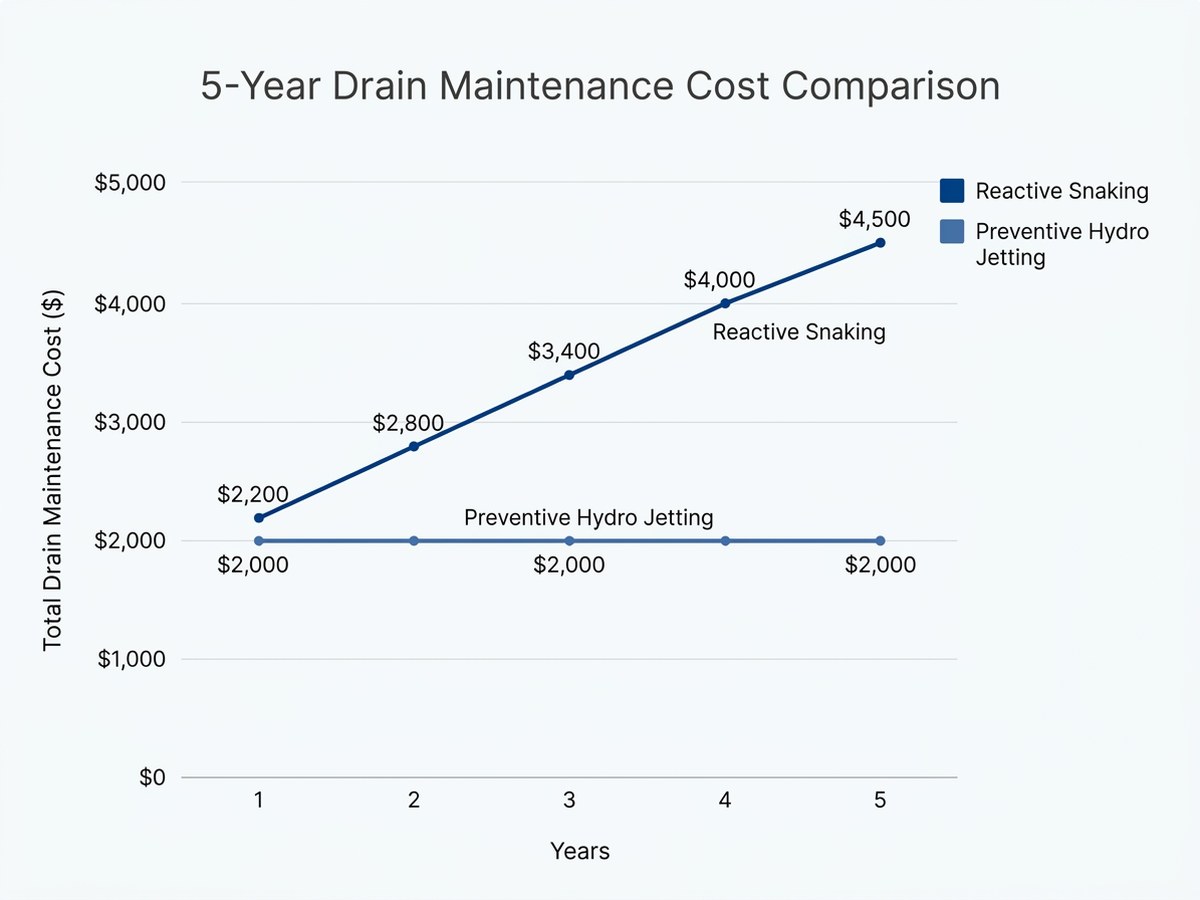
Commercial hydro jetting drain cleaning addresses specific drain challenges that vary by facility type, usage intensity, and regulatory exposure. Six facility categories represent the majority of commercial hydro jetting applications.
Food Service Facilities: Grease Trap Discharge Lines and Kitchen Drains
Restaurants, commercial kitchens, cafeterias, and food processing facilities generate fats, oils, and grease (FOG) that coat drain pipes downstream of grease traps. Even with properly sized and maintained grease traps, residual FOG passes into discharge lines and solidifies as water cools, narrowing pipe diameter and slowing flow. Best practices for food service plumbing recommend pairing trap service with hydro jetting of the discharge line to prevent FOG buildup between inspections. The Commercial Plumbing Services in Gahanna, OH team serves numerous food service facilities where grease management is critical to operational continuity.
Multi-Tenant Commercial Buildings: Preventing Cross-Contamination and Tenant Complaints
Office buildings, retail centers, and mixed-use developments with shared drain infrastructure face a compounding problem: one tenant's neglect affects all tenants on the same vertical drain stack. A restaurant tenant on the ground floor that doesn't maintain its grease trap can cause backups in second-floor retail spaces. Facility managers use scheduled hydro jetting of main lines and vertical stacks to prevent cross-contamination and reduce tenant complaint frequency.
Healthcare Facilities: Laundry Drains and Infection Control Compliance
Hospitals, nursing homes, surgical centers, and outpatient clinics operate high-volume laundry facilities that discharge lint, detergent residue, and biological contaminants into drain systems. Lint accumulates in horizontal drain runs, trapping moisture and creating biofilm growth that accelerates stainless steel corrosion. Healthcare facility managers adopt regular hydro jetting of laundry drains, combined with camera inspections, to maintain compliance and prevent the operational disruption of emergency drain repairs during patient care hours.
Industrial Facilities: Sediment and Scale in Process Water Lines
Manufacturing plants, food processing facilities, and distribution centers with floor drains, wash-down stations, and process water discharge systems accumulate sediment, mineral scale, and product residue that chemical treatments can't dissolve. Commercial hydro jetting drain cleaning removes inorganic buildup without introducing chemicals that might contaminate production areas or violate discharge permits.
Hospitality Facilities: Guest Experience and Health Inspection Readiness
Hotels, convention centers, and event venues depend on functional drain systems to maintain guest satisfaction and meet health inspection standards. A backed-up drain in a guest room or a slow-draining kitchen sink during a banquet creates immediate reputation risk. Hospitality facility managers adopt preventive hydro jetting schedules to ensure that drain issues never reach guest-facing spaces.
Property Management Portfolios: Standardized Maintenance Across Sites
Facility service providers and property management firms that oversee multiple commercial buildings need drain maintenance protocols that scale without requiring site-specific troubleshooting. Commercial hydro jetting drain cleaning standardizes the service: every facility receives camera inspection, jetting, and verification documentation on a schedule determined by facility type and usage intensity.
High-pressure water jetting carries inherent safety requirements and pipe compatibility considerations that distinguish professional commercial service from residential drain cleaning. Facility managers evaluating hydro jetting providers need to understand when the method is appropriate and when it requires modified PSI settings.
Pre-Inspection Identifies Fragile or Damaged Pipes
The camera inspection that precedes every commercial hydro jetting drain cleaning service reveals cracks, corrosion, root intrusion points, and joint separation (conditions that indicate fragile pipe integrity). For older cast iron drain lines with visible rust scaling or clay tile systems with offset joints, the operator adjusts PSI downward to minimize stress on weakened sections. The pre-inspection prevents the scenario where high-pressure water causes a pipe failure, and documented camera footage protects both the facility manager and the service provider from liability disputes.
PSI Calibration Based on Pipe Material and Age
Different pipe materials tolerate different pressure ranges. PVC and ductile iron installed in the last few decades handle higher PSI without stress. Cast iron installed before 1980, especially in facilities with aggressive wastewater chemistry, may require lower PSI to avoid joint stress. Clay tile sewer lines, common in buildings constructed before 1950, are particularly fragile. High-pressure water jetting safety standards require operators to verify pipe material, assess visible condition through camera inspection, and select PSI settings that balance cleaning thoroughness with pipe preservation.
Certified Operators Prevent Over-Pressure and Equipment Misuse
Hydro jetting equipment generates pressures that can cause severe injury if mishandled. Operators require training on hose handling, nozzle selection, PSI calibration, and cleanout access procedures. Licensed commercial plumbers with hydro jetting certification understand how to match nozzle jet patterns to blockage types, how to advance the hose at a controlled rate, and how to recognize warning signs (unusual vibration, hose whip, pressure spikes) that indicate equipment malfunction or pipe damage. Trusted Plumbing Services Built on Experience and Accountability emphasize safety protocols and operator certification as core components of commercial hydro jetting service.
When Hydro Jetting Is NOT Appropriate
Three pipe conditions preclude hydro jetting: (1) Severely deteriorated pipes with longitudinal cracks or separated segments, where water pressure could cause catastrophic failure; (2) Clay tile systems with offset joints exceeding one inch, where the nozzle might catch on misaligned sections; (3) Pipes with active root intrusion so dense that mechanical root cutting is required before hydro jetting can proceed. In these cases, the camera inspection identifies the condition and the facility manager receives a repair or replacement recommendation before cleaning can occur.
The operational value of commercial hydro jetting drain cleaning emerges not from isolated service calls but from scheduled maintenance intervals that prevent blockages before they disrupt operations. Facility managers who integrate hydro jetting into preventive maintenance programs eliminate most emergency drain calls, extend pipe lifespan, and gain predictable maintenance expenditures.
From Reactive Firefighting to Scheduled Service Intervals
Most commercial facilities enter the drain maintenance market reactively: a drain backs up, an emergency call goes out, a contractor arrives (often with after-hours fees), snakes the line, and leaves. The facility pays for the emergency response, operations resume, and the cycle repeats months later. The reactive model costs more per year than preventive programs and delivers zero predictability.
Preventive maintenance inverts this model. Facility managers schedule commercial hydro jetting drain cleaning at intervals determined by facility type and usage intensity. The service occurs during planned maintenance windows, combines camera inspection with jetting and verification, and produces documentation for compliance audits. According to industry research on preventive drain maintenance, facilities that adopt scheduled hydro jetting intervals reduce emergency backup frequency substantially within the first year and extend pipe service life compared to reactive-only maintenance.
PlumbGuard™: Scheduled Intervals with Combined Services
PDP's Proactive Plumbing Maintenance Built for Business Continuity integrates commercial hydro jetting drain cleaning into a comprehensive contract that combines drain cleaning, camera inspections, grease trap cleanouts, and backflow testing into a single scheduled service. Facility managers receive upfront annual pricing, scheduled service windows (no waiting for emergency availability), and documented service history that satisfies health department inspections and insurance audits. The combined service model reduces vendor coordination overhead (one contractor, one invoice, one accountability relationship).
Many jurisdictions require annual backflow testing for commercial facilities. Compliance research shows that facilities combining backflow testing with hydro jetting inspections reduce vendor coordination overhead and ensure that all plumbing compliance requirements occur during the same service window.
Facility managers evaluating commercial hydro jetting drain cleaning often focus on per-service pricing without comparing it to the total lifecycle cost of reactive drain maintenance. The ROI calculation requires measuring not just service call expenses, but emergency response frequency, pipe replacement timing, downtime impact, and compliance exposure.
The Reactive Model: Higher Long-Term Costs
A mid-size commercial facility that relies on reactive drain cleaning typically experiences recurring scheduled service calls, multiple emergency backups with after-hours fees, and accelerated pipe replacement timelines. Recurring blockages stress joints and accelerate corrosion. Operational impact includes multiple emergency disruptions, tenant complaints, health inspection citations, and unpredictable maintenance budget variance.
The Preventive Model: Predictable Costs and Extended Infrastructure Life
The same facility adopts regular hydro jetting with camera inspections. Emergency backups reduce to near zero. Pipe replacement timelines extend significantly, deferring substantial capital expenditure. Operational impact: zero surprise disruptions, documented compliance for audits, predictable maintenance budget, and extended infrastructure lifespan.
The preventive model may show similar or modestly higher scheduled service expenditure, but eliminates emergency response costs and defers major capital replacement. PlumbGuard® clients report substantial reductions in emergency drain calls within the first year of scheduled commercial hydro jetting drain cleaning.
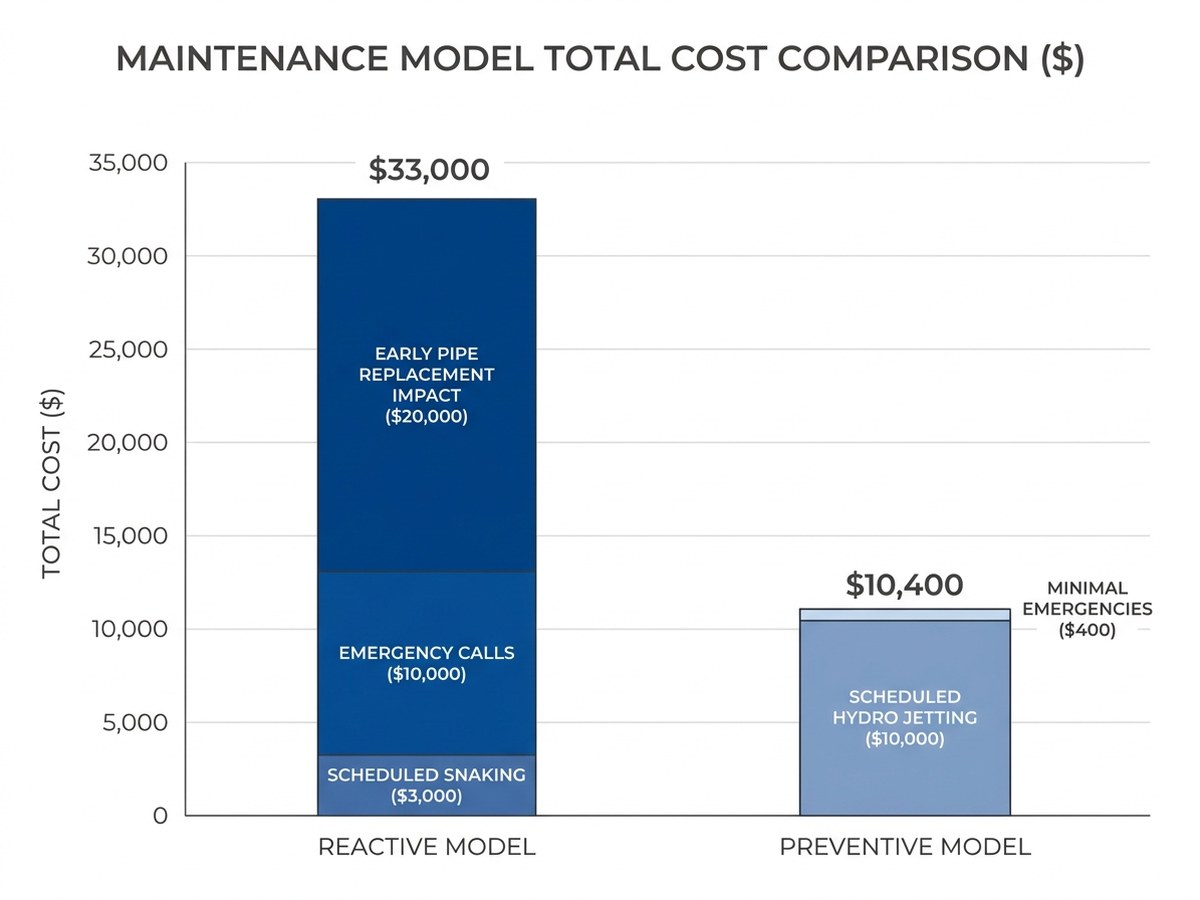
Additional ROI dimensions include downtime cost (a restaurant kitchen backup during dinner service loses substantial revenue per hour), tenant satisfaction (retail tenants withhold rent or break leases after recurring plumbing issues), and compliance exposure (health department citations for inadequate grease trap maintenance carry significant fines plus reputation damage). When facility managers measure hydro jetting ROI across all these dimensions (not just per-service pricing), the preventive model delivers strong returns within the first two years. For additional facility maintenance insights and cost-reduction strategies, visit the Plumbing & Drain Professionals Blog.
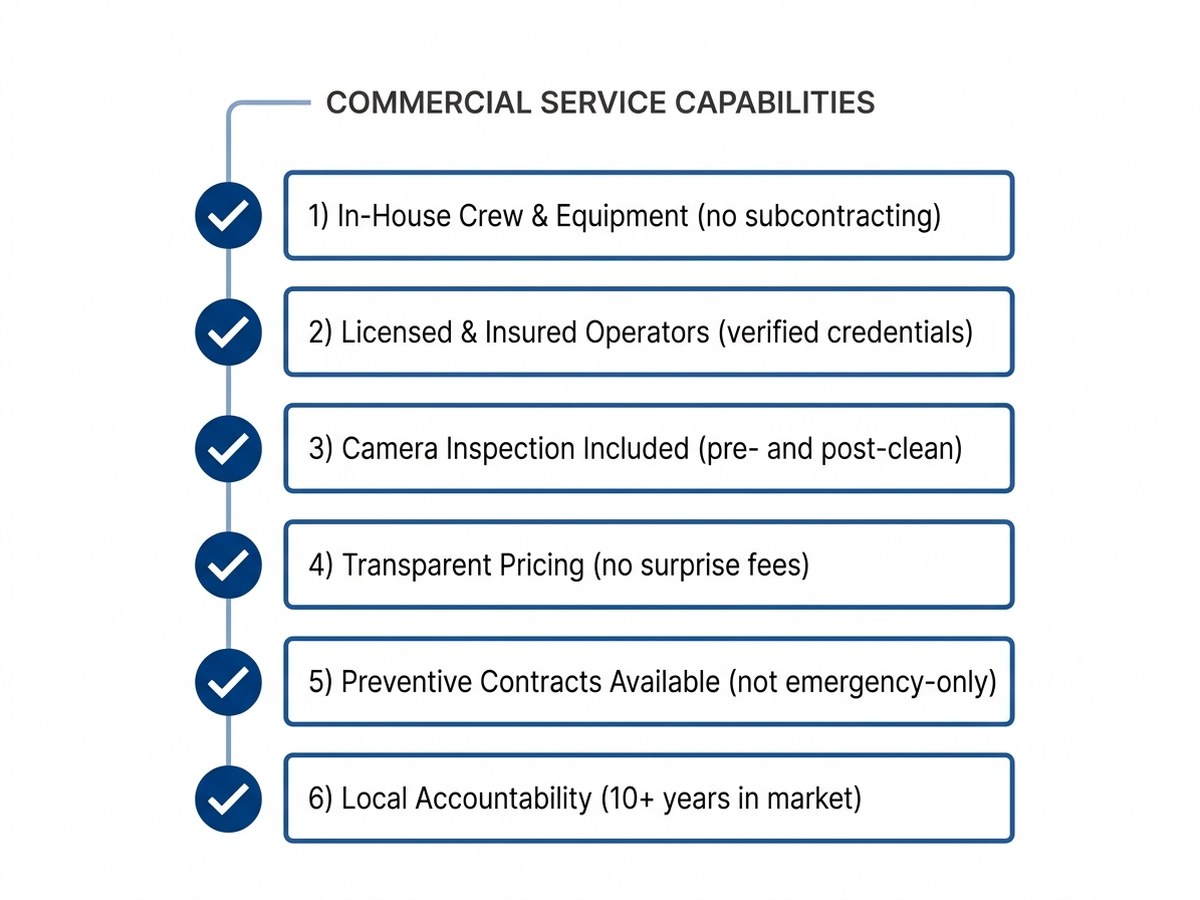
Facility managers evaluating hydro jetting contractors should use a structured checklist that separates professional commercial plumbing providers from residential-focused drain cleaning services. Six criteria distinguish providers who deliver documented, scalable, accountable service.
1. In-House Crew and Equipment (No Subcontracting)
Many commercial plumbing contractors subcontract hydro jetting to third-party drain cleaning specialists, which introduces coordination delays, accountability gaps, and inconsistent service quality. Providers who own their hydro jetting equipment, employ their own licensed operators, and perform camera inspections in-house eliminate vendor coordination overhead and own the entire service lifecycle. Facility managers work with one crew, one accountability relationship, and one documented record.
2. Licensed and Insured Operators
Hydro jetting generates pressures that require specialized training, equipment knowledge, and safety protocol compliance. Licensed commercial plumbers with hydro jetting certification understand pipe material compatibility, PSI calibration, nozzle selection, and emergency shutdown procedures. Facility managers should verify that the provider employs licensed plumbers (not unlicensed drain technicians), carries commercial general liability insurance, and maintains workers' compensation coverage for all crew members.
3. Camera Inspection Included (Pre- and Post-Clean Documentation)
Professional commercial hydro jetting drain cleaning service includes camera inspection as a standard component, not an upsell. The pre-clean inspection identifies blockages, assesses pipe condition, and determines appropriate PSI settings. The post-clean inspection verifies that pipe walls are clear, documents restored diameter, and provides objective proof of service thoroughness. The camera footage becomes part of the facility's compliance documentation, used during health inspections, tenant disputes, and insurance claims.
4. Transparent Pricing (Per-Linear-Foot or Flat-Rate, No Surprise Fees)
Professional providers quote hydro jetting service on a per-linear-foot basis or as a flat rate for standard main line sections. The quote includes camera inspection, jetting, verification, and documentation with no surprise fees. Transparent pricing allows facility managers to budget accurately and compare total service cost across contractors, not just advertised base rates.
5. Preventive Maintenance Contract Options (Not Emergency-Only Service)
Providers who operate primarily in the emergency response market lack the operational structure to support preventive maintenance contracts. Facility managers need contractors who offer scheduled service intervals, annual maintenance agreements, and multi-site contract pricing for property management portfolios. The preventive maintenance contract should include upfront annual pricing, scheduled service windows, and documented service history accessible through a customer portal.
6. Local Accountability and 24/7 Availability
Commercial facilities require contractors who respond within hours, not days, and who maintain local inventory, local crews, and local accountability. National franchise operations and referral networks introduce response delays, inconsistent crew quality, and finger-pointing when service disputes arise. Facility managers should prioritize providers with a documented local presence, owner accountability, and 24/7 emergency availability. Local contractors understand municipal code requirements, maintain relationships with inspectors and permitting offices, and deliver faster response times because crew dispatch originates within the service area. To learn more about PDP's in-house excavation and jetting capability, licensed crew credentials, and founder-led accountability, visit Trusted Plumbing Services Built on Experience and Accountability.
For facility managers responsible for commercial drain infrastructure, commercial hydro jetting drain cleaning represents the operational transition from reactive firefighting to predictable, documented, compliant drain maintenance. The method removes buildup completely from pipe walls, extends infrastructure lifespan, integrates into preventive maintenance schedules that eliminate surprise downtime, and produces camera-verified documentation that facility managers use for compliance audits, tenant disputes, and capital planning. Residential Plumbing Services for Greater Columbus Homeowners also benefit from scheduled hydro jetting for properties with recurring kitchen or laundry drain issues that conventional snaking can't resolve.
Ready to eliminate recurring drain issues and build a predictive maintenance program for your facility? Book an Appointment With Plumbing & Drain Professionals and speak with a licensed commercial plumbing specialist about commercial hydro jetting drain cleaning service intervals, camera inspection packages, and PlumbGuard® preventive maintenance contracts tailored to your operations. Visit Book an Appointment With Plumbing & Drain Professionals for immediate support or to schedule a facility assessment.
Book a service request or consultation. We respond quickly and operate to professional service standards.
We’re Happy to Confirm
If your property is located in or around the Greater Columbus area and you don’t see your city listed, our team can quickly confirm coverage and service options.