2026-09-08
15
min read
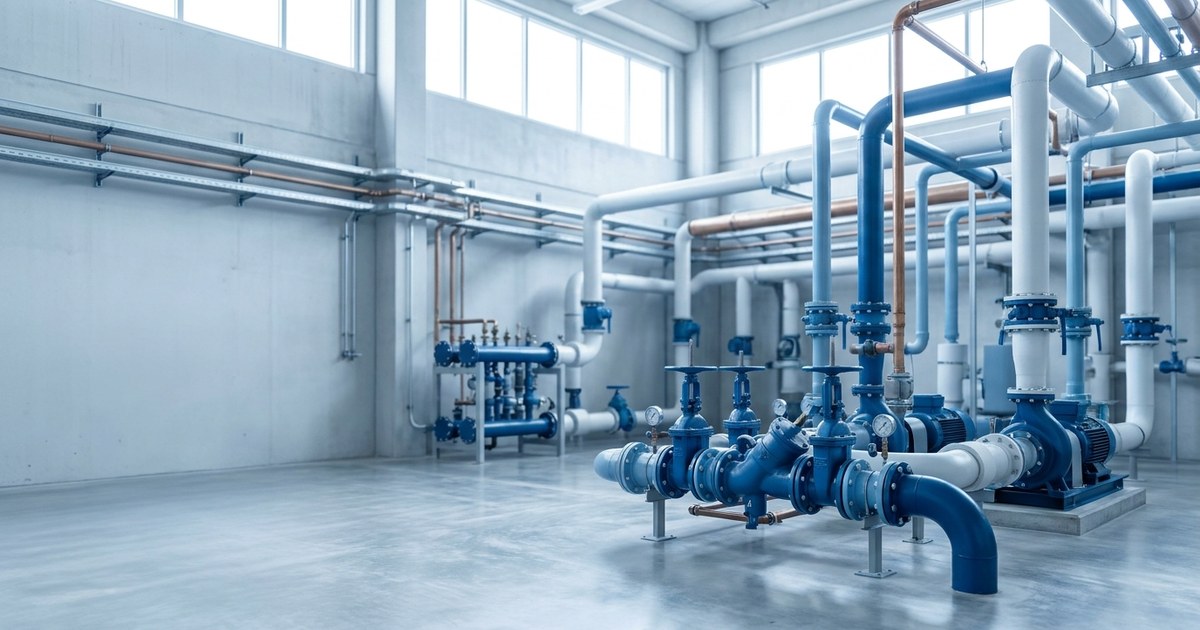
Industrial facility plumbing systems maintenance manages water supply, process wastewater, cooling systems, and sanitary drainage at scales far beyond residential or light commercial capacity. Proactive plumbing maintenance built for business continuity programs (scheduled drain jetting, backflow testing, grease interceptor service, pump inspections, and pressure testing) prevent unplanned downtime, ensure regulatory compliance, and extend infrastructure life in manufacturing plants, warehouses, and distribution centers where production continuity depends on reliable utilities.
When a main line backs up during peak production, the clock starts ticking in thousands of dollars per hour. According to research from Aberdeen Group on manufacturing downtime costs, unplanned outages in mid-sized facilities can exceed $260,000 per incident, with plumbing failures ranking among the top five disruption sources in multi-shift operations.
This guide walks facility managers, plant engineers, and operations directors through the structural differences of industrial facility plumbing systems maintenance, the preventive maintenance protocols that protect uptime, and the compliance documentation requirements that keep facilities operational and audit-ready. Trusted plumbing services built on experience and accountability partnerships shift plumbing from reactive emergency mode to scheduled service intervals that fit production calendars.
Industrial facility plumbing operates at volumetric, structural, and operational scales that residential and light commercial contractors cannot support. Understanding these differences matters when selecting maintenance partners and designing service agreements.
Water flow rates in industrial water systems measure in hundreds or thousands of gallons per minute, not the 5-10 GPM typical of residential supply. According to the U.S. Department of Energy's Advanced Manufacturing Office, facilities with continuous-process operations consume exponentially more water than commercial buildings, creating infrastructure demands that require specialized design and maintenance capabilities.
Process wastewater creates a second parallel infrastructure. Sanitary drainage (restrooms, break rooms, administrative areas) flows through standard DWV systems. High-volume plumbing maintenance addresses process wastewater (cooling tower blowdown, manufacturing rinse water, food processing discharge, chemical process streams) which requires separate collection systems designed for higher solids content, temperature extremes, and regulated discharge parameters. Many facilities operate their own pretreatment systems (oil-water separators, pH adjustment tanks, grease interceptors) before discharging to municipal sanitary sewers.
Infrastructure age compounds complexity. Facilities built before 1980 typically installed cast iron drain lines and galvanized steel supply lines. Both materials corrode predictably: cast iron develops pipe wall thinning and joint separations after 50-60 years, while galvanized steel experiences internal rust accumulation that reduces flow capacity and increases pressure loss.
Multi-building campus layouts add distributed system management challenges. A 200,000-square-foot distribution center spans multiple structures connected by underground utility corridors. Water service enters at one point, then distributes through buried mains running hundreds of feet to satellite buildings. Plumbing and drain services across the Greater Columbus area serve industrial parks where facilities face additional code and regulatory requirements. EPA Clean Water Act pretreatment standards govern industrial wastewater discharge, local sewer authorities set biochemical oxygen demand (BOD) and total suspended solids (TSS) limits, and OSHA confined-space protocols apply to maintenance work in below-grade vaults and lift stations.
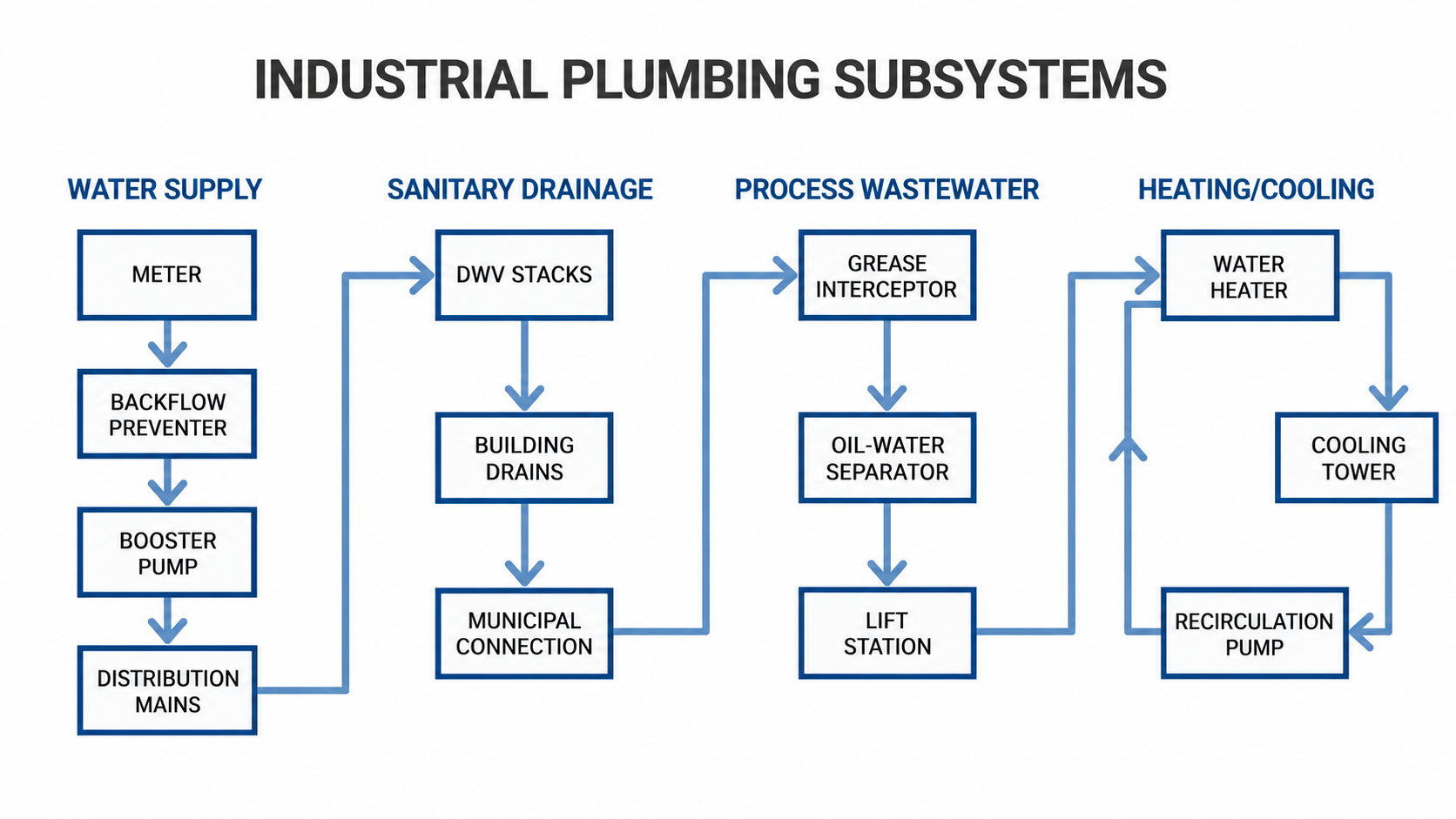
Manufacturing plumbing systems comprise interconnected subsystems, each with distinct maintenance requirements and failure modes. Facility managers who understand component-level architecture can prioritize preventive maintenance budgets and emergency response readiness.
Incoming water service sizing determines facility capacity. A light commercial building might operate on a 2-inch meter and service line. Manufacturing facilities require 6-inch to 12-inch water services feeding fire suppression systems, process water demands, cooling towers, and sanitary fixtures simultaneously.
Backflow prevention assemblies protect municipal water supplies from contamination. Commercial plumbing services in Gahanna, OH and across Greater Columbus serve facilities with chemical injection systems, cooling towers, or process tanks that could introduce contaminants. These facilities must install reduced pressure zone (RPZ) assemblies or double-check valve assemblies at the point of service entry. Annual testing by certified technicians is required, with test results submitted to municipal water authorities within 30 days. Failure to test triggers violation notices and potential water service disconnection.
Booster pump systems maintain consistent pressure across multi-story buildings or expansive campuses. Variable frequency drives (VFDs) modulate pump speed to match real-time demand, reducing energy consumption while ensuring adequate pressure at distant fixtures.
Fire suppression integration adds critical redundancy requirements. Sprinkler systems and standpipe risers connect to dedicated fire service lines or share domestic water service with priority valving. National Fire Protection Association (NFPA) 25 standards mandate quarterly visual inspections, annual flow tests, and five-year internal inspections.
Sanitary drainage handles waste from restrooms, break rooms, and administrative spaces using gravity flow to building drains, then to municipal sanitary sewers. Industrial facilities with high occupancy (manufacturing plants with 200 or more employees per shift) require large-diameter drain lines (4-inch to 6-inch) and multiple vent stacks to prevent fixture backups and sewer gas infiltration.
Process wastewater drainage collects manufacturing byproducts, cooling water, and equipment wash-down flows. This infrastructure operates separately from sanitary drainage due to different discharge characteristics. Food processing facilities generate high-fat-oil-grease (FOG) waste requiring grease interceptors sized to facility production volume. According to EPA pretreatment standards, facilities must install and maintain interceptors based on wastewater characteristics and local discharge requirements.
Floor drains and trench drains collect spills and wash-down water in production areas. These drains connect to oil-water separators or sediment traps before entering sanitary or storm sewer systems. Trap seal failures (caused by infrequent use or high evaporation rates) allow sewer gases into occupied spaces, creating OSHA air quality violations.
Pump stations and lift stations handle below-grade drainage where gravity flow to municipal sewers is impossible. Sewage ejector pumps in basement areas, process water lift stations in low-lying production zones, and sump pumps in mechanical rooms prevent flooding during peak discharge events.
High-capacity water heating serves manufacturing processes, employee facilities, and equipment cleaning operations. Tank-style water heaters in industrial applications range from 100 gallons to 1,000 or more gallons, while tankless systems deliver continuous hot water at 5-10 gallons per minute or higher. Scale buildup from hard water reduces heat transfer efficiency, increasing energy costs and shortening equipment life. ASHRAE's HVAC Applications Handbook recommends commercial water heaters undergo annual inspections including anode rod replacement, sediment flushing, and pressure relief valve testing.
Cooling towers dissipate heat from HVAC systems and process equipment. Open-loop cooling towers cycle water through evaporative cooling cells, concentrating dissolved minerals that cause scale formation on heat exchanger surfaces. Facilities must maintain water treatment programs (chemical inhibitors, filtration, blowdown scheduling) to prevent scale buildup and biological growth (Legionella bacteria).
Recirculation pumps maintain hot water availability across long distribution runs in large facilities. Pump seal leaks, bearing failures, and impeller erosion create pressure drops and temperature inconsistencies.
Expansion tanks and pressure relief systems protect closed-loop heating systems from over-pressure failures. Expansion tanks absorb thermal expansion as water heats, preventing pressure spikes that damage pipes and fixtures. Pressure relief valves automatically discharge when system pressure exceeds safe limits. Both components require annual testing.
Preventive maintenance shifts industrial facility plumbing systems maintenance from emergency firefighting to scheduled service intervals aligned with production calendars. Facilities operating structured maintenance programs experience measurably lower emergency call rates and longer infrastructure lifecycles.
Scheduled drain and sewer line jetting prevents grease, scale, and debris accumulation that triggers backups during peak production shifts. High-pressure hydro jetting uses water streams at 3,000 to 4,000 PSI to scour pipe interiors, removing buildup that mechanical snaking cannot reach. Facilities with food service operations or high-solids wastewater should schedule quarterly jetting; manufacturing plants with lower organic loading can extend intervals to semi-annual or annual service.
Backflow prevention device testing meets municipal water authority mandates and protects potable water supplies from contamination. RPZ assemblies and double-check valves require annual testing by certified technicians who verify check valve seating, pressure differential across the assembly, and relief valve operation. Facilities that miss testing deadlines receive violation notices with 30-day cure periods before water service disconnection. Book an appointment with Plumbing and Drain Professionals to schedule annual backflow certification testing and receive compliance documentation for water authority submission.
Grease interceptor and oil-water separator service prevents overflow violations and EPA enforcement actions. Grease interceptors accumulate FOG waste until capacity is reached; once full, grease passes through the device and enters sanitary sewers, causing downstream blockages and treatment plant disruptions. Local sewer authorities mandate pump-out frequency based on facility wastewater volume and interceptor performance characteristics. Facilities must retain manifests documenting proper disposal at licensed receiving facilities.
Water heater and boiler inspections extend equipment life and maintain energy efficiency. Annual inspections should include anode rod replacement (sacrificial corrosion protection in tank water heaters), sediment flushing (removes mineral accumulation at tank bottoms), pressure relief valve testing (manual lift to verify discharge operation), and combustion analysis (boilers only, verifying proper air-fuel mixture). According to the U.S. Department of Energy, proper water heater maintenance maintains peak efficiency and extends equipment service life.
Pump system testing and seal inspection catch failures before production disruptions occur. Sump pumps, sewage ejector pumps, and booster pumps should undergo semi-annual testing including float switch calibration, seal inspection for leakage, bearing condition assessment, and discharge pressure verification.
Camera inspection of underground lines identifies root intrusion, pipe sag, and corrosion before catastrophic failure. Push-camera inspections feed video cameras through drain lines, documenting pipe condition and joint integrity. Facilities with aging cast iron or clay pipe infrastructure should schedule camera inspections every 2-3 years, targeting high-risk sections (lines under parking lots, near large trees, below-grade runs between buildings).
Pressure testing of closed-loop systems detects concealed leaks in heating loops, chilled water systems, and process water circuits. Hydrostatic pressure tests apply test pressure (typically 1.5 times operating pressure) to isolated piping sections, then monitor for pressure decay over time. Facilities with suspended ceiling spaces above production areas should pressure-test overhead piping annually to prevent undetected leaks that cause ceiling collapses and production interruptions.
Even facilities with rigorous preventive industrial facility plumbing systems maintenance programs experience unexpected failures. Emergency response planning minimizes downtime by pre-establishing vendor relationships, defining response protocols, and maintaining on-site spare parts inventories.
Pre-qualified vendor relationships eliminate the 2 a.m. panic of searching for emergency plumbers. Facilities should establish service agreements with commercial-only plumbing providers before emergencies occur. Service agreements define response time commitments (target arrival within 2 hours for critical failures, 4 hours for non-critical), pricing structures (no after-hours surcharges for contract clients), and escalation procedures (on-call supervisor contact for complex failures).
Response time commitments should differentiate critical failures (main line backups affecting production, water service failures halting operations, flooding in occupied spaces) from non-critical issues (single fixture failures, slow drains in non-production areas). Reliable local service backed by professional standards and established service level agreements (SLAs) define response time targets and emergency escalation procedures.
On-site spare parts inventory reduces emergency response time when critical components fail. Facilities should maintain inventories of high-failure-rate items (pump seals, pressure switches, backflow device parts, water heater elements, expansion tank bladders) sized to facility-specific failure history.
Documentation and post-incident reporting provide root cause analysis for recurring failures. Emergency service calls should generate written reports documenting failure mode, root cause assessment, corrective actions taken, and recommended preventive measures. Facilities should require service providers to deliver reports within 24 to 48 hours of emergency calls.
OSHA confined-space protocols apply to emergency work in underground vaults, lift stations, and below-grade mechanical rooms. Facilities must verify that emergency service providers maintain confined-space entry certifications, atmospheric monitoring equipment, and rescue retrieval systems.
Industrial facility plumbing systems maintenance operates under multiple regulatory frameworks. Compliance requires documented testing schedules, certified service records, and timely reporting to regulatory authorities.
EPA Clean Water Act pretreatment standards govern industrial facilities discharging process wastewater to municipal sanitary sewers. Facilities must meet local sewer authority discharge limits for BOD, TSS, pH, heavy metals, and FOG. According to EPA's National Pretreatment Program, facilities exceeding discharge limits without approved pretreatment systems face enforcement actions including fines starting at $10,000 per day per violation, mandatory installation of pretreatment equipment, and potential discharge permit revocation.
Backflow prevention testing requirements vary by municipal water authority but typically mandate annual testing of all testable backflow devices. Facilities must retain test results for three years and submit copies to water authorities within 30 days of testing. Devices that fail testing must be repaired or replaced immediately.
Grease interceptor compliance regulations require documented pump-out frequency, disposal manifests, and maintenance records. Sewer authorities typically require regular interceptor inspection and pump-out based on facility discharge volume and interceptor capacity. Facilities must document inspection dates and pump-out volumes to demonstrate compliance during routine audits.
OSHA confined-space protocols apply to maintenance work in underground utility vaults, lift stations, sewage pump pits, and any space meeting OSHA confined-space criteria (limited entry/exit, unfavorable natural ventilation, not designed for continuous occupancy). Facilities must maintain confined-space entry permits documenting atmospheric testing (oxygen, carbon monoxide, hydrogen sulfide, lower explosive limit), ventilation procedures, rescue equipment availability, and attendant assignments.
Fire suppression system inspection requirements follow NFPA 25 standards mandating quarterly visual inspections, annual flow tests, and five-year internal inspections of sprinkler systems. Facilities must document all inspections, maintain test records for system life, and correct deficiencies immediately. Insurance carriers often require proof of NFPA 25 compliance as a policy condition.
Documentation best practices include digital service records with timestamped photos, parts inventories, and technician notes. Every PDP service call is documented in ServiceTitan with timestamped photos, parts inventories, and compliance test results, giving facility managers audit-ready records on demand. Professional plumbing services for Dublin, OH businesses and across Greater Columbus benefit from digital documentation systems that maintain compliance calendars tracking all recurring test and inspection deadlines.
Facility managers juggling multiple vendors for plumbing, excavation, and drain service face coordination overhead, accountability gaps, and delayed emergency response. Commercial-only providers eliminate these friction points by consolidating all plumbing infrastructure services under single-source accountability.
Signals you need a commercial-only partner:
Your current vendor subcontracts excavation and sewer work. Subcontracting introduces coordination delays, split accountability when failures occur, and premium pricing (general contractor markup on subcontractor invoices). When a main line fails in an underground run between buildings, facilities need immediate excavation capability, not a 48-hour wait while your plumber sources an excavation subcontractor. Commercial-only providers with in-house excavation teams (hydro excavation, trenchless sewer replacement, camera inspection performed by the same crew) compress response time and eliminate finger-pointing.
Emergency calls trigger after-hours surcharges that inflate invoices unpredictably. Many plumbing contractors charge 1.5 to 2 times standard rates for after-hours service (nights, weekends, holidays). For facilities operating 24/7 schedules, every emergency call becomes a premium-rate event. Commercial-only providers offering 24/7 service with transparent pricing convert unpredictable emergency costs into fixed monthly maintenance budgets.
You lack documented maintenance history. Facilities relying on reactive service calls accumulate no infrastructure knowledge over time. When auditors ask for backflow testing records, grease interceptor pump-out manifests, or water heater inspection logs, facilities without documented service histories face compliance violations and retrofit costs. The Plumbing and Drain Professionals blog offers additional insights on maintaining compliant documentation practices for industrial facility plumbing systems maintenance.
Your contractor schedules residential service calls ahead of your facility's needs. General plumbers serving both residential and commercial clients prioritize service calls by revenue potential and geographic convenience, not by customer operational urgency. Residential plumbing services for Greater Columbus homeowners differ fundamentally from industrial facility needs. Commercial-only providers understand facility downtime cost and prioritize accordingly.
You need a single vendor for plumbing, drain, excavation, and backflow testing. Multi-vendor coordination creates scheduling complexity: one contractor for routine plumbing, another for drain jetting, a third for excavation, a fourth for backflow testing. Each vendor maintains separate service records, invoices through separate accounting processes, and points to other vendors when failures occur.
PDP differentiators include in-house excavation capability (hydro excavation, trenchless sewer replacement, camera inspection performed by PDP crews), commercial-only focus (every technician understands facility downtime cost and compliance deadlines), documented preventive maintenance contracts (scheduled service lifecycles with same-day service and no after-hours fees), and ServiceTitan-powered documentation (compliance records, photos, and service history accessible on demand).

Industrial facility plumbing systems maintenance addresses predictable failure patterns. Facility managers who recognize warning signs can schedule preventive interventions before catastrophic failures halt production.
Main line backups during peak production shifts manifest as multiple fixtures draining slowly simultaneously, floor drains backing up during high-volume discharge events, and audible gurgling in drain lines. The root cause is grease, scale, and debris accumulation reducing pipe capacity until peak flows exceed drain capacity. Prevention requires quarterly or monthly hydro-jetting schedules adjusted to facility wastewater volume and solids content.
Backflow prevention device failures present as dripping relief valves, pressure drops across the device during normal operation, and failed annual test results. Causes include internal check valve seal wear, spring fatigue reducing closing force, and sediment buildup preventing valve seating. Prevention requires annual testing and immediate certified repair or replacement when devices fail tests. Facilities should budget for device replacement every 7 to 10 years regardless of test results.
Water heater and boiler inefficiency or failure signals through rising energy costs, inconsistent temperature delivery, and visible corrosion or leakage at tank exteriors. Sediment buildup at tank bottoms insulates water from heat exchanger surfaces, requiring longer heating cycles and higher fuel consumption. Prevention requires annual inspection including anode rod replacement (typically every 3 to 5 years), sediment flushing, pressure relief valve testing, and combustion analysis (boilers). Facilities should replace tank water heaters proactively at 12 to 15 years regardless of apparent condition.
Underground pipe collapse or root intrusion appears as recurring slow drains, backups in the same location, and wet spots or sinkholes in outdoor areas above underground pipe runs. Aging cast iron or clay pipes develop joint separations allowing tree roots to infiltrate drain lines. Prevention requires camera inspection every 2 to 3 years for facilities with aging underground infrastructure. Video inspections identify root intrusion locations (allowing targeted root cutting and chemical treatment) and document pipe condition (allowing trenchless lining or pipe bursting before catastrophic failure).
Pump station failures (sump pumps, sewage ejector pumps, booster pumps) present as pump run-time increases, reduced discharge flow, unusual noise or vibration, and complete pump failure during high-demand events. Causes include seal wear allowing water into motor housings, impeller clogging with debris or solids, bearing failures from continuous operation, and float switch failures preventing pump activation. Prevention requires semi-annual pump testing including float switch calibration, seal inspection for leakage, bearing condition assessment, and discharge pressure verification.
Grease interceptor overflow and EPA violations occur when interceptor capacity is exceeded, allowing FOG to pass through and enter sanitary sewers. Visual warnings include FOG accumulation floating on interceptor water surface (visible during lid removal), slow drainage from fixtures upstream of interceptor, and foul odors from interceptor vent stacks. Prevention requires scheduled interceptor service based on facility wastewater volume and local regulatory requirements.
Industrial facility plumbing systems maintenance is mission-critical infrastructure. Reactive-only maintenance converts plumbing from a managed operational variable into an uncontrolled business risk. Facilities experience measurable operational benefits when they shift to documented preventive maintenance programs: reduced emergency call frequency, extended infrastructure lifecycles, audit-ready compliance documentation, and predictable maintenance budgets that replace unpredictable emergency invoices.
A commercial-only plumbing partner eliminates the coordination overhead of multi-vendor relationships. In-house excavation capability compresses emergency response time, 24/7 availability without after-hours fees protects facility managers from invoice surprises, and digital service documentation delivers compliance records on demand. Facilities operating 24/7 production schedules cannot afford vendor accountability gaps, subcontractor delays, or residential-focused service prioritization.
Ready to build a preventive industrial facility plumbing systems maintenance program that protects your facility's uptime and keeps you compliant? Request a Quote to schedule a facility assessment and discuss documented maintenance contracts designed for manufacturing plants, warehouses, and distribution centers.
Book a service request or consultation. We respond quickly and operate to professional service standards.
We’re Happy to Confirm
If your property is located in or around the Greater Columbus area and you don’t see your city listed, our team can quickly confirm coverage and service options.


