2026-10-23
16
min read
By PDP
Trenchless sewer repair fixes or replaces a damaged underground sewer line without digging a continuous trench. Crews work through small access points, then either line the old pipe with a new resin liner or pull a new pipe into its place. For commercial facilities, it means less downtime, less torn-up pavement, and fewer closed entrances.
If you manage a retail center, a medical office, a restaurant or an industrial site in Columbus, a failing sewer line is a business problem before it is a pipe problem. Backups close restrooms. Odors drive tenants away. A health-code finding can shut a kitchen. The usual fix sounds worse: a trench through the lot, a closed entrance, and weeks of lost goodwill. That is why our trenchless sewer replacement for commercial properties in Columbus exists, and why this guide treats trenchless as a decision, not a product.
We wrote it for facility managers, property managers and commercial owners across Greater Columbus, including Dublin, Gahanna, Westerville, Reynoldsburg and Pickerington. We work only on commercial facilities. Our crews handle camera inspection, cleaning, trenchless work and excavation in-house. That lets us say plainly when trenchless is the right call and when it is not.
In our work with commercial facilities, one rule holds every time: the camera comes first and the method comes second. The sections below cover the definition, the main methods, when each approach fits, a five-step selection process, the real cost drivers, and the questions to ask any contractor.
Trenchless sewer repair is a way to fix or replace a buried sewer pipe by working from a few small access pits instead of opening a long trench. It restores flow and structure with a liner or a replacement pipe. Most pavement, landscaping and utilities stay where they are.
"Trenchless technology" is the umbrella term for this family of methods. The International Society for Trenchless Technology publishes educational material on the field [CITATION_NEEDED: ISTT definition and scope of trenchless technology]. The methods reach well beyond sewers. Trenchless technology also enables complex pipeline crossings, such as the horizontal directional drilling example at the Athabasca River in Canada referenced by the Canadian Energy Regulator's Western Regulators Forum page on pipeline standards. The same idea scales down to a lateral under your loading dock. You go under the obstacle instead of removing it.
How it works in plain English. Crews dig one or two small access pits at the ends of the damaged section. They clean the pipe, usually with hydro jetting, and run a camera through it to record every defect. Then they do one of two things. They either install a resin-soaked liner that hardens inside the old pipe, or they pull a new pipe along the old path. A second camera pass confirms the result.
Trenchless vs. open-cut at a glance. Open-cut means excavating a continuous trench along the pipe. The table shows how the two approaches differ on the questions a facility manager actually asks.
| Factor | Trenchless | Open-cut excavation |
|---|---|---|
| Surface impact | Small access pits; most pavement and landscaping stay | Continuous trench along the pipe path; restoration needed |
| Business disruption | Entrances, drive aisles and docks can often stay in use | Lanes, entrances or docks often close along the trench |
| Access needs | Pits at each end of the section | Open access along the whole route |
| Best fit | Structurally damaged pipe that still follows its original path | Collapsed pipe, severe sag, wrong grade, or a needed re-route |
When we talk about "minimal disruption," we mean something specific. The entrance, the drive aisle and the dock stay usable, and the work is confined to the pit areas. It is not a slogan, and it does not apply to every pipe.
This is also why we treat in-house sewer repair, excavation and trenchless technology as one capability, not three vendors. One crew inspects, cleans, repairs and, if needed, digs. Whether you run a restaurant, a medical office or a multi-tenant property, the starting point is the same: one quote request. The sewer work does not change by building type. The pipe does.
Takeaway: Trenchless repair works from small access pits, and it is only "minimal disruption" when the pipe and the site actually allow it.
The two core methods are cured-in-place pipe lining, which forms a new pipe inside the old one, and pipe bursting, which breaks the old pipe while pulling a new one into its path. Spot repairs patch short sections. The right choice depends on pipe condition, size and layout.
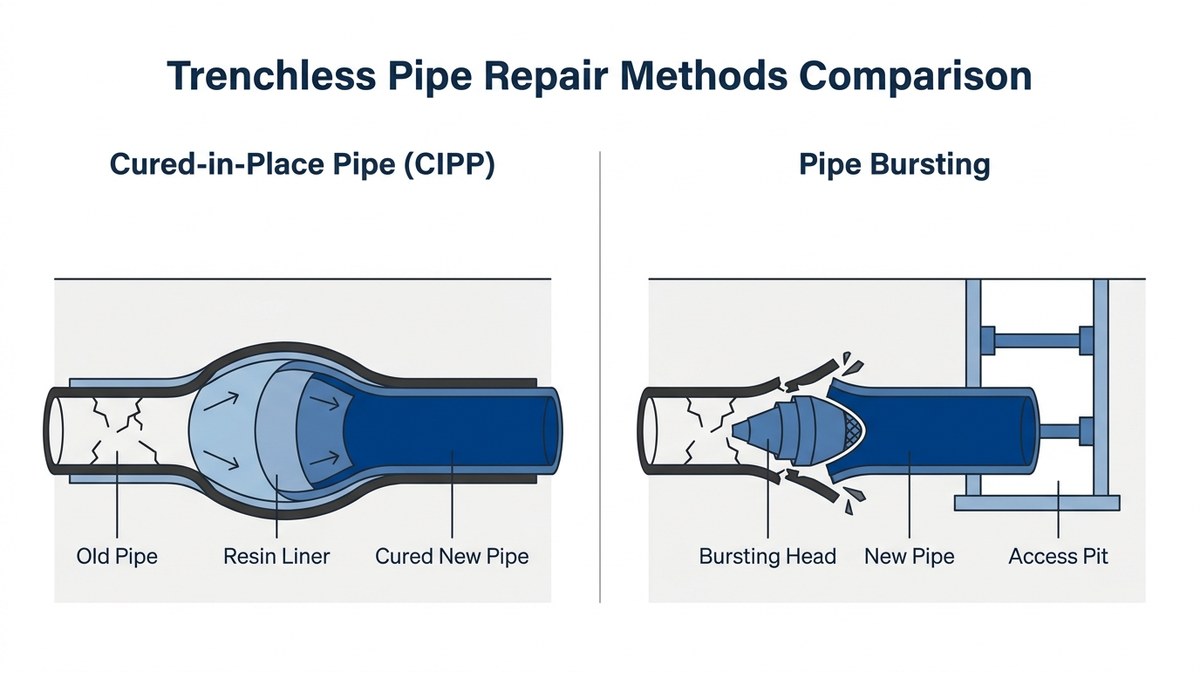
Cured-in-place pipe lining (CIPP) uses a flexible tube soaked in resin. Crews pull or invert it into the cleaned host pipe, then cure it with heat, steam or light. It hardens into a smooth, jointless pipe inside the old one. After this, we say "liner" or "lining."
Lining suits cracks, failing joints, root entry points and aging pipe that still follows its original path. It does not make the pipe wider or change its slope. The host pipe still sets the route. Standards bodies such as ASTM International publish installation standards for lining by inversion and resin impregnation [CITATION_NEEDED: ASTM F1216 title, current edition and year]. The standard matters because a liner is only as durable as its preparation and installation.
Pipe bursting is a replacement method. A bursting head breaks the old pipe outward into the surrounding soil while a new pipe follows behind it. It can restore capacity, and in some cases increase pipe size, along the same path. It needs entry and exit pits. It also needs room to work, so nearby utilities have to be located and protected first.
Bursting is a fit when the old pipe is too damaged to line but the route is still correct. Our trenchless sewer replacement work sits in this territory. We recommend replacement over lining only when the camera shows the pipe cannot carry a liner.
Spot repair patches a short damaged section instead of treating the whole run. It is a sensible choice when the camera shows one isolated defect and the rest of the pipe is sound. It is a poor choice when the pipe is aging evenly, because the next failure appears a few feet away. We only recommend a spot repair when the footage supports it.
Trade coverage of this topic notes that two steps are often underestimated: pipe preparation and verification. We agree, and it is where the most avoidable failures start.
Before lining, the pipe must be clean. Grease, scale, roots and debris prevent the liner from bonding or leave it wrinkled. Cleaning is not a separate chore. It is part of the repair. Hydro jetting for commercial drains shows how high-pressure water prepares a line, and the six kinds of blockages jetting can clear explains what a crew is actually removing. Because the same in-house crew does the jetting and the lining prep, there is no handoff between subcontractors where a problem can fall through.
After the repair, a recorded camera pass proves what was installed. It also checks for leaks and gaps. Local rules may apply to this stage. Reynoldsburg, which is in our service area, publishes its municipal ordinances online, including City of Reynoldsburg Ordinance 60-17, which touches on leak detection. Confirm with your city which requirements apply to your site.
One caution on claims. Different contractors perform different methods. Ask any contractor, including us, which methods its own crews perform and which it subcontracts.
Takeaway: Lining, bursting and spot repair each fit a different pipe condition, and none of them lasts without proper cleaning beforehand and a camera check afterward.
Use trenchless repair when the line is structurally damaged but still follows its original path, such as cracks, root intrusion or failing joints, and when digging would shut entrances, loading areas or utilities. It fits best where downtime and surface restoration cost more than the repair itself.
Look for these patterns in a camera report or a maintenance log:
When several of these appear together, you likely have a structural problem and not a maintenance problem. A commercial sewer line repair can then be planned instead of reacted to.
The pipe is only half the decision. The other half is what sits on top of it. Trenchless tends to win when the line runs under any of the following:
Obstacles are where trenchless technology earns its place. The same principle that lets crews drill under a river, per the Canadian Energy Regulator reference above, applies when the obstacle is a parking lot you cannot afford to close.
If the pipe still follows its path and digging would cost you more than the repair, start with trenchless.
That test is a starting point, not a verdict. The camera has the final word.
Facility managers often ask whether lining is as durable as digging up the pipe. The honest answer is that it depends on the host pipe, the preparation and the installation, not on the label "trenchless." Lined pipe is installed to recognized standards, and a documented camera pass after the work is how you confirm it [CITATION_NEEDED: NASSCO or EPA guidance on post-installation inspection and expected service life of lined pipe]. We do not promise a service life without the camera footage that supports one.
Our commercial work is concentrated in Greater Columbus, where facility managers want inquiries answered quickly and repairs scheduled around operating hours. That is why we keep the decision simple: inspect, then recommend.
Takeaway: Choose trenchless when the pipe is damaged but on its original path and the surface above it is worth protecting.
Open-cut is better when the pipe has collapsed, has a severe belly (a sag that holds water), needs a change in grade or route, or sits where access pits are impractical. A camera inspection confirms which case you have before anyone commits to a method.
Here is why each case matters.
Collapsed pipe. A liner needs a pipe it can follow. If the host pipe has caved in, there may be no passage to line. Crews have to open the ground.
Severe belly. A belly is a low spot where water and solids settle. A liner follows the shape of the old pipe, so it generally cannot correct a sag or restore proper slope [CITATION_NEEDED: EPA or NASSCO guidance on lining and bellied pipe]. Our sewer repair work covers broken and bellied pipes for this reason. Digging lets crews reset the grade.
Wrong grade or a needed re-route. If the line was installed with poor slope, or if a tenant build-out requires moving it, the route itself has to change. That is an excavation job.
Larger campus drainage and mixed systems. Larger sites with combined or interconnected storm and sanitary lines add complexity. Access pits may not be practical, and the connections may need to be rebuilt. Storm drain and sanitary sewer maintenance shows how these systems differ and why they should be handled separately.
When excavation is the right call, how it is done matters. Our in-house hydro excavation truck uses pressurized water and vacuum to expose the pipe precisely, which keeps digging small and protects nearby utilities. Because we own the equipment and the crew, there is no subcontractor wait. Our position is simple: we run both crews, so the recommendation follows the pipe, not the equipment.
That is also the practical advantage of working with a contractor that owns its excavation capability. A contractor that only does lining has a reason to line every pipe. One that only digs has a reason to dig. A crew that does both can tell you the truth.
Takeaway: Open-cut wins when the pipe has collapsed, sags badly, or needs a new route, and the camera tells you which case you have.
Start with a camera inspection, clean the line so the defect can be seen and the repair surface is ready, classify the damage, then match the method to the pipe and your operating constraints. A contractor who does all of this in-house can compare options without bias. We use a five-step process.
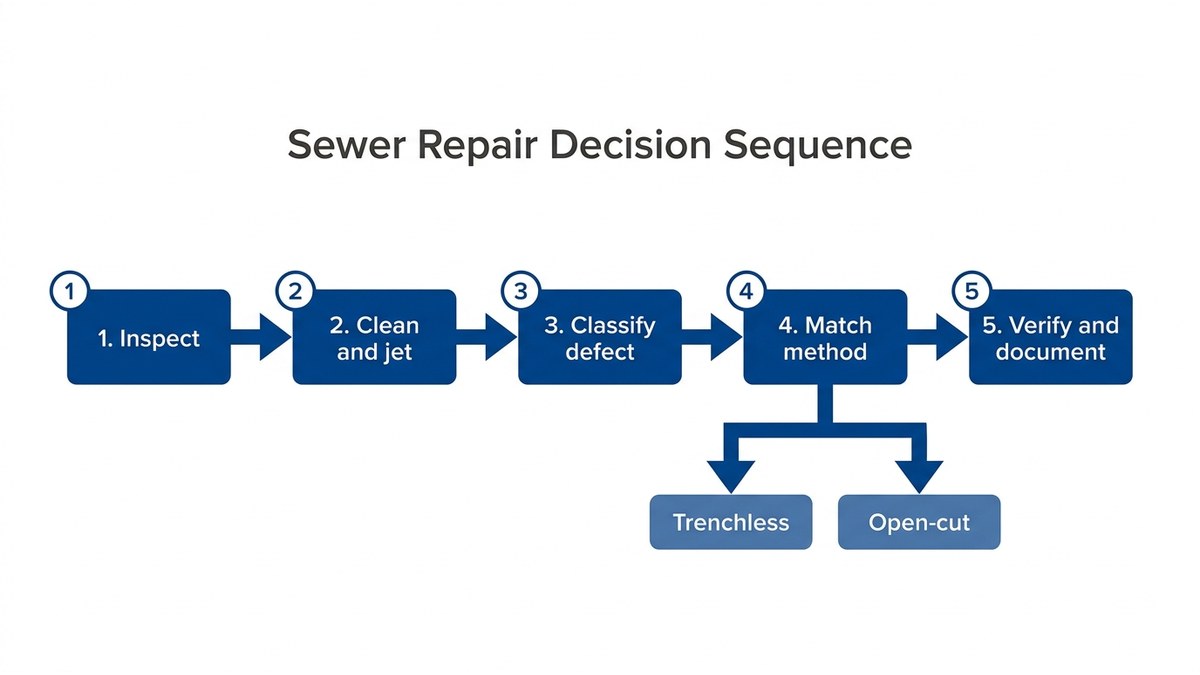
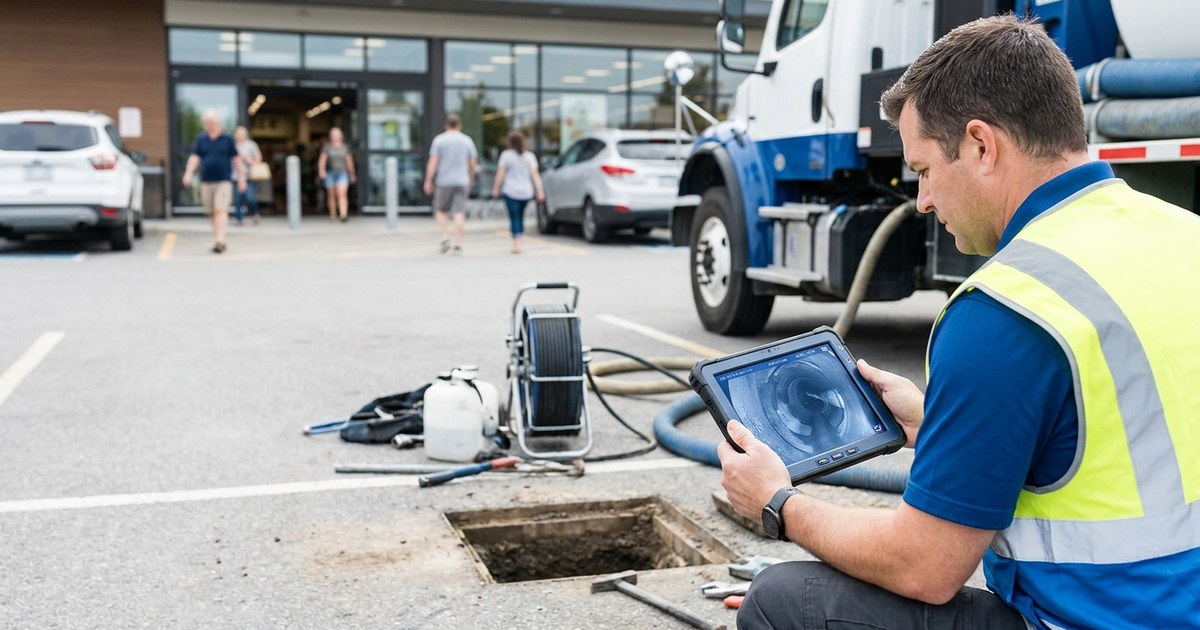
A crew runs a camera through the line and records the footage. You should receive a written defect report, not just a verbal opinion. Camera inspection of your sewer line is the first step because every other decision depends on what the footage shows. In our work with commercial facilities, we never recommend a method before this step is done.
A dirty pipe hides defects and ruins repairs. Jetting and root removal let the camera see the true condition of the wall and prepare the surface for any liner. Slow drains, odors and repeat backups are often the first clues that a line needs this step, and the top signs your drains need professional cleaning lays out what to watch for. This is the step competitors tend to skip.
Sort what you found into categories: structural cracks, root intrusion, joint failure, collapse, or grade problems. Industry coding systems exist for this, such as the defect-coding material published by NASSCO [CITATION_NEEDED: NASSCO PACP defect coding and its use in classifying sewer inspection findings]. Classification turns a pile of footage into a decision.
Now compare options against your constraints. Ask which entrances must stay open, when the tenants operate, when deliveries arrive, and what compliance deadlines apply. A method that suits the pipe but ignores your schedule is the wrong method. Because the same crew can pivot from trenchless work to hydro excavation, the plan can change when the footage shows lining won't work.
After the repair, a recorded camera pass confirms the result. Keep the footage, the scope and the invoice together. We keep work history in ServiceTitan so there is a documented record behind every job. That is the principle behind our approach to vendor accountability: own the process, own the documentation.
What to hand your contractor. You can speed up the inspection by gathering:
Read this list on your phone before the site walk. It takes two minutes.
Takeaway: Inspect, clean, classify, match and verify, in that order, and the method choice becomes a conclusion instead of a guess.
Cost and disruption depend on pipe length, diameter, depth, access, the type and number of defects, and surface restoration. Trenchless often costs less in total on busy sites because it avoids lost business, repaving and utility conflicts. A site-specific quote is the only reliable number.
These factors move the price most:
The repair invoice is only part of the cost on a working site. Lost sales, tenant complaints, repaving and utility conflicts all add up [CITATION_NEEDED: peer-reviewed or Water Research Foundation study on the social or life-cycle cost of trenchless versus open-cut sewer repair]. We do not publish price ranges. Pricing is project-based, and it is set after inspection. You will get a straight answer once the camera has shown what the pipe actually needs.
Even trenchless work puts equipment on your property. Plan for staging space, after-hours scheduling, tenant notice and delivery windows. Keeping a retail site open during plumbing work covers the practical side. The point is to decide in advance which areas stay open, which close, and for how long. Do not accept "minimal disruption" without those specifics in writing.
Any work that involves digging, including access pits, requires a utility locate first. Call 811 before any digging [CITATION_NEEDED: Ohio811 call-before-you-dig requirements]. Then check municipal permit rules for your jurisdiction [CITATION_NEEDED: City of Columbus Division of Sewerage and Drainage guidance on private sewer laterals and permits]. We will tell you what applies to your site, but the permit process varies, so confirm timing early.
Takeaway: Price follows the pipe, the access and the site, so get a quote after the inspection and ask for the disruption plan alongside it.
Trenchless repair is a capital project. Preventive maintenance is what protects it. Roots, grease and debris shorten the life of any sewer repair, so scheduled jetting and inspection keep a new liner or pipe working as designed. They also move a facility from emergency firefighting to planned work.
Think of it as two tracks. One handles the pipe's structure, which is what trenchless repair is for. The other handles what flows through the pipe, which is what cleaning is for. Food-service sites feel this most. Grease builds up quickly, and a line that was repaired last year can still back up if no one is managing it. That is why why preventive drain cleaning lowers long-term cost matters even after a repair.
Our PlumbGuard™ program is built around this idea. It sets scheduled service intervals with documented history behind each visit. Program clients get same-day service with no after-hours fee. For a property manager with several sites, that means fewer surprises and a record to show owners and inspectors. Drain cleaning and hydro jetting for facilities is the service that sits underneath it.
This is a commercial program for commercial facilities. Whether you are a restaurant operator, a healthcare administrator or a multi-site property manager, the path is the same, and so is where you start: a single quote request.
Takeaway: A repaired sewer line stays repaired when scheduled cleaning and documented inspections follow it.
Before you hire anyone for sewer work, ask questions that reveal who does the work and how it is documented. This is vendor accountability in practice. It keeps you from juggling multiple contractors when something goes wrong.
Use this checklist:
Our answers are on the record. Our crew is in-house, licensed and insured, and the work is documented. We have served Columbus for about 11 years.
You can also apply the same test to us. If a contractor cannot answer these questions plainly, keep looking.
Takeaway: The best predictor of a good sewer repair is a contractor who inspects first, owns the crew, and documents the result.
Here is the short version:
If you have a camera report, a recurring backup or a failing-line warning, the next step is a site-specific assessment. Ready to find out whether trenchless fits your site? Request a Quote
Book a service request or consultation. We respond quickly and operate to professional service standards.
We’re Happy to Confirm
If your property is located in or around the Greater Columbus area and you don’t see your city listed, our team can quickly confirm coverage and service options.