08/24/26
9
min read

A grocery store manager in Gahanna faces a Saturday afternoon crisis: the main restroom has flooded at 3 p.m., peak shopping hours. Customers are turned away, staff scramble to contain the water, and revenue evaporates by the minute. Every attempt to reach a plumber meets an answering service promising "same-day response," which could mean six hours from now. By the time a technician arrives, the store has lost thousands in sales and posted apologetic signs that will live on social media for weeks.
This scenario repeats across retail facilities every week because most stores operate on a reactive plumbing model: everything works until it doesn't, and when it doesn't, you scramble. The perceived trade-off is false. Either accept catastrophic mid-day failures or close sections for maintenance and lose revenue during the fix. Neither option is sustainable.
Retail plumbing downtime is minimized through three operational strategies: scheduled preventive maintenance during low-traffic hours (early morning or after close), a pre-vetted 24/7 emergency response partner with sub-2-hour arrival guarantees, and facility-specific service documentation that tracks compliance and predicts failure intervals before they disrupt revenue.
Plumbing & Drain Professionals (PDP) has served Greater Columbus retail facilities for 11 years with commercial-only expertise, focusing on Proactive Plumbing Maintenance Built for Business Continuity, in-house excavation capability, and 24/7 emergency response with no after-hours penalties. This guide unpacks the operational playbook for facility managers who need stores running through every business hour.
A plumbing failure during business hours translates directly to lost revenue. For a mid-sized grocery store generating $15,000 per hour in sales on a weekend afternoon, a flooded restroom that forces partial closure costs $7,500 in direct sales for every 30-minute delay. A backed-up drain in a mall food court that triggers a health department visit shuts down three tenants and costs each operator a full day of revenue.
The hidden costs compound: staff time managing the crisis instead of serving customers, expedited vendor fees for emergency service, customer complaints amplified on social media, and health code violations that trigger follow-up inspections. Plumbing services designed to protect commercial operations understand that unplanned failures cost retail facilities 3 to 5 times more than scheduled maintenance would have prevented.
For facility managers overseeing multi-location portfolios, a single recurring failure (the same grease trap backing up every quarter, the same water heater failing every 18 months) signals a systemic problem. Reactive service models cannot scale across retail operations. The emergency becomes the baseline. Trusted Plumbing Services Built on Experience and Accountability prevents this cycle by addressing root causes before they escalate.
Retail facilities face specific failure modes driven by high daily usage and public access. Main drain backups in food courts or multi-tenant retail are the most operationally catastrophic. A single backed-up line can flood multiple tenant spaces and trigger immediate health department closures. Water heater failures in coffee shops or grocery delis eliminate hot water required by health codes, forcing operational shutdowns until replacement.
Backflow incidents, though rare, carry severe regulatory consequences. A contaminated water supply traced to a retail facility's plumbing system results in mandatory closures, public health notices, and liability exposure. Grease trap overflows in food service tenants (mall restaurants, grocery delis, stadium concessions) create visible health hazards and immediate code violations.
Restroom fixture failures during peak traffic periods force partial closures of customer-facing facilities. A broken toilet or flooded floor in a single-gender restroom during a Saturday rush reduces facility capacity by half and creates customer frustration that spreads through online reviews. Sewer line collapses in parking lots or basement access points create safety hazards, environmental violations, and excavation projects that disrupt store access for days.
Every scenario shares a common operational reality: the plumbing failure doesn't wait for a convenient maintenance window, and every hour of delay compounds the revenue and reputational damage. Professional preventive maintenance standards structure service to prevent these failures before they reach critical mass.
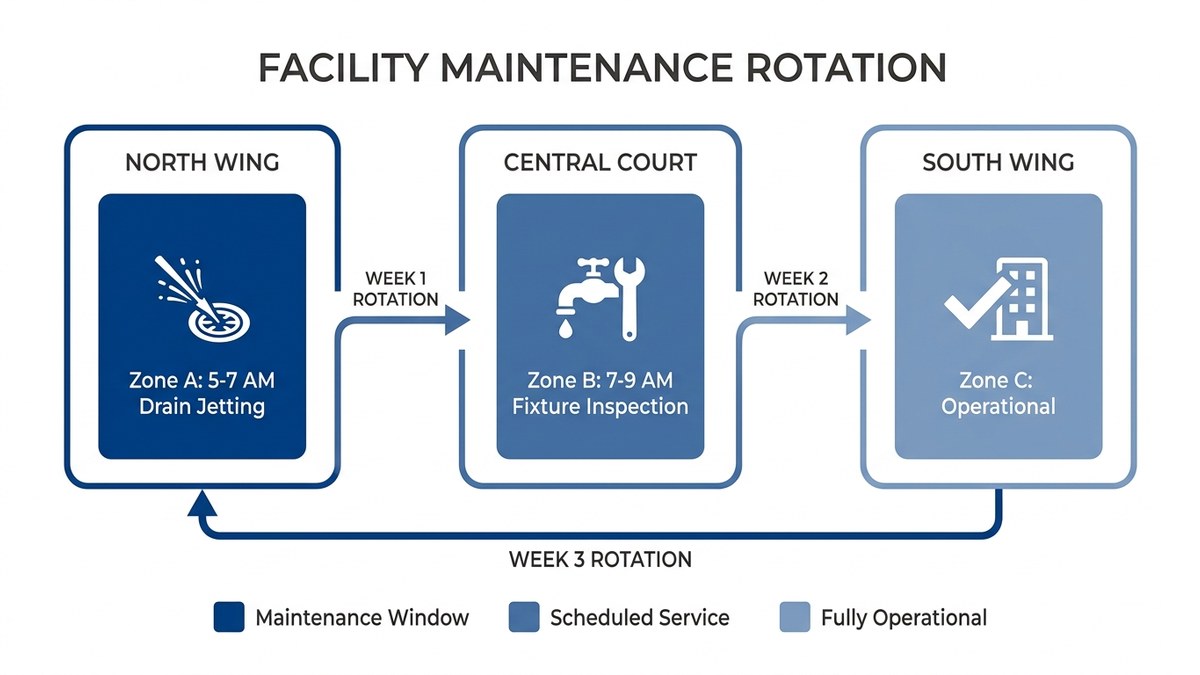
Preventive maintenance eliminates the false trade-off between operational uptime and plumbing reliability. The operational key is scheduling work during low-traffic windows. Early morning (5 to 7 a.m. before doors open), late evening (post-close for stores with 9 p.m. closings), or overnight for 24-hour operations. These windows allow comprehensive service without impacting revenue or customer experience.
A retail-focused maintenance schedule addresses the full system: drain line jetting to clear grease and debris buildup, grease trap cleanouts for food service tenants, water heater inspections and anode replacement, backflow prevention testing, fixture checks in public restrooms, and camera inspections of main sewer lines to identify root intrusions or structural failures before they cause backups. Each task is scheduled at intervals that prevent failure, not react to it.
The operational advantage is predictability. Scheduled maintenance means the facility manager controls when and where work happens. A quarterly drain jetting appointment at 6 a.m. on a Tuesday prevents the Saturday afternoon backup that would have forced a partial closure. A documented maintenance history proves due diligence during health inspections and lease audits. Regular commercial plumbing inspections prevent costly downtime for businesses by identifying potential failures before they disrupt operations, and facilities with documented preventive schedules reduce emergency service calls by 70 to 80 percent compared to reactive-only models.
Maintenance programs structured around retail operational realities include service windows scheduled to minimize disruption, documented compliance tracking for health inspections, and flexible contracts covering single locations or multi-site portfolios.
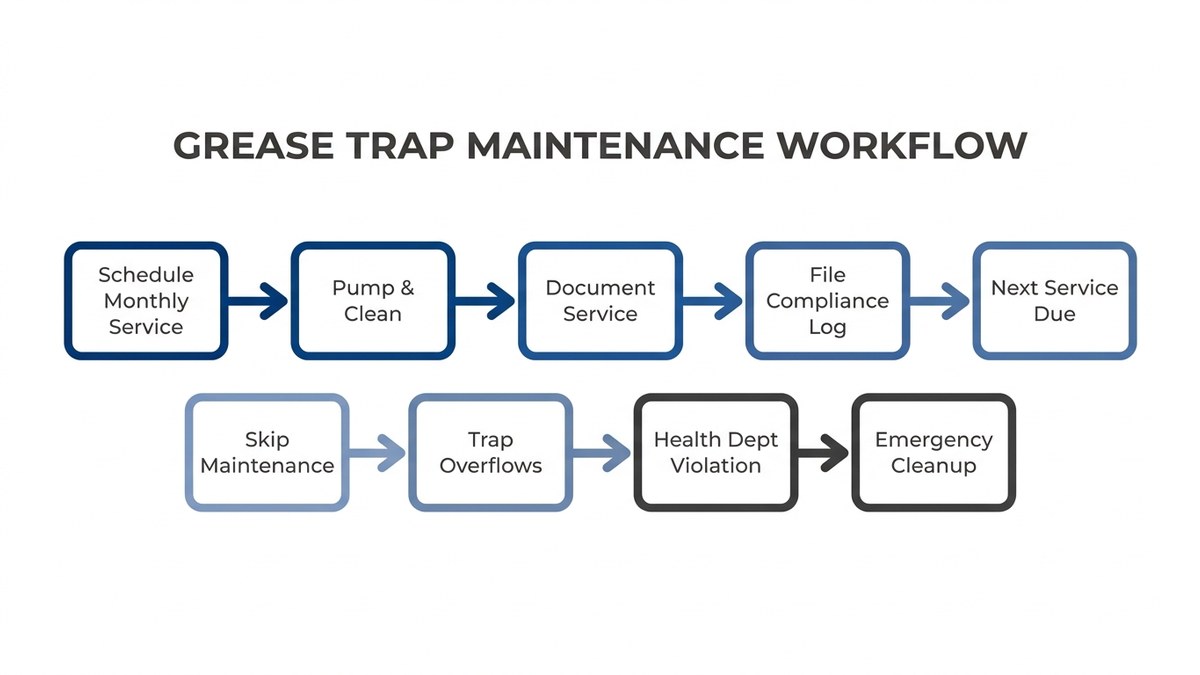
High daily usage accelerates wear and debris accumulation in retail plumbing systems. Quarterly drain jetting is the operational standard for high-volume food service facilities (grocery delis, coffee shops, mall food courts) where grease and organic debris build faster than lower-traffic operations. Monthly grease trap service is required for restaurants and food courts to maintain health code compliance and prevent overflow incidents.
Backflow prevention testing follows regulatory mandates: annual testing in most Ohio municipalities, semi-annual for food service facilities in some jurisdictions. Missing a testing deadline results in fines, failed health inspections, or municipal water service shutoff. Reliable Local Service Backed by Professional Standards emphasizes proactive scheduling to avoid enforcement actions.
Annual camera inspections of main sewer lines identify root intrusions, joint separations, and structural failures before they cause backups. Fixture usage in public restrooms is orders of magnitude higher than office buildings. A retail restroom serving 500+ customers daily experiences more wear in one month than a residential bathroom sees in five years. Semi-annual fixture inspections catch leaks, worn flappers, and pressure imbalances before they become visible failures.
Water heaters in food service tenants require annual inspections and anode replacement to prevent premature tank failure. A water heater that fails during business hours eliminates hot water required by health codes, forcing immediate operational shutdowns. Preventive service extends equipment life and eliminates the emergency replacement scenario.
Zone-by-zone service allows maintenance without reducing facility capacity. Work on the men's restroom while the women's restroom stays open. Rotate sections in multi-tenant facilities so no tenant loses access during their peak hours. For 24-hour stores, schedule high-impact work (main line jetting, water heater replacement) during the lowest-traffic hours, typically 2 to 5 a.m.
Advance communication to staff and tenants eliminates operational surprises. A facility manager notifies store managers 48 hours before scheduled drain jetting, posts clear signage during work, and confirms completion before peak hours begin. Pre-vetted service partners arrive on time, complete work in the agreed window, and document everything for compliance tracking.
The operational standard is invisible maintenance: customers never see the work happening, and store operations continue without interruption. Strategic planning helps avoid plumbing emergencies in retail environments through properly scheduled preventive service. A quarterly maintenance visit at 6 a.m. prevents the catastrophic mid-day failure that would have forced closures, customer complaints, and emergency service fees three times higher than preventive work.
Fast response in retail contexts is measured in arrival time, not vague promises of "same-day service." The operational standard is arrival within two hours for emergencies, not four hours or "next available." A plumber who shows up in four hours has already cost a Saturday-afternoon grocery store $15,000 in lost sales and forced a partial closure notice that will live on Google reviews for months.
Facility managers vetting emergency response partners must demand documented performance guarantees. Arrival within two hours for emergencies, not an answering service that pages someone eventually. A 24/7 dispatch line answered by a live person who can immediately dispatch a licensed crew, not a voicemail promising a callback.
Transparent pricing communicated before the truck rolls, not surprise invoices with 3x after-hours surcharges. Licensed and insured crews who understand health codes and facility compliance requirements, not residential handymen promoted to "commercial service."
Emergency response models structured around these performance standards connect to live dispatch 24/7, licensed crews arrive within two hours for emergencies, and pricing is communicated upfront. The operational difference is accountability: one call, one crew, one documented service record. Health code compliance standards recognize that emergency response delays compound regulatory risk when health department inspections occur during or immediately after a plumbing failure.
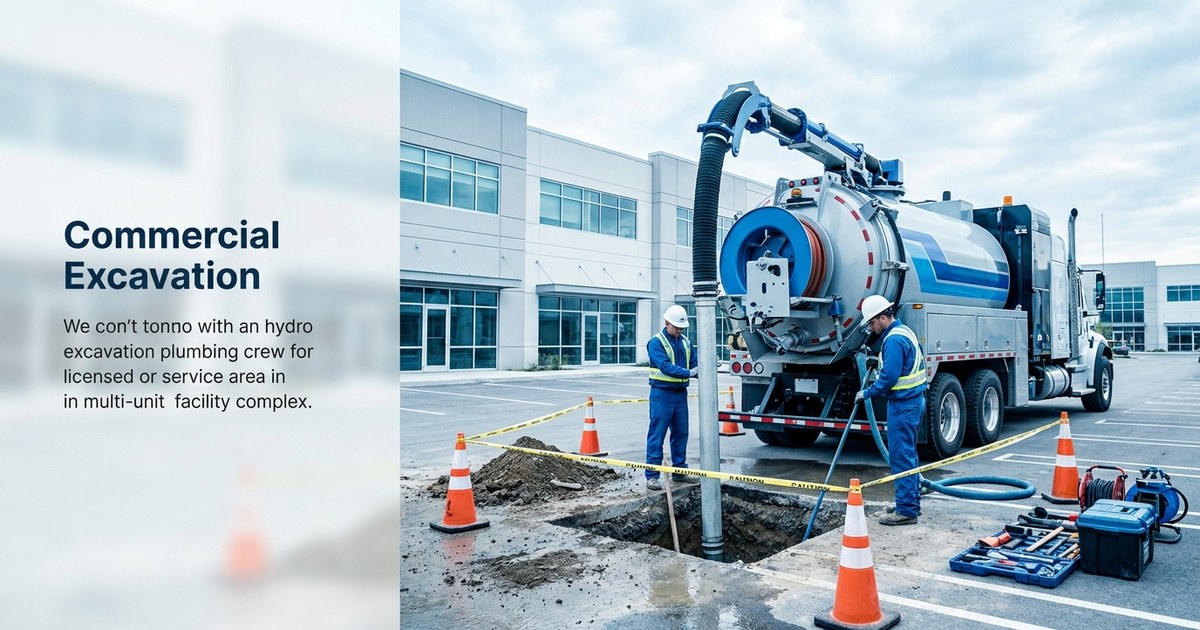
Most plumbing companies subcontract excavation work for sewer line repairs, camera inspections, or hydro excavation projects. The operational bottleneck is coordination: the plumber calls a separate excavation crew, each has its own dispatch schedule, and the facility manager waits for two companies to align availability. A sewer line collapse that could be repaired in four hours with an in-house team stretches to two days when subcontractors are involved.
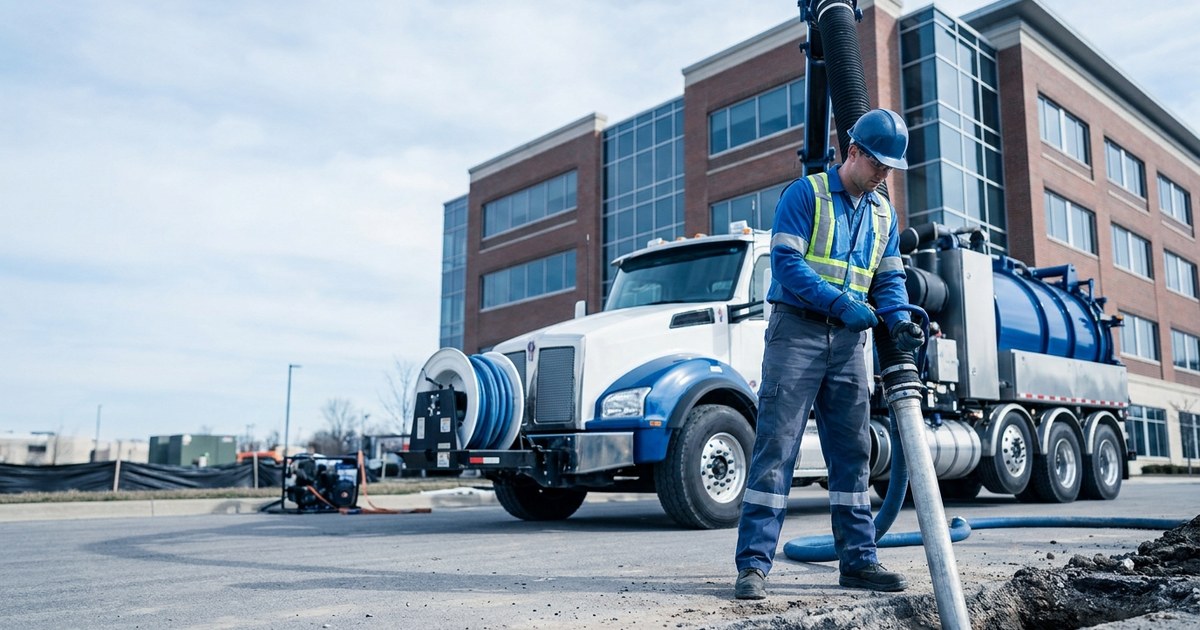
Service providers who own excavation equipment and crews (hydro excavation trucks for non-destructive digging, camera inspection systems for real-time sewer line diagnostics, and trenchless sewer replacement capability for minimal surface disruption) dispatch full capability with a single crew accountable for completion timeline and work quality.
For a retail facility manager juggling a crisis (parking lot sewer collapse during weekend traffic), this operational model is the difference between a contained four-hour repair and a multi-day ordeal that requires rerouting customer access and posting construction signage. The in-house model also eliminates the finger-pointing dynamic when something goes wrong: one company owns the outcome, and the facility manager has one point of accountability.
Retail facilities operate when residential properties don't: evenings, weekends, and holidays are peak revenue hours. Many plumbing companies charge double or triple rates for after-hours service, which penalizes retail operators for calling when something breaks during their busiest periods. A Sunday afternoon emergency that costs $800 during weekday business hours becomes a $2,400 invoice with after-hours surcharges.
PlumbGuard maintenance clients receive same-day emergency service with no after-hours fees. Transparent pricing means the facility manager knows the cost before approving the work: diagnostic fees, labor rates, materials, and total project cost communicated upfront, not discovered on an invoice three days later.
This operational transparency removes the financial penalty for operating 70+ hours per week and eliminates the "should I wait until Monday to save money" calculation that often makes emergency damage worse.
The pricing model reflects commercial operational reality: retail facilities need plumbing service when they're open, and penalizing them for that timing creates misaligned incentives. A pre-vetted partner with transparent pricing and no after-hours penalties becomes the default first call, not the last resort after trying three discount providers.
Documentation is operational insurance, not paperwork theater. Retail facility managers face multiple audit scenarios where documented maintenance history is required. Health department inspections (especially for food service tenants) demand grease trap cleanout logs and backflow test certificates. Lease compliance audits (many retail leases require documented HVAC and plumbing maintenance). Corporate portfolio oversight (multi-location operations directors need centralized service history across all sites). Liability protection (when a customer claims injury from a restroom slip-and-fall caused by a plumbing leak, documented maintenance proves due diligence).
Without documentation, a facility manager is guessing whether the grease trap was serviced last month or six months ago. When a health inspector asks for backflow testing certificates, the answer cannot be "I think we did that last year." When corporate operations requests a portfolio-wide compliance report, the facility manager cannot compile it from memory or file cabinets full of paper invoices.
The operational standard is a single source of truth: every service call logged, every completed task documented with photos and inspection reports, every upcoming maintenance interval surfaced proactively, and every compliance deadline tracked centrally. This eliminates the reactive scramble when an audit notice arrives and transforms maintenance from chaotic firefighting to structured operational rhythm.
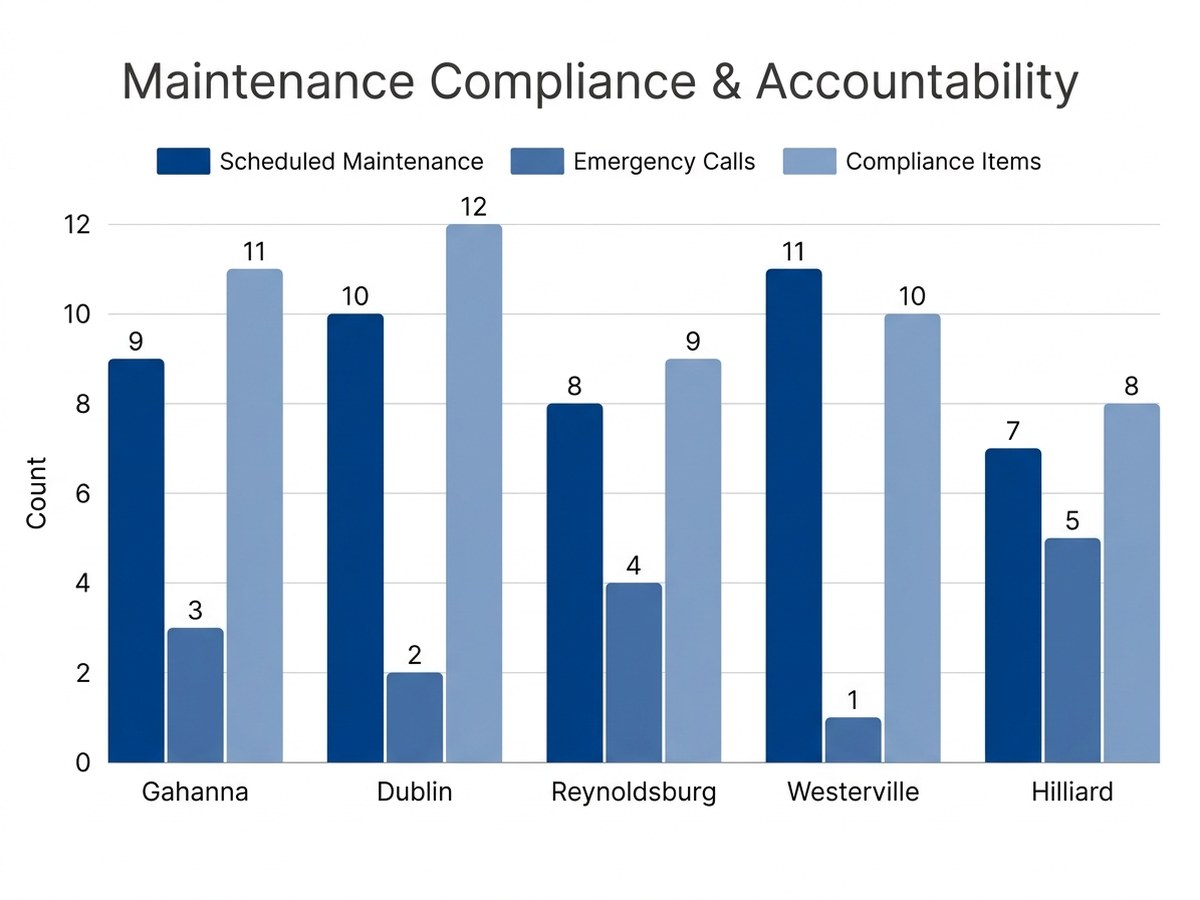
For facility managers overseeing 5, 10, or 50 retail locations, centralized service documentation is the operational backbone. ServiceTitan scheduling integration tracks every service call, logs every completed task, stores photos and inspection reports, and surfaces upcoming maintenance intervals automatically.
The facility manager logs into a dashboard and sees the complete service history for every location: "Gahanna store: backflow test due in 14 days; Dublin store: grease trap serviced last Tuesday; Reynoldsburg store: main line camera inspection flagged a root intrusion, trenchless repair scheduled for next Thursday 6 a.m."
This operational visibility enables proactive management instead of reactive crisis response. The system flags upcoming compliance deadlines before they become violations. The documentation proves maintenance history during health inspections without digging through paper files. The centralized record supports corporate reporting requirements and lease compliance audits. When a facility changes management or a new operations director takes over the portfolio, the complete service history transfers without gaps.
The alternative is chaos: scattered invoices, verbal promises of "we took care of that," and no systematic tracking of which location needs what service when.
PDP's PlumbGuard program delivers the three-strategy framework as a turnkey operational solution: scheduled drain and line jetting (quarterly for high-volume food service, semi-annual for lower-traffic facilities), grease trap and interceptor cleanouts on monthly or quarterly schedules, backflow prevention testing timed to meet annual regulatory deadlines, water heater inspections and anode replacement, pipe and leak inspections during low-traffic windows, pump system testing for facilities with below-grade plumbing, and fixture inspections in public restrooms.
The cadence is customized to facility type and usage. A grocery store with an in-store deli receives monthly grease trap service and quarterly drain jetting. A big-box retailer with minimal food service receives semi-annual maintenance focused on restroom fixtures and main sewer lines. A mall property with multiple food court tenants receives coordinated monthly service across all grease traps and quarterly backflow testing.
Single-location contracts provide turnkey service for independent retailers and single-site facility managers. Multi-site portfolio agreements cover retail chains with 5 to 50+ locations across Greater Columbus, centralizing scheduling, documentation, and compliance tracking under one contract.
The operational advantage is predictability: no surprise invoices, no emergency scrambling, no missed compliance deadlines. The maintenance happens on schedule, the documentation proves it happened, and the facility manager focuses on operations instead of plumbing crises.
A grocery store with a high-volume deli generates significant grease and organic debris through daily operations. Without preventive maintenance, grease and debris accumulate in the main drain line over 6 to 9 months until a Saturday afternoon backup floods the prep area and forces a partial closure. Customers see the mess, health department issues a violation notice, and the store loses a full day of peak weekend revenue while emergency crews clear the line and sanitize the area.
With PlumbGuard, quarterly drain jetting clears the line before it backs up. A scheduled 6 a.m. service visit removes accumulated grease, the camera inspection documents clear flow, and the facility manager receives a dated service report for health department compliance. The backup never happens. The revenue loss never occurs. The health department violation never lands.
A second scenario: the same camera inspection during routine maintenance flags a root intrusion in the parking lot sewer line. The roots haven't caused a backup yet, but the inspection shows they will within 60 to 90 days. Trenchless sewer repair is scheduled during a low-traffic Tuesday morning, completed in four hours with minimal surface disruption, and documented with before-and-after camera footage.
The catastrophic parking lot sewer collapse that would have forced store closures, emergency excavation, and multi-day repairs never happens because the preventive inspection caught it early.
The operational principle is consistent: preventive maintenance shifts failures from unplanned catastrophes (mid-day backups, weekend emergencies) to scheduled, controlled interventions (early-morning service, documented repairs, predictable costs). The facility manager sleeps through the night instead of managing 2 a.m. crises.
Backflow prevention testing is a legally mandated safeguard against contaminated water flowing backward into potable supply lines. Municipal water authorities enforce annual testing requirements (some jurisdictions require semi-annual for food service facilities) to prevent cross-connection contamination events.
Retail facilities with food service operations (grocery delis, coffee shops, mall food courts, sit-down restaurants) are high-priority enforcement targets because cross-connection failures in these environments create public health risks.
Testing schedules are jurisdiction-specific, but the operational standard across Greater Columbus is annual certification by a licensed backflow tester. Backflow testing is a legal requirement in most jurisdictions. Missed testing results in fines, failed health inspections, and potential water service shutoff until compliance is restored.
The certification process includes physical testing of backflow prevention devices, documentation of test results, and filing of certificates with the municipal water authority.
Facility managers cannot delegate this compliance requirement to memory or hope. A systematic preventive maintenance contract schedules backflow testing 30 days before the deadline, completes the test during a low-traffic window, files the certification with the appropriate authority, and stores the certificate in the documented service history for audit readiness. The operational risk of non-compliance (water shutoff, health department closure, public notice of contamination risk) far exceeds the cost of annual testing.
Municipal ordinances across Columbus and surrounding cities require regular grease trap cleanouts for food service establishments to prevent fats, oils, and grease (FOG) from entering sewer systems and causing blockages. Health code compliance depends on documented service logs reviewed during inspections. An overdue grease trap cleanout flagged during a routine health inspection results in violation notices, mandatory follow-up inspections, and potential operating permit revocations.
The operational necessity is equally clear: a full grease trap backs up into the kitchen, forcing immediate closures until the trap is pumped and cleaned. A mall food court with three restaurant tenants sharing a common grease trap system faces coordinated shutdowns if the trap overflows during peak lunch hours.
Service intervals depend on volume: monthly cleanouts for high-volume operations (food courts, full-service restaurants with 200+ daily covers), quarterly for lower-volume facilities (coffee shops, small delis). The cleanout service includes pumping the trap, cleaning baffles and screens, documenting waste disposal per environmental regulations, and logging the service for health department compliance.
Water authorities have established cross-connection control policies to protect public water systems. Many Ohio municipalities have adopted FOG ordinances modeled after EPA guidelines; violations carry fines, mandatory remediation, and operating permit revocations for repeat offenders.
A facility manager operating food service tenants cannot treat grease trap maintenance as optional or defer it to save short-term costs. The operational and regulatory consequences of failure (health department closures, environmental violations, customer-facing sewage backups) are catastrophic. The preventive service cost is a rounding error compared to the emergency response and lost revenue when the trap overflows mid-service.
Not every plumbing issue is an emergency, and not every emergency is preventable. Facility managers need a decision framework to triage issues and allocate response appropriately.
Emergency scenarios require immediate dispatch:
These scenarios require immediate dispatch because every hour of delay compounds revenue loss, health code violations, safety hazards, and customer impact.
Routine maintenance scenarios should be scheduled during off-peak windows:
These tasks are predictable and controllable. Scheduling them proactively during low-traffic hours prevents them from becoming emergencies.
Gray-area scenarios require same-day service, not middle-of-the-night urgency:
The operational principle is simple: preventive maintenance eliminates 70 to 80 percent of emergency calls. The remaining 20 to 30 percent are genuinely unforeseeable failures (sudden pipe burst, storm-related sewer backup, equipment failure despite regular maintenance). A pre-vetted 24/7 partner handles both the preventive schedule and the unforeseeable crisis with the same accountability and documentation.
For homeowners seeking similar preventive protection, Residential Plumbing Services for Greater Columbus Homeowners apply the same preventive philosophy at a smaller scale: scheduled inspections, transparent pricing, and documented service history protect both commercial facilities and residential properties from catastrophic failures.
Retail plumbing downtime is minimized through three operational strategies: scheduled preventive maintenance during off-peak hours, a pre-vetted 24/7 emergency response partner with sub-2-hour guarantees and in-house excavation capability, and documented service history that keeps facilities compliant and audit-ready. This operational framework shifts plumbing from unplanned catastrophes (mid-day backups, weekend emergencies, health department violations) to controlled interventions (early-morning service, documented repairs, predictable costs).
Every hour of plumbing downtime is lost revenue, brand damage, and customer frustration. A flooded restroom during Saturday peak traffic costs more than six months of preventive maintenance. A grease trap overflow that forces a health department closure erases a quarter's profit margin. A sewer line collapse in the parking lot creates safety hazards and multi-day excavation projects that redirect customer access and damage store reputation.
PDP has served Greater Columbus retail facilities for 11 years with PlumbGuard preventive maintenance contracts, 24/7 emergency response at 614-758-6237, and an in-house excavation team that eliminates subcontractor delays. Commercial expertise and ServiceTitan documentation deliver operational accountability at every step.
Commercial Plumbing Services in Gahanna, OH and service across the Greater Columbus Area mean every technician understands facility downtime cost and compliance deadlines. Stay informed with expert insights and practical guidance through the Plumbing & Drain Professionals Blog.
Request a Quote to get a customized PlumbGuard maintenance plan for your retail facility or Book an Appointment With Plumbing & Drain Professionals. Fast response, transparent pricing, and documented accountability across Greater Columbus.
Book a service request or consultation. We respond quickly and operate to professional service standards.
We’re Happy to Confirm
If your property is located in or around the Greater Columbus area and you don’t see your city listed, our team can quickly confirm coverage and service options.