2026-11-23
14
min read

Backflow testing in New Albany is the annual check a certified tester performs on every backflow prevention device that protects a commercial water supply. Many properties must test once a year, results go to the local water authority, and only a certified tester can do the work. You keep the records for inspectors.
Most facilities that miss a backflow deadline do not have a bad device. They have an unowned obligation and thin records. The test date slips because no one's name is next to it. Then an inspector asks for paperwork that is scattered across three inboxes.
This guide is for facility managers and healthcare administrators who own the compliance calendar. It covers the backflow testing New Albany sites need: who must test, how often, what the technician does, and what happens when a date lapses. It is written for New Albany and the Greater Columbus area, so confirm your own water provider's rules before you lock a schedule. If you want a certified crew to run the work, start with our annual backflow testing and certification for commercial properties.
Backflow testing confirms that a prevention device stops contaminated water from reversing into the clean supply when pressure changes. Facilities with cross-connection hazards generally need it. That includes healthcare sites, food service, irrigation, fire suppression, and industrial or chemical processes.
Backflow is the unwanted reversal of water flow in a plumbing system. When it happens, it can draw contaminants into clean water. A pressure drop in the main, a broken line, or heavy demand on a fire system can be enough to pull water the wrong way. A backflow prevention device is the barrier that stops it. Backflow testing is the certified inspection that proves the barrier still works.
For a facility manager, the working definition is narrower. Backflow Testing New Albany sites depend on is the inspection and certified testing of prevention devices on commercial properties. It uses specialized pressure testing equipment. The goal is to confirm each device works correctly and meets compliance rules.
We provide this service for commercial properties across Greater Columbus, with annual compliance support built in. Our team helps property owners confirm that backflow preventers are working properly, so contaminated water does not reach the clean water supply.
The need follows your connections, not your building type. Look at what ties into your potable supply:
Each of those is a point where non-potable water or chemicals could meet the clean supply if pressure reverses. That is why backflow prevention New Albany facilities install is not optional equipment. It sits between your process and the public water supply.

Regular testing finds failing devices early, protects public health, and keeps the property in step with annual testing requirements. The wider field treats cross-connection control as a specialty. The USC Foundation for Cross-Connection Control and Hydraulic Research offers membership, benefits and resources for people involved in protecting potable water through backflow prevention and cross-connection control.
Takeaway: If something non-potable touches your water system, you almost certainly need a certified test every year.
Many properties with backflow prevention devices must complete certified testing at least once every 12 months. Cities publish the rule in their own terms. New York City's Department of Environmental Protection, for example, sets out cross-connection control requirements that include certified testing at least every 12 months. Annual is the common cadence. Your schedule is still jurisdiction-specific, so confirm it with your own water provider and your tester.
In Greater Columbus, the operational standard is annual certification by a licensed backflow tester. Most commercial facilities with cross-connection hazards test their prevention devices once a year. The tester's results go to the local water authority, typically Columbus Division of Water or your municipal provider, within 10 days of testing.
We present that as the Columbus standard. If you manage a New Albany site, ask your provider which authority receives your reports and what its filing window is. We do not assume a New Albany rule we cannot point to. For facilities, backflow certification New Albany managers hold is only as good as the filing behind it.
Missing the date is usually a calendar problem, not a device problem. Track certification expiration dates and schedule testing 30 to 60 days in advance. That window leaves room to repair a failed device and retest before the certification lapses. Our guide to annual deadlines and how to avoid citations walks through that calendar in more detail.
The question we hear most from facility managers is whether in-house maintenance staff can test the device themselves. They cannot. Backflow testing generally must be performed by a certified and approved technician using properly calibrated equipment. Property owners cannot test their own backflow device, however capable their maintenance team is. For backflow testing New Albany facilities schedule, the certified tester is not optional.
There is a records reason too. A test by someone without certification gives you no result an inspector or the water authority will accept. You would pay for the labor and still have a gap in your file.
Your in-house team still has a role. They can watch for visible leaks, report a weeping relief valve, and keep the mechanical room accessible on test day.
Takeaway: For backflow testing New Albany sites rely on, plan for one certified test a year, book it 30 to 60 days early, and never count on an in-house test.
A certified technician inspects the assembly, tests it with calibrated equipment, and documents the result. Here is the sequence, step by step:

Here is what that looks like in our work. The steps run in the same order on every visit, and the inspection always comes first. Our specialized equipment gives us the pressure differentials, and we write up each result so it supports compliance reporting and annual maintenance records. Those three habits are the difference between a test and a defensible compliance file.
Code compliance testing New Albany managers schedule follows the same logic as any other jurisdiction: inspect, measure, decide, document. A complete backflow testing New Albany visit does not skip a step, because a skipped step leaves a result that is hard to defend.
The last two steps are where facilities most often fall short. The test itself might take a short visit. The record has to last years. It should name the device, the date and the result, and it should be easy to find. We cover how to build that kind of file in a compliance-ready plumbing record system written for facility managers.
Takeaway: A good test ends with a pass or fail on every component and a record you can hand to an inspector.
Missed testing can bring fines, a failed health inspection, and potentially a water-service shutoff until compliance is restored. It also weakens an insurance claim, because you cannot show maintenance diligence. Backflow testing is a legal requirement in most jurisdictions, and enforcement does not wait for a convenient moment.
Picture a health department inspector who asks for three years of backflow test records. "We definitely had that done" does not count as proof. The facility either produces dated certifications from licensed testers or receives a deficiency citation with a correction deadline. That deadline then lands on top of your normal operations.
The cost side is lopsided. A single day of closure costs more in lost revenue than several years of documented testing. We will not put a number on it here, because it varies by site. But ask your finance lead what one day of lost operations costs, then compare it with an annual test.
Downtime does not stop at the closure day. Staff reschedule, customers go elsewhere, and vendors scramble. Our breakdown of what unplanned plumbing downtime costs a facility shows how those costs stack up.
Insurance is the quieter exposure. A property manager who files a water damage claim after a pipe burst faces immediate scrutiny. When was the system last inspected? What preventive maintenance took place? An insurer reviewing the claim will ask. If you cannot show maintenance diligence, the claim becomes harder to defend.
That is why a documented service history protects a facility in both settings. The same dated records answer the inspector and the adjuster.
A failed test can also raise repair-or-replace questions about aging assemblies and the pipe around them. You are not alone in facing that choice. Federal energy research is paying attention to repairing aging pipe infrastructure, as the ARPA-E REPAIR program page shows. Your own decision should rest on the tester's findings and your repair history.
Backflow Testing New Albany facility managers put off is rarely skipped on purpose. It is skipped because nobody owns the date. The fix is organizational before it is technical.
Takeaway: A missed date costs you in fines, inspections, shutoff risk and insurance scrutiny, and dated records are the cheapest protection.
These sites carry the highest enforcement attention. Equipment tied to potable water, such as dishwashers, ice machines, beverage systems, spray valves and clinical equipment, needs protection. Inspectors treat backflow failures as high-priority violations. Each setting has its own watch list.
Healthcare sites draw close attention to water systems, and for good reason. Clinical equipment tied to potable water, such as dental chairs and lab sinks, can create cross-connections. The prevention device protects patients, staff and the wider supply. A lapse is hard to explain to an inspector.
Healthcare administrators also manage a heavy compliance load, and backflow dates compete with many others. Put backflow testing New Albany healthcare sites need on the same calendar as your other inspections. Our overview of healthcare facility plumbing standards covers the wider reliability picture.
Every food service facility in Columbus with mechanical equipment connected to potable water must install backflow prevention. That includes dishwashers, ice machines, carbonated beverage systems and pre-rinse spray valves. Backflow prevention protects public water supplies from contamination, and health departments treat failures as high-priority violations.
The practical point is that installing a device is the first obligation and testing it is the recurring one. A device that passed at install and has never been tested again gives you no proof. Our guide to food service plumbing and health-code requirements explains how those obligations fit together.
Retail facilities with food service operations are high-priority enforcement targets. That covers grocery delis, coffee shops, mall food courts and sit-down restaurants. Cross-connection failures in these settings create public health risks, so the annual certification described earlier applies to these sites without exception.
Missed testing in these settings leads to fines, failed health inspections, and potential water service shutoff until compliance is restored. In a multi-tenant property, ask which tenants run food operations. Those are the ones to schedule first.
Water quality is part of the same conversation for retail and office sites. The line between a backflow barrier and what comes out of the tap matters to everyone inside. See water purification for staff, tenants and customers for how that fits in.
Takeaway: Food operations and clinical equipment put you at the front of the enforcement line, so schedule those devices first.
Assign one owner for the deadline, track certification dates, schedule testing well ahead of expiry, keep every test record in one place, and re-check your hazard profile whenever the use of the space changes. A scheduled maintenance program makes this routine. Here is how to build each habit.
Name one owner, in writing. Landlords and tenants each often assume the other handles testing. That ambiguity is itself the risk. Write down who owns the date, who books the tester, and who stores the record. In a multi-tenant building, put it in the lease or the vendor agreement.
Re-check the hazard profile when use changes. A change in property use can change the hazard rating. A suite that was office space becomes a clinic, or a retail unit adds a coffee counter. The device that was fine last year may not be the right protection now. Ask your tester to review any change of use.
Build one records system. Every compliance-ready record starts with identification: the facility address, the specific equipment serviced, such as the backflow device serial number, and the service date with start and completion timestamps. That detail matters when an inspector cross-references your documentation against permit records. It also matters when an insurance adjuster reconstructs the timeline of a failure. Facilities with documented maintenance histories can bring a new contractor up to speed in hours, not weeks, because intervals, specifications and deadlines are already mapped.
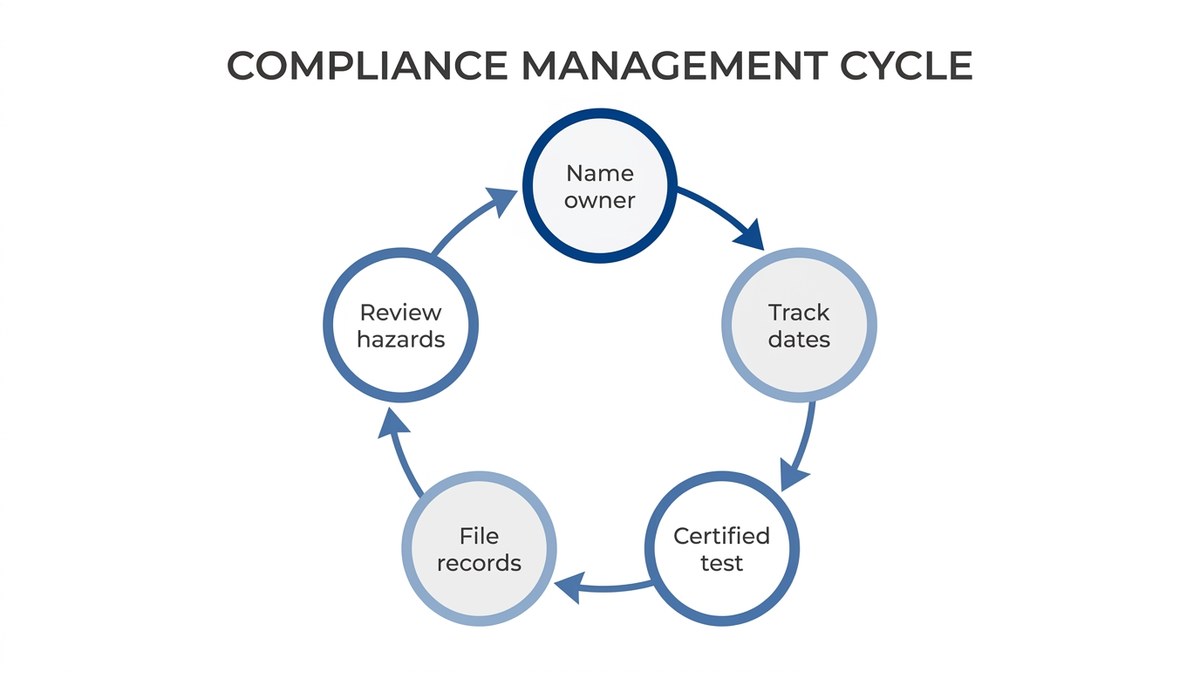
Fold testing into scheduled maintenance. Our PlumbGuard™ maintenance program lists backflow testing among its inclusions, so backflow testing New Albany sites require rides on a fixed calendar and not on someone's memory. It also comes with no after-hours fees. Commercial programs like this shift a facility from reactive firefighting to planned service.
Look at the neighboring water systems. Backflow devices share a building with other water-side equipment. Treatment and filtration protect that equipment, and a test visit is a good moment to review them together. See commercial water treatment and filtration for equipment protection, and our companion article on commercial water treatment filtration systems for how treatment choices affect upkeep.
Drain lines are the other water-side service worth pairing with a test visit. High-use facilities do better with scheduled maintenance than with emergency calls. Consider scheduled drain jetting alongside backflow testing so one visit calendar covers both.
Municipal policy shows why ownership needs to be explicit. Under a nearby Columbus-area city's policy, the City of Reynoldsburg's water leaks page says the city is responsible for leaks from the curb box to the water main and the mains themselves. The property owner is responsible for the line from the curb box to the structure. Responsibility splits at a boundary. We cite it as an example of how utilities divide duties, not as a New Albany rule. The bridge for your site is simple: the device on your side of the meter is yours to test and keep in compliance.
Takeaway: Code-ready means one named owner, one records system, and a test booked before the old certification expires.
Ask for proof of certification, calibrated equipment, a pre-test inspection, and documents you can file. Backflow Testing New Albany providers vary in how they handle each of those, and the answers tell you how audit-ready you will be. Use this checklist:
Do not skip the response question. A device failure on test day is a small emergency, and you want a vendor who shows up. Customers praise our crew for getting onsite within an hour during emergencies at commercial facilities. We cite that as response reliability, not as a backflow result. It tells you how we treat a facility's time.
If a provider cannot answer these six questions plainly, keep looking.
Takeaway: Hire the provider who can show certification, a pre-test inspection, calibrated gear and records you can file.
The three habits are simple. Name an owner for the date. Put the certification expiry and a 30 to 60 day booking window on a shared calendar. Keep every dated test record in one place that an inspector or insurer can see.
Facilities that do those three things rarely get surprised. Those that do not tend to find the gap on the worst day, with an inspector standing in the lobby. Backflow Testing New Albany facility managers rely on is a small annual task. It works when someone owns it and the paperwork is ready.
If you manage a site in New Albany or elsewhere in Greater Columbus, the next step is getting your next test date booked before it lapses. We will help you confirm what applies to your devices and build the record that goes with it.
Book a service request or consultation. We respond quickly and operate to professional service standards.
We’re Happy to Confirm
If your property is located in or around the Greater Columbus area and you don’t see your city listed, our team can quickly confirm coverage and service options.