2026-10-28
14
min read

Commercial plumbing downtime cost is everything a facility loses while a plumbing failure limits normal operations: lost operating hours, idled staff, disrupted customers, compliance exposure, and the repair itself. The repair bill is usually the smallest line. The larger cost is the time the facility cannot operate normally.
If you run a building in Columbus, Worthington or Dublin, you already know the feeling. A drain backs up at lunch. A restroom closes. A supply line fails overnight. Within an hour the problem is no longer a plumbing problem. It is an operations problem, and you are the one answering for it.
This guide breaks down commercial plumbing downtime cost and shows where the money goes when that happens. It also shows what you can control. If you want a clear picture of the vendor side first, read what to expect from a commercial emergency plumber before an outage forces the question.
Commercial plumbing downtime cost is the total business impact of a plumbing failure: lost operating time, staff and customer disruption, compliance risk and emergency labor. It is not just the plumber's invoice. It counts any period when the issue reduces your ability to operate or meet safety and hygiene expectations.
Most budgets only see the invoice. The invoice is one line on one page. The rest of the cost shows up in other places: a shift sent home, a dining room closed early, a tenant complaint, a missed inspection window. Nobody labels those costs "plumbing," so nobody adds them up. That is why commercial plumbing downtime cost stays invisible, and why plumbing gets treated as a maintenance line item instead of an operational risk.
This is not homeowner plumbing. It is operational continuity. A house can live without one bathroom for a day. A building with hundreds of daily users, shared systems and public-facing obligations cannot.
Downtime is also bigger than the burst pipe. It starts when the issue first limits what you can do, and it ends when you are fully back to normal. A slow drain that forces you to restrict restroom access counts. So does a water heater failure that shuts down a kitchen's dish line. The pipe may be fixed in an afternoon while the downtime runs for days.
Commercial failures also escalate faster than residential ones, for four reasons:
We see the same pattern across facilities. The longer a minor issue is ignored, the wider it spreads. Our guide on what happens when commercial plumbing maintenance is ignored walks through how a small, deferred fix turns into a multi-system failure.
Takeaway: Commercial plumbing downtime cost begins when the plumbing issue limits operations, not when the plumber arrives, and the invoice is the smallest part of it.
Costs fall into five groups: lost revenue or productivity, idle labor, damage to property and inventory, compliance and regulatory exposure, and the repair and emergency premium. Most facilities only track the last one. The other four usually add up to more.
This five-part framework is the core of how we talk with facility teams about facility downtime impact and commercial plumbing downtime cost. It turns a vague worry into categories you can price.

1. Lost operating time. This is revenue or output that does not happen while the facility is limited. A restaurant cannot serve. A clinic reschedules patients. A warehouse slows a wash-down process. An office sends people home. This group is often the largest, and it never appears on the plumber's invoice.
2. Idle labor. Your people are still on the clock. Staff wait for water to return, for a restroom to reopen, or for the crew to finish. You pay wages for reduced output. Overtime often follows when the work is made up later.
3. Property and inventory damage. Water spreads fast. It reaches flooring, drywall, ceiling tiles, stored product and equipment. A sewer backup adds sanitation work on top. Food-service and healthcare sites can lose stock or supplies that cannot be saved.
4. Compliance and regulatory exposure. A failure can put you out of step with code, health or safety expectations before you have fixed it. The next section covers how quickly that happens.
5. Repair and emergency premium. This is the visible bill: labor, parts, and any rush charge. It is the only group most facility budgets capture.
Restroom loss deserves a special note. When washrooms go out of service, public-facing and high-occupancy sites feel it right away. Even a basic fixture problem matters at scale, which is why prompt commercial shower and restroom repair is an operations decision, not a cosmetic one.
Beyond the five groups, three things multiply the damage.
First, rushed decisions. Under pressure, people pick the first vendor who answers, approve scope they have not reviewed, or patch a symptom instead of finding the cause. Those choices cost more later.
Second, goodwill. Tenants, patients, customers and staff remember the day the building did not work. That cost is real, even though it never gets an invoice number.
Third, repeat failures. When the root cause is not fixed, the same problem returns. Each return restarts the clock on every cost group above.
Documented service history is how you prove what an outage really cost. If you keep maintenance and repair records for each site, you can look back and price past events instead of guessing. We return to this in the calculation section.
Takeaway: The repair invoice is one of five groups that make up commercial plumbing downtime cost, and the other four are usually larger and almost always untracked.
Often within hours. When clean water, working restrooms or waste removal are unavailable, a facility can fall out of code or health requirements the same day. Food service, healthcare and public-facing sites feel this first because they have the fewest workarounds.
Compliance is where commercial plumbing downtime cost turns from an inconvenience into a liability. It is also where the Operations Director gets pulled in. The clock does not wait for the repair schedule.
We have kept this section general on purpose. Specific code sections and inspection cycles vary by site, use and jurisdiction, so confirm the requirements that apply to your facility with the relevant authority. What follows describes where exposure tends to appear, by type of facility.
Kitchens depend on working drains, grease management and hot water. When a drain backs up or a grease trap overflows, the kitchen may have to stop. Grease interceptors need regular cleanouts, and a missed cycle is one of the most common ways a food-service site ends up with an emergency. Our crew handles scheduled grease trap cleaning for food service so cleanouts happen on your calendar, not after a backup.
Clinical settings rely on safe water supply and protected systems. Backflow prevention matters here because a lapse can affect water quality. Loss of clean water or sanitary fixtures limits what a care site can do, and few alternatives exist.
Restrooms are the pressure point. Public-facing sites and larger offices have occupancy expectations, and a restroom outage can force reduced access or a partial closure. The compliance question is rarely dramatic, but the customer and tenant impact is immediate.
Process water and floor drainage keep production and sanitation running. A drainage failure can stop a line or create a safety hazard on the floor. Heavy-use drains also tend to clog from buildup, which is where routine jetting earns its keep.
Multi-tenant buildings multiply exposure. One shared line failing can hit several tenants at once, each with their own obligations and expectations. Your vendor response becomes a landlord responsibility, and the paper trail matters.
Backflow testing is easy to forget because nothing visibly breaks when it lapses. Facilities often discover a missed test only when a notice arrives from the water authority, or when a property is being sold. By then the fix is a scramble, not a schedule.
This is the quiet side of business interruption. A missed test does not stop operations today, but the consequence can arrive at the worst possible time. Scheduled intervals and good records remove the surprise.
Takeaway: Compliance exposure can start within hours of a failure, and the quietest lapses, like backflow testing, are the ones that surprise you later.
Wrench time is rarely the delay. Outages run long because of access windows, shutdown coordination, tenant constraints, and waiting on subcontracted excavation or specialty crews. A delay of a few hours at the start can stretch recovery across days.
Facility managers often assume the repair itself is the long part. In practice the repair is short and the logistics are long. That is why vendor structure shapes commercial plumbing downtime cost more than repair difficulty does.
Think through a typical commercial job. The plumber needs access to a mechanical room or a tenant space that is locked or occupied. Water has to be shut off, which affects other users, so someone has to coordinate the shutdown window. Tenants may only allow work after hours. If the problem turns out to be below the slab or in an underground line, the job may need excavation, which is a different trade with a different schedule.
That last handoff is where many outages stretch. When a plumbing contractor subcontracts excavation, the original crew leaves, the second crew has to be scheduled, and nobody owns the whole timeline. Each handoff adds waiting.
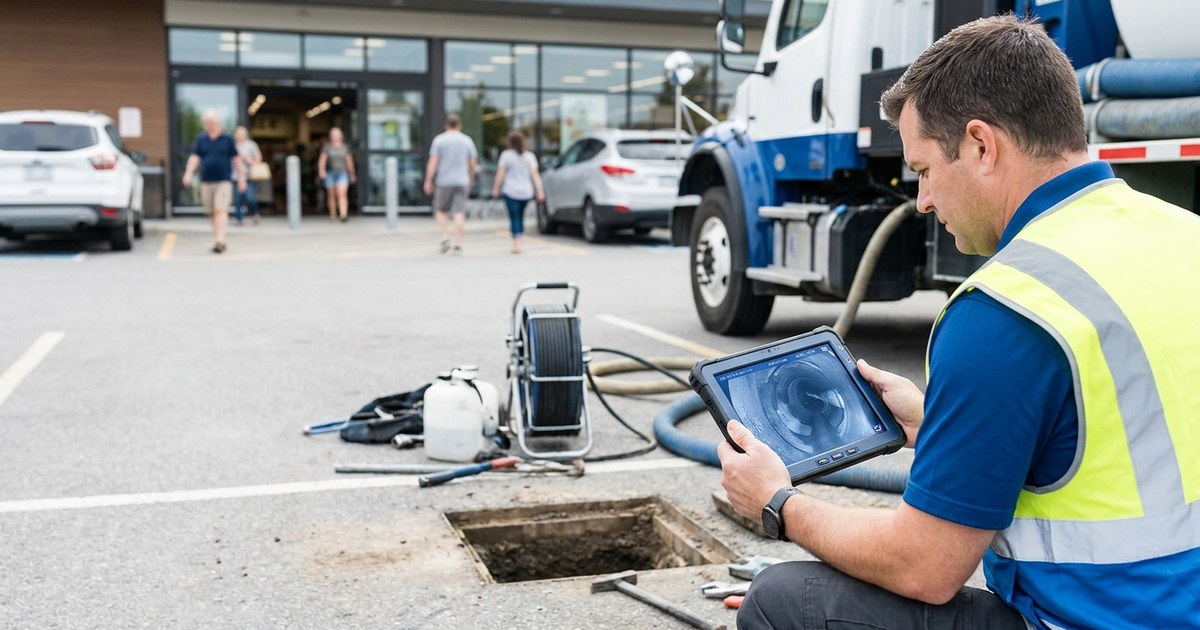
Our approach is different. We run our own excavation and sewer crew, with our own hydro excavation truck, camera inspection and trenchless replacement capability. When the diagnosis points underground, the same company continues the work. There is no search for a second vendor, and no gap while two contractors align their calendars.
Planned work also changes the picture. When maintenance is scheduled, you choose the access window. You pick the quiet hours, notify tenants in advance, and keep shutdowns short. That is one reason facilities choose to get a PlumbGuard™ preventive maintenance contract: the work happens on your terms, before a failure forces the schedule.
A useful exercise is to ask your current vendors three questions:
If the answers involve phone tag between several companies, you are paying downtime cost in waiting time.
Takeaway: Vendor structure, not repair difficulty, usually decides how long an outage lasts and how much commercial plumbing downtime cost you absorb.
Many providers add a premium for nights, weekends and holidays, which pushes facilities to delay the call. Delay raises downtime cost. PDP charges no after-hours or weekend surcharge, so the decision to call depends on the problem, not the clock.
Think about the decision a facility manager faces at 11 p.m. A drain is slow but still working. A leak is small but spreading. The call would carry a premium. So the manager waits until morning and hopes.
That hope is where plumbing emergency expense quietly grows, and commercial plumbing downtime cost grows with it. A small problem left overnight becomes a larger one by sunrise. Water spreads. A backup reaches more fixtures. The facility opens with a compromised system, or does not open at all. The premium avoided is small next to the downtime that follows.
A pricing structure that punishes early action creates exactly the wrong incentive. The earlier you call, the cheaper the total event usually is. Any premium that discourages the call works against you.
This is why our 24/7 commercial emergency response runs with no after-hours or weekend surcharge. We want the decision to call to depend on the problem, not the time on the clock. If it is 2 a.m. and something is failing, you can reach our emergency line at 614-758-6237 without doing a cost calculation first. For a closer look at how we handle urgent calls, see our guide to 24/7 emergency response for Worthington facilities.
Whatever provider you use, ask a few questions before you need them:
Answers to those questions, collected in advance, turn an emergency decision into a routine one.
Takeaway: After-hours premiums create a delay incentive, and delay is one of the fastest ways to raise commercial plumbing downtime cost.
Estimate hours offline, multiply by hourly revenue or labor cost for the affected area, then add damage, compliance and repair costs. Run it for a realistic worst case at each site. A simple worksheet turns a vague risk into a number you can budget against.
We deliberately give you a method for commercial plumbing downtime cost here, not a made-up dollar figure. Your facility, your hours and your revenue are different from anyone else's, and an invented example would mislead you. Fill in your own numbers.

Run this for each site, one affected area at a time:
Then ask the key question: how many hours offline is realistic in the worst case at this site? Use your own history. If a past outage lasted a full shift, use a full shift. If your building has a single main line serving every floor, assume the whole building is affected.
A few habits make the worksheet useful instead of academic.
Run it per site. A multi-site portfolio has different hourly values and different risks at each property. A single average hides the sites that matter most.
Run it twice. Once for a short outage and once for a long one. The gap between the two shows what a fast response is worth.
Use your records. Documented service history gives you real durations and real invoices to start from. In our work with Columbus-area facilities, the sites that can estimate their commercial plumbing downtime cost are the ones that kept records of past events. Our work records give clients that history, so past outages can be priced, not remembered.
Finally, take the number upward. For an Operations Director, a documented figure changes the conversation. Plumbing stops being an overhead line and becomes a risk with a measurable exposure. Our own financial case study on preventive maintenance shows how we compare reactive costs with planned ones, and it is a good model for building your internal case.
Takeaway: A per-site worksheet using your own hours and rates turns downtime from a vague worry into a figure you can budget against.
Reduce it by shifting from reactive repair to scheduled work. Planned maintenance catches problems before they stop operations, lets you pick the access window, and builds the records that prove compliance. The goal is to make downtime predictable, not catastrophic.
You cannot remove every failure. You can change when and how failures happen, and how much they cost when they do.
A reactive repair happens on the failure's schedule. A planned service happens on yours. The difference shows up in every cost group above.
Scheduled intervals can cover line and drain jetting, grease trap and interceptor cleanouts, backflow testing, water heater inspections, pipe and leak inspections, pump testing and fixture inspections. Each one targets a known failure point. Routine hydro jetting and drain cleaning for commercial lines clears buildup before it becomes a backup, which matters most for kitchens, restrooms and heavy-use industrial drains.
Our commercial plumbing maintenance service puts these checks on a calendar, so inspections do not depend on someone remembering them.
PlumbGuard™ is our preventive maintenance program built around this idea. It scales from a single site to a multi-site portfolio, and it is designed to make downtime predictable, not catastrophic. You can read how PlumbGuard protects a facility day to day for the details of what scheduled service looks like in practice.
Earlier we covered how handoffs stretch outages. The fix is a vendor that keeps the job in-house. Our crew handles hydro excavation, camera inspection and trenchless replacement with our own people and equipment. When the problem is underground, there is no second contractor to find, brief and schedule.
For a facility manager juggling several contractors, that also means one point of accountability. One company answers for the work, the timeline and the documentation. If you want to see how a program is structured around continuity, visit our page on proactive plumbing maintenance built for business continuity.
Records are part of downtime control. Documented service history shows an auditor, a landlord or an insurer that you maintained your systems. It also supports your own planning by showing which lines fail repeatedly and which sites cost the most.
We document the work we do, so a facility has a service record for each visit. When an inspection or review comes up, you can show what was done and when, instead of reconstructing it. Good records also reduce the business interruption that follows a compliance question, because the answer is already on file.
Takeaway: Scheduled maintenance, an in-house vendor and good records are the three levers that turn commercial plumbing downtime cost from a surprise into a plan.
The thesis is simple. The repair bill is the smallest piece of commercial plumbing downtime cost, the larger costs sit in lost operating time, idle staff, compliance exposure and rushed decisions, and a facility manager can control most of them. The method is also simple: put your own numbers on the worksheet, find the sites with the biggest exposure, and move those sites from reactive repair to scheduled work.
Tell us about your facility and get a number you can plan around.
Request a Quote → https://www.plumbinganddrainpro.com/request-a-quote
Book a service request or consultation. We respond quickly and operate to professional service standards.
We’re Happy to Confirm
If your property is located in or around the Greater Columbus area and you don’t see your city listed, our team can quickly confirm coverage and service options.