2026-10-26
12
min read

What is healthcare facility plumbing compliance? Healthcare facility plumbing compliance means meeting the plumbing code, backflow and cross-connection rules, and water management requirements that apply to your building, then proving it with records. In practice: a current water management program, annual certified backflow testing, scheduled maintenance of drains, water heaters and pumps, and documentation an inspector or surveyor can review on request.
A compliance miss in a care area is an operations event, not paperwork. A failed backflow assembly, a hot-water loop that runs cold or a missing test report can take a unit offline and put a finding on your survey record. Most facility managers know the rules exist. What they need is one place that says what they owe and when.
Start with the calendar. Annual backflow testing deadlines in Columbus arrive fast, and healthcare buildings carry many assemblies that must be tested.
We organize this guide around a simple frame we call the Proof Stack. It has three layers:
Each section below maps back to one or more of those layers.
Healthcare facility plumbing compliance requires that your building's plumbing meets the plumbing code, cross-connection rules, water management expectations and accreditation standards that apply to you, and that you can show it. Compliance is two things: the physical system is right, and the records prove it.
Several rule sets overlap. This table shows who sets what.
| Layer | Who sets it | What it asks of you |
|---|---|---|
| Plumbing code | Ohio Board of Building Standards (Ohio Administrative Code, or OAC, 4101:3) | Fixtures, piping, venting and drainage installed and altered to code |
| Cross-connection control | Ohio EPA and your water provider | Backflow preventers on hazards, tested and reported |
| Water management | Centers for Medicare & Medicaid Services (CMS) and ASHRAE Standard 188 | A written program to control Legionella |
| Accreditation | The Joint Commission | Proof that you run the program you wrote |
| Design guidelines | Facility Guidelines Institute (FGI) | Plumbing design for care areas |
Ohio's plumbing code sits in OAC Chapter 4101:3, administered by the Ohio Board of Building Standards. Check the current edition and its effective date before you scope any alteration. That is the baseline for every building, from a large hospital to a medical office suite.
Design-side expectations for care areas come from the FGI Guidelines for Design and Construction of Hospitals, 2022 edition. If you are renovating a unit, check them before the first wall opens.
Not every building carries every layer. CMS set its water management expectations for hospitals, critical access hospitals and long-term care facilities in its revised survey memo QSO-17-30 (2018). The Joint Commission adds its Environment of Care standard EC.02.05.02 for accredited hospitals, which expects a water management program that you actually run. Confirm the current wording with your accreditation contact.
Outpatient clinics and medical office buildings are driven mainly by the plumbing code and backflow rules. Do not build a hospital-grade program for a small clinic. Do not run a clinic-level program inside a hospital.
The Proof Stack turns these layers into one test: can you show design proof, interval proof and response proof for every system that touches patients?

PDP works with commercial facilities only, so we treat this as facility operations and deadline management. Compliance is the outcome of many small decisions and a documented schedule. That is the idea behind our PlumbGuard™ preventive maintenance contracts: moving a commercial healthcare facility from reactive firefighting to scheduled operations.
Isn't compliance just passing inspection day? No. It is continuous interval discipline, and skipping it has a cost. See what deferred plumbing maintenance costs a facility.
Takeaway: compliance is a physical system plus a paper trail, and the Proof Stack checks both.
Healthcare facilities need backflow preventers on cross-connections such as boilers, sterilizers, dialysis equipment, lab sinks and fire lines. Certified testers typically test assemblies at installation and at least annually, then report results to the authority. Confirm your exact schedule with your local water provider.
Healthcare buildings have more high-hazard connections than most commercial sites. Water feeds equipment that handles contaminated fluids, chemicals and steam. If pressure drops in the street main or inside the building, that water can flow backward into the potable supply. A backflow preventer is the barrier that stops it.
Ohio's cross-connection rules are in OAC Chapter 3745-95 (Ohio EPA). They frame how public water systems and the properties they serve control cross-connections. Your water provider sets the working details: which assemblies need testing, when, and where the report goes.
For the City of Columbus, confirm the testing and reporting process directly with the Department of Public Utilities cross-connection program. Local rules decide where results are filed and by when, so get the current requirements in writing.
Hazard classification matters because it decides which assembly type a connection needs. The usual technical references are the EPA cross-connection control manual and AWWA Manual M14. Ask your tester which reference your water provider applies.
PDP provides certified backflow testing, prevention and compliance documentation for commercial healthcare facilities working to code deadlines. Ask any tester which certification your water provider accepts, and get it in writing. Then treat the test date as a calendar item owned by one vendor, not a surprise.
A failed assembly does not automatically mean a shutdown. Usually it means repair and retest. The questions are how fast and how much of the building is affected. Same-day service matters when an assembly protects equipment you cannot idle, and when the provider's reporting clock is running. Document the failed result, the repair and the passing retest together so the record tells one complete story.
Takeaway: backflow is interval proof at its simplest, a dated test with a named tester and a filed report.
ASHRAE Standard 188 and CMS requirements expect hospitals, critical access hospitals and long-term care facilities to maintain a written water management program. It identifies where Legionella can grow, sets control limits such as temperatures and disinfectant levels, and records monitoring and corrective action.
ASHRAE stands for the American Society of Heating, Refrigerating and Air-Conditioning Engineers. Its standard covers risk management for building water systems, and ASHRAE Guideline 12 offers companion guidance on managing Legionellosis risk. Check the current edition before you rely on specific requirements.
Your infection prevention team and water management team own the program. They decide the control limits, the monitoring plan and the corrective actions. A plumbing contractor does not replace them. The contractor's job is to deliver the maintenance and documentation that team needs.
The CDC's water management program toolkit (2021) lays out the program elements: a program team, a description of the building water system, a hazard analysis, control measures, monitoring and documentation. Use it as a checklist for what your team should already have.
The stakes are practical. The CDC's 2016 Vital Signs report on Legionnaires' disease found that most outbreaks it studied traced back to preventable problems in how building water systems were maintained. Maintenance discipline is the point of the program.
A water management program lives or dies on physical conditions. Temperature control, dead legs (pipe runs with no flow), stagnation, flushing and water heater condition all sit in the plumbing system. If a heater fails or a branch sits unused, the written program cannot fix it.
Commercial water heater systems deserve particular attention. Storage temperature, recirculation and tank condition affect whether hot water reaches fixtures at the temperature your team set. Inspect them on a schedule, not after a complaint.
PlumbGuard covers water heater inspections, pipe and leak inspections, pump system testing and fixture inspections. Those are the physical control points a water management team relies on. When we find a problem, it goes into the record with the corrective action, so your team can use it.
Water quality is the other side. Your team may specify treatment or filtration as a control measure in some parts of the building. Our work covers commercial water treatment and filtration, installed and maintained to the specification your team sets.
Where point-of-use quality is the concern, commercial water purification systems can address it at the tap or the equipment. Confirm with your infection prevention team where they are appropriate.
Takeaway: your water management team writes and owns the program, and the plumbing contractor keeps the physical system in a condition the program can rely on.
Schedule by risk, not by calendar alone. Patient-critical areas (sterile processing, surgery, dialysis, neonatal) get tighter intervals for drains, water heaters and fixtures. General areas follow a lighter cycle. Document each visit so the interval can be defended to a surveyor.
Sort the building into three tiers. Then assign intervals to each tier, and write down why.

We do not publish one interval for everyone. PlumbGuard intervals are customized per facility type and risk profile, include emergency service and scale across multi-site portfolios. A scheduled commercial plumbing maintenance program gives you one cadence and one record across every building you manage.
The usual objection is cost: preventive contracts look like an extra line item. Compare it with the alternative. Downtime in a care area, emergency calls and deferred repairs that grow into larger ones all carry costs of their own. Interval discipline moves that spend from the 2 a.m. emergency to a planned visit.
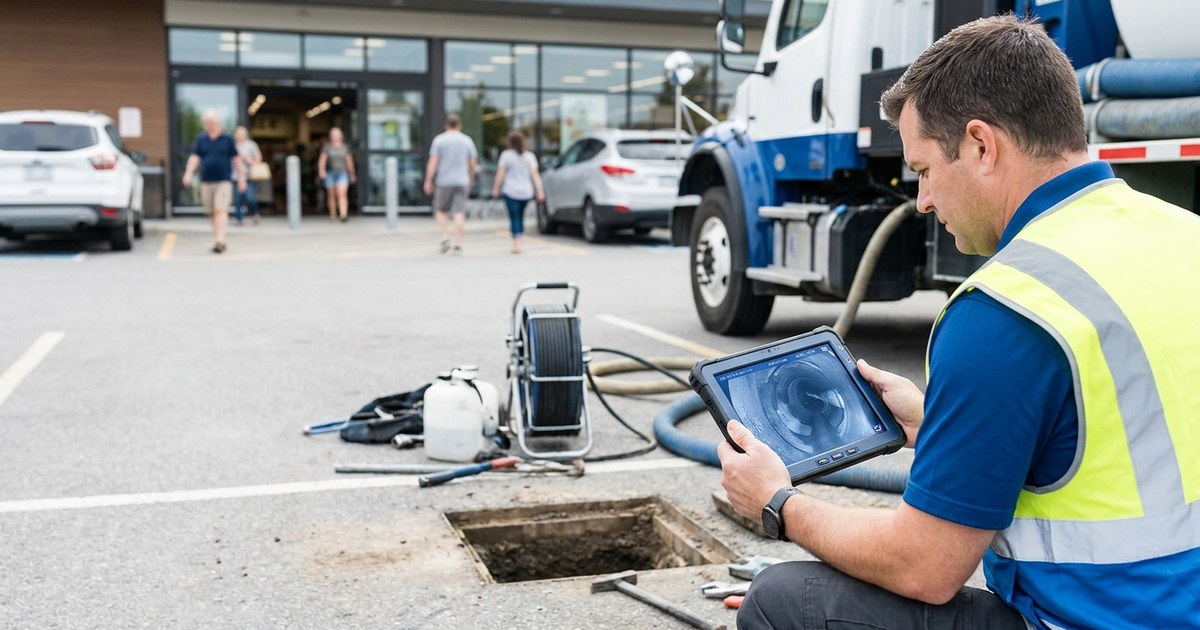
Most hospital checklists focus on supply water. The sanitary and sewer side gets forgotten until a backup. Our in-house camera inspection and jetting crews mean drain and sewer diagnosis does not wait on a subcontractor. For the building's drainage lines and sewer connections, see our sanitary system and sewer line services.
Put drains in the schedule, with camera inspection where history shows repeat problems. A scheduled jetting visit is cheaper than a sewage event near a care area.
Some signs mean inspect now, not at the next interval:
Our guide to the warning signs your system needs inspection covers each one. Log the sign, the inspection and the fix.
Takeaway: a risk-tiered schedule with documented reasons for each interval is easier to defend than a single calendar for the whole building.
Keep backflow test reports, water management program records, temperature and flushing logs, maintenance work orders, repair histories and as-built drawings. Each record should show who did the work, when, what they found and how problems were corrected.
Here is the working record set:
"Good" means each entry answers four questions: who did the work, when, what they found and how it was corrected. A record that says "serviced, OK" will not satisfy a careful surveyor.
In our work with Columbus commercial facilities, every service visit is logged with findings and corrective action in ServiceTitan, so the maintenance history is retrievable on request. All PDP work is licensed, insured and documented for audit readiness.
The most common objection is that records are spread across vendors. One vendor handling testing, maintenance and repair means one accountable record instead of several fragments. See how to build a compliance-ready plumbing record system.
Takeaway: the record that wins a survey shows the who, when, what and fix for every entry, in one place.
Treat every plumbing repair in a care area as an infection control event. Run an infection control risk assessment before opening walls or shutting water. Plan alternate water and fixtures for patients. Use a vendor who can respond around the clock.
An infection control risk assessment (ICRA) looks at the work, the patients nearby and the controls needed, such as barriers and airflow. The CDC's environmental infection control guidelines (HICPAC, 2003, updated 2019) cover the principles. Your infection prevention team sets contractor rules for care areas, so build your vendor planning around them.
Plan before the failure:
Response proof is the third layer. Log the failure, the response time, the repair and the follow-up check. Review the incident like any other event.
PDP runs a 24/7 emergency line at 614-758-6237, with transparent pricing and no after-hours or weekend fees for PlumbGuard clients. That removes the penalty for a night call. Our in-house hydro excavation and trenchless crew means sewer failures do not wait on subcontractors. See the commercial plumbing failures facilities see most and how each is fixed.
Takeaway: emergency planning for a care area happens before the failure, and the log afterward is your response proof.
Use this as a template, not a fixed schedule. Your own program and local authority set the real dates. PDP's PlumbGuard scope covers many of these tasks, but the calendar is a planning tool, not a contract schedule.
| When | Task | Proof Stack layer |
|---|---|---|
| Quarter 1 | Audit last year's records. Schedule annual certified backflow tests ahead of your provider's deadline. | Interval |
| Quarter 2 | Water heater inspection and temperature review. Pipe and leak inspection in critical care areas. | Design, Interval |
| Quarter 3 | Drain, grease and sanitary service. Camera inspection where history shows repeat problems. | Interval |
| Quarter 4 | Pump system testing and fixture inspection. Year-end record audit and gap list. | Interval |
| Ongoing | Temperature and flushing logs per your program. Log every failure, response and follow-up. | Response |
If you want this cadence delivered under one agreement, see a PlumbGuard™ preventive maintenance contract built around your facility type and risk profile.
Takeaway: a calendar turns healthcare facility plumbing compliance from an annual scramble into routine operations.
Healthcare facility plumbing compliance depends on all three, and the records tie them together. A one-off repair does not deliver it. Interval discipline and one accountable record do.
Standards and local rules change. Confirm requirements with your authority having jurisdiction, your water provider and your infection prevention team. This guide is not legal or engineering advice.
If you have a backflow test coming due, want a PlumbGuard™ maintenance schedule built for your commercial healthcare facility, or need a 24/7 emergency response plan, start with a quote.
Book a service request or consultation. We respond quickly and operate to professional service standards.
We’re Happy to Confirm
If your property is located in or around the Greater Columbus area and you don’t see your city listed, our team can quickly confirm coverage and service options.