2026-10-30
14
min read

Commercial water treatment filtration systems clean, soften, or condition a facility's water supply to protect pipes, water heaters, fixtures, and the people who use them. The right system starts with a water quality test, matches treatment to the problem found, and is maintained on a documented schedule.
Bad water shows up as operations problems first. A water heater scales up and fails early. Aerators clog. The same fixture gets serviced for the third time. When a kitchen, clinic, or tenant restroom cannot stop running, nobody has time to ask whether the cause is the water or the pipes. The pattern shows up in the common commercial plumbing problems and their fixes that facility managers see every year, and water quality sits behind more of them than most teams realize.
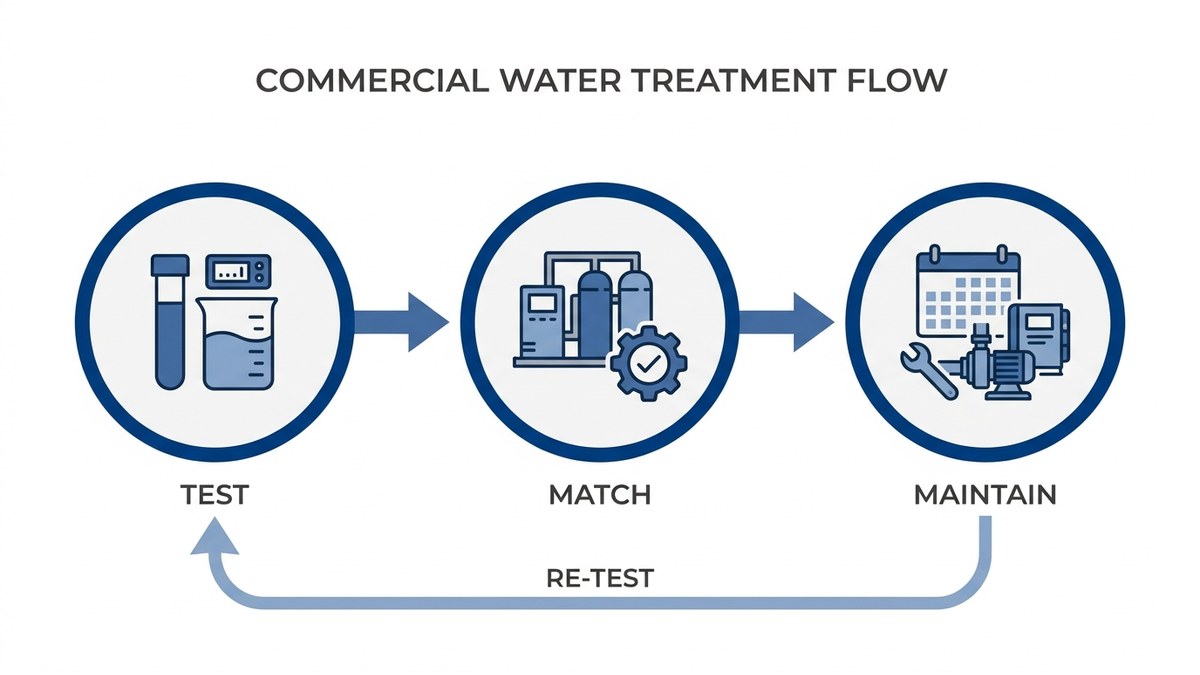
This guide to commercial water treatment filtration systems follows a simple sequence: test, match, maintain. Test the water first. Match treatment to what the test shows and to your type of facility. Then keep the system on a documented service schedule so it never becomes one more thing you have to babysit.
Commercial water treatment filtration systems remove or reduce contaminants and minerals in a building's water. Common types include sediment filters, carbon filters, softeners, and reverse osmosis. They protect plumbing and equipment, and they improve water quality where staff, customers, or processes use it.
At PDP, commercial water treatment filtration systems are part of our commercial plumbing service scope, not a side product. Our commercial water treatment systems service sits alongside repair, inspection, and backflow work because the same water moves through all of it. We work on commercial facilities only, and our commercial water systems work follows that same logic.
Here is what treatment protects:
A building's plumbing is an interacting system. Pipes, water heaters, fixtures, drains, and backflow assemblies all share the same water, so a change in one part affects the others. A filter that slows flow, for example, can change pressure and how long water sits in the lines. That is why treatment belongs in the plumbing plan, not beside it. If one team installs a filter, another services the water heater, and a third tests backflow, nobody owns the whole picture.
Takeaway: Treat water as part of the facility's plumbing system, serviced by one accountable team, and not as a standalone gadget.
You know when the same equipment keeps failing and the pattern points to the water. Scale on fixtures and heaters, reduced flow, recurring clogs, and taste or odor complaints are the usual signs. Repeat repairs on the same equipment are the strongest signal.
Facility managers tell us the same thing: repeat calls with no known cause. A part gets replaced, and months later the same part fails. The invoices pile up, and no one can say whether the water or the plumbing is at fault. Name that problem first, because it changes how you act on it.
Watch for these symptoms:
None of these proves the water is the cause. Some of them point to a plumbing fault instead. Our signs a commercial plumbing system needs inspection article covers the wider list, including symptoms that look like water quality but are not.
Some of those symptoms can also come from a leak or a failing line. Reduced pressure, for example, may mean scale in the pipes or water escaping somewhere you cannot see. Non-invasive commercial leak detection helps rule that in or out. Camera inspection and pipe inspections do the same job for drain and supply lines. Separating a water-quality problem from a plumbing fault saves you from treating the wrong thing.
Once the evidence points to the water, the next step is a test. It is not a quote for equipment.
Takeaway: Repeat repairs on the same equipment are the clearest sign, and a plumbing inspection should rule out leaks and faults before you treat the water.
Commercial water quality testing samples water at the point of entry and at key points of use, then checks for hardness, sediment, chlorine, and other conditions. The results show which problem exists and where. Treatment is then matched to the problem instead of installed on a guess.
If you search for water quality testing commercial providers, you will find a wide range of offers. Before you evaluate any commercial water treatment filtration systems, keep the purpose simple: a test tells you what the water is doing to your building, so you buy only the treatment you need. In the Backflow Testing, Compliance & Commercial Water Systems work we do, testing is where every good water decision starts.
Sample in two kinds of places:
Comparing the two tells you something a single sample cannot. If the water is fine at entry and poor at a point of use, the cause may be inside the building, such as old piping, a dead leg, or a stagnant section. That points to a plumbing fix, not a filter.
A test is a snapshot. It shows conditions on the day water was sampled, at the places you sampled. It can show hardness, sediment, chlorine, and other readings. It cannot explain every symptom, and it will not predict every change in the supply. Some conditions can be read on site. Others need a laboratory report. The method depends on the question you are asking.
Do not read regulatory thresholds into a result without checking the standard that applies to your facility. Healthcare and food service sites may have rules of their own, so confirm them before you set targets.
Plan to re-test. Water supplies change, and a system that fits today's results may need adjustment later.
A quote for commercial water treatment filtration systems written before a test is a guess. A system sized for the wrong problem wastes capital and may leave the real problem in place. Test first, then design. Treat only what the test shows.
This is our standard sequence in our work with commercial facilities: test, match, maintain. When a test points toward high-purity needs at specific points of use, our commercial water purification and reverse osmosis installation service is the next conversation. Ask us about the scope for your site.
Takeaway: Test at entry and at points of use, treat only what the results show, and never size a system before the test.
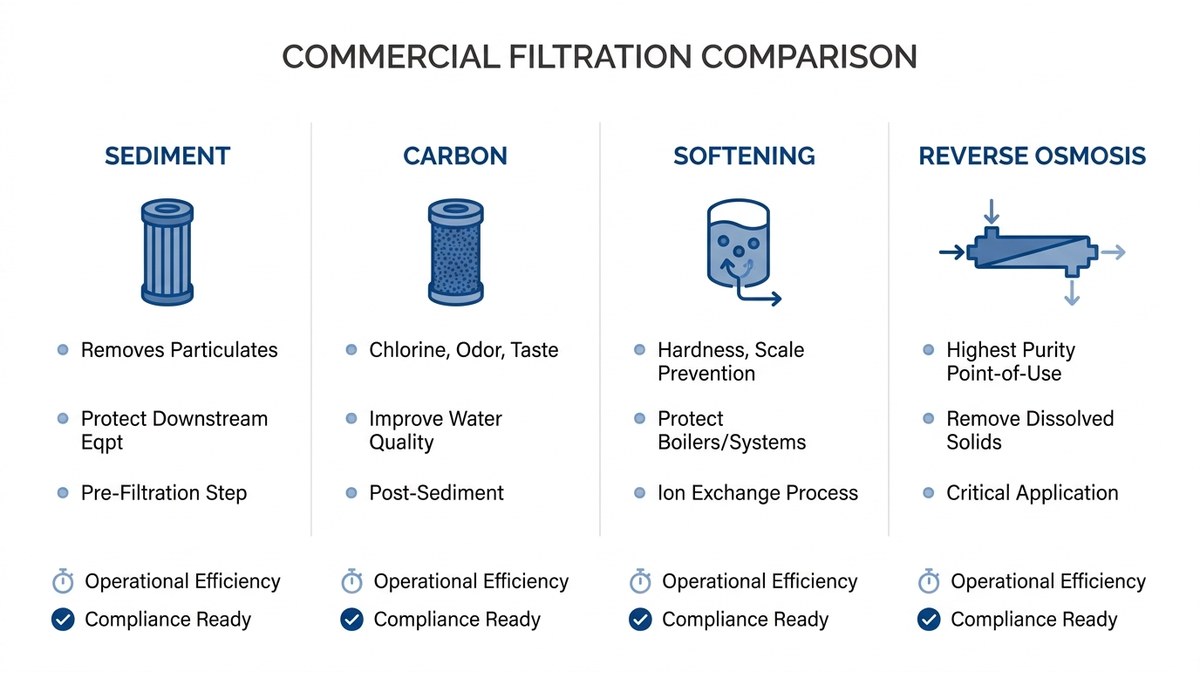
The main options are sediment filtration for particles, carbon filtration for chlorine, taste, and odor, softening for hardness and scale, and reverse osmosis for the highest purity at specific points of use. Many facilities combine two or three stages. Each option answers one problem, so the commercial water filtration options you choose should follow your test results.
Sediment filters catch particles such as sand, rust flakes, and silt. They protect everything downstream, including heaters, fixtures, and finer filters. They fit nearly any facility as a first stage. They need regular replacement, and a clogged sediment filter can restrict flow, so the schedule matters.
Carbon filters reduce chlorine, taste, and odor. Food service and hospitality sites often start here because staff and customers notice taste and smell. Carbon media wears out, and a spent filter stops doing its job without any visible warning. Replacement on a set interval is the answer.
Softeners reduce the minerals that cause hardness. Hardness is what leaves scale on heaters, fixtures, and equipment. For sites with repeated water heater failures, softening is often the stage that matters most. Softeners need salt or media upkeep and periodic checks to keep performing as designed. If you are weighing treatment against new equipment, see our commercial water heater installation service for how the two decisions connect.
Reverse osmosis (RO) pushes water through a very fine membrane to remove most dissolved material. It delivers the highest purity, so it usually serves specific points of use, such as ice machines, labs, or process equipment, instead of the whole building. Membranes and pre-filters need scheduled service. RO also produces waste water, so plan the drain connection.
Most commercial water treatment filtration systems are not a single device. They are a sequence: sediment first, then carbon or softening, then RO where purity matters. Order matters, because each stage protects the next.
| Option | Problem solved | Best-fit facility | Maintenance need |
|---|---|---|---|
| Sediment | Particles, rust, silt | Nearly any commercial site, as a first stage | Scheduled filter replacement |
| Carbon | Chlorine, taste, odor | Food service, hospitality, offices | Scheduled media or filter replacement |
| Softening | Hardness and scale | Sites with heaters, boilers, kitchens | Salt or media upkeep and checks |
| Reverse osmosis | Highest purity at specific points | Ice, labs, process equipment | Membrane and pre-filter service |
Takeaway: Pick stages by the problem each one solves, put them in order, and plan the maintenance for each one before you buy.
Choose by what the water has to protect or deliver. Food service prioritizes taste, ice, and equipment scale. Healthcare prioritizes consistent quality and compliance. Retail and office prioritize fixtures and water heaters. Industrial sites prioritize process equipment. Test results then set the stage design.
We do not run a separate program for each industry. The commercial water treatment filtration systems that suit a restaurant will differ from those for a clinic, but the sequence is the same for a restaurant owner, a property manager, or a healthcare facility: test, match, maintain. What changes is the stage design and the service frequency. In our PlumbGuard™ work, service frequency is customized per facility type and risk profile.
Kitchens run on water. Taste affects every dish and drink, ice machines need clean supply, and dishwashers and steamers scale up quickly. Carbon filtration and softening are common starting points, with RO on ice and beverage lines where purity matters. Grease and drain care belong in the same plan.
Clinics need consistent water quality and clear documentation. Interruptions are not an option, so maintenance schedules and records matter as much as the equipment. Compliance expectations vary by facility, so confirm the rules that apply before you set targets.
These sites care most about restrooms, fixtures, and water heaters. A clogged aerator in a tenant-facing restroom generates a complaint. For multi-site portfolios, a standard approach across buildings makes service, records, and budgeting simpler. One accountable vendor means one place to ask what was done, and when.
Process equipment, boilers, and wash systems depend on water conditions. The test should be tied to what that equipment needs. A general-purpose filter can miss the point entirely.
Heaters are where hard water shows itself first. Scale insulates heating surfaces, raises energy use, and shortens life. Many facilities treat the heater as the problem when the water is the cause. Our repair-versus-replace guidance for commercial water heaters helps you decide, and a water test tells you whether a new heater will face the same fate.
Takeaway: Match treatment to what your facility type must protect, then let the test set the stages.
Commercial water treatment filtration systems and backflow assemblies share the same water system, so plan them together. Any treatment installation or change should account for backflow compliance and testing deadlines. Adding a stage without checking the assemblies can create gaps in your records or in your protection.
This is where treatment connects to the Backflow Testing, Compliance & Commercial Water Systems side of our work. Backflow assemblies protect the public water supply from contamination. Treatment equipment changes the plumbing around those assemblies, so both need to be tracked together. The process is the same whether the site is a restaurant, a property portfolio, or a clinic.
For the testing side, see our certified backflow testing for commercial facilities service. Healthcare, food service, and other commercial facilities often have deadlines and documentation requirements.
If you need to plan your calendar, read how to meet your backflow testing deadline in Columbus. Schedule treatment work so it does not collide with a testing deadline, and keep the documents for both in one place.
Takeaway: Plan treatment changes and backflow testing together, and keep one record for both.
Water treatment ROI comes from avoided costs: fewer scale-related failures, longer equipment life, fewer emergency calls, and less downtime. Calculate it by comparing the cost of recurring water-related repairs against the cost of treatment and maintenance. Use your own service history as the baseline.
We do not quote payback periods or percentage savings here. Every facility is different, and any figure we gave you would be a guess. What we can give you is a way to build your own business case with your own numbers, and to judge whether commercial water treatment filtration systems fit your budget. We focus on commercial facilities only, so the model below is written for operations and facility budgets.
If recurring costs are small, treatment may not pay off, and a good test will show that. If they are large and repeated, treatment is easier to justify. The risk side matters too. See the consequences of ignoring commercial plumbing maintenance for what deferral can look like.
Being honest about this earns trust with owners and budget holders. A documented service history makes the case far stronger than any general claim.
Takeaway: Build the water treatment ROI case from your own repair, emergency call, and downtime records, and let a test decide whether treatment is worth it.
Put filters, softeners, and RO components on scheduled service intervals, record each visit and test result, and tie the schedule to your preventive maintenance program. Documented history proves compliance, speeds troubleshooting, and keeps treatment performing as designed.
This answers the objection we hear most: "Is this one more system I have to babysit?" It is not, if someone else owns the schedule and the paper trail. Commercial water treatment filtration systems only perform as designed when someone owns that schedule.
Service intervals and what gets recorded. Every treatment stage wears out in its own way. Sediment filters clog, carbon media is spent, softeners need upkeep, and RO membranes age. Set an interval for each stage based on the system design and the water test. Record the date, what was done, what was replaced, and any test result. When something fails, you can see what changed. When an inspector or owner asks, you have the answer.
One accountable vendor versus several. Coordinating a testing contractor, a treatment installer, a plumber, and a backflow tester creates gaps. Each one sees only part of the system, and the records end up in four places. In our work with commercial facilities, one in-house crew with owned equipment, a documented record of each visit in ServiceTitan, and one scheduled plan removes those gaps.
That is what PlumbGuard™ does. Service frequency is customized per facility type and risk profile, and it scales to multi-site portfolios. PlumbGuard clients get same-day service with no after-hours or weekend fees. Learn more about a PlumbGuard™ preventive maintenance contract and how it fits a facility's schedule. We are licensed and insured, and we have worked in Columbus for 11 years.
Takeaway: A set interval for each stage, a record of each visit, and one accountable vendor keep treatment from becoming one more system to babysit.
Commercial water treatment filtration systems pay off when they follow evidence. Start with a test at the point of entry and at key points of use. Match treatment to the problem the test shows and to what your type of facility has to protect. Then keep the system on a documented schedule, under one accountable team, tied to your backflow and preventive maintenance records.
If repeat repairs, scaled heaters, or clogged fixtures keep landing on your desk, a water assessment is the right first step. We can help you decide what to test, what to treat, and what to leave alone. Request a Quote
Book a service request or consultation. We respond quickly and operate to professional service standards.
We’re Happy to Confirm
If your property is located in or around the Greater Columbus area and you don’t see your city listed, our team can quickly confirm coverage and service options.


