9/3/26
8
min read
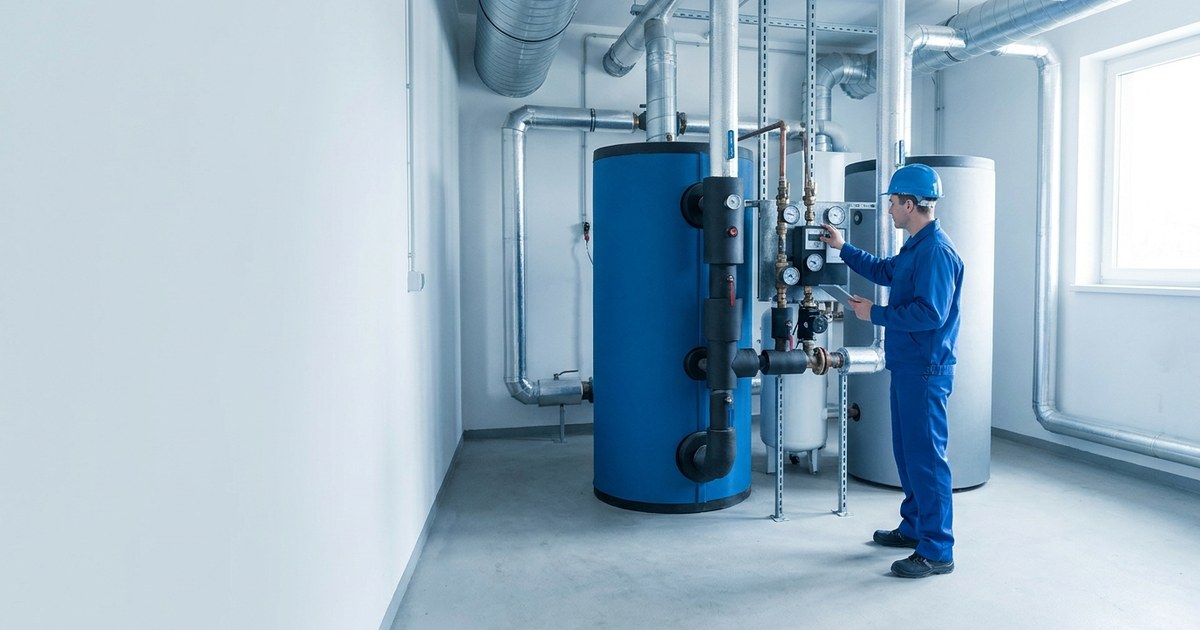
When a water heater fails in a commercial facility, the consequences cascade far beyond a broken piece of equipment. A restaurant without hot water faces health code violations and immediate closure. A healthcare facility compromises patient care standards. A multi-family property fields tenant complaints and potential lease violations. Facility managers who treat water heaters as disposable commodities (replacing on failure rather than managing through a documented lifecycle) pay emergency replacement premiums, inherit undersized or oversized systems for a decade, and expose their operations to preventable downtime.
Commercial water heater systems require lifecycle planning, not reactive replacement. Facility managers should schedule annual maintenance (anode rod inspection, pressure relief valve testing, sediment flushing), establish repair-versus-replace decision criteria based on age and failure type, right-size replacement units to current facility demand, and document all service for compliance and capital planning. Proactive management reduces emergency downtime and extends asset life, according to industry maintenance standards published by ASHRAE for commercial building mechanical systems.
This guide provides the operational framework facility managers need: a maintenance schedule that satisfies compliance audits, diagnostic criteria for repair-versus-replace decisions, a methodology for sizing replacement capacity, and a comparison of tankless versus traditional tank systems grounded in commercial facility reality. Shifting from reactive replacement to documented preventive service prevents the 2 a.m. emergency call and keeps facilities operational.
A failed water heater in a commercial facility triggers operational disruption that compounds hourly. Restaurants cannot operate without hot water for dishwashing and handwashing. Health departments mandate minimum temperatures at fixtures, and failure means immediate closure until the system is restored. Healthcare facilities face patient care disruption when hot water is unavailable for sanitation. Multi-family properties deal with tenant complaints, potential lease violations, and emergency service coordination across occupied units.
Emergency replacement decisions compound the problem. When a water heater fails outside business hours, facility managers face premium service rates, rushed equipment procurement, and sizing decisions made under pressure. A system installed during an emergency often locks in the wrong capacity for 10 to 15 years because no one conducted a demand assessment. The replacement matched the old unit's specifications, regardless of whether tenant mix changed, the facility expanded, or the original system was already undersized.
Based on our 11 years serving Columbus commercial facilities, emergency water heater calls that forced building closures and health code violations could have been avoided with annual anode rod inspection and sediment flushing. The operational cost of reactive replacement (downtime, emergency service premiums, compliance violations, wrong-sizing decisions) far exceeds the investment in preventive lifecycle management.
Facility managers accountable for uptime and capital planning cannot treat water heaters as invisible infrastructure until they fail. A documented maintenance program extends asset life, creates the compliance audit trail health inspectors and insurance auditors require, and informs capital replacement timing with data rather than crisis. The facilities that avoid emergency downtime are the ones that shifted to scheduled preventive service.
Reactive maintenance (calling a vendor when the water heater fails) leaves facilities exposed to preventable downtime and compliance gaps. A documented maintenance schedule prevents the majority of failures, satisfies health department and insurance compliance audits, and creates the service history that informs capital replacement decisions.
Every commercial water heater requires annual service. Annual tasks include anode rod inspection and replacement, pressure relief valve testing, sediment flushing, burner inspection (gas units), heating element testing (electric units), and thermostat calibration.
The anode rod prevents tank corrosion by attracting corrosive elements in the water. When the rod depletes (typically after three to five years), the tank itself begins to corrode, leading to leaks and premature failure. Annual inspection catches rod depletion before it compromises the tank. Replacing an anode rod costs $150 to $300; replacing a corroded tank costs $3,000 to $15,000 plus downtime.
Pressure relief valves prevent dangerous pressure buildup. Testing the valve annually ensures it opens and reseats properly. A stuck valve can cause tank rupture; a leaking valve indicates excessive pressure or expansion tank failure.
Sediment accumulates at the bottom of storage tanks, reducing effective capacity, insulating the heating element or burner from the water (decreasing efficiency), and accelerating corrosion. Annual flushing removes sediment before it hardens. Facilities in hard-water areas may require semi-annual flushing. Regular cleaning of commercial piping infrastructure prevents long-term system degradation.
Burner inspection (gas units) ensures proper combustion, identifies soot buildup, and confirms venting integrity. Heating element testing (electric units) measures resistance and identifies elements approaching failure. Thermostat calibration verifies that the unit maintains the correct temperature, critical for health code compliance in food service and healthcare.
Restaurants, healthcare facilities, gyms, and multi-family properties with laundry rooms operate water heaters at higher duty cycles than office buildings or retail spaces. These facilities benefit from semi-annual maintenance: drain and flush the tank, inspect for visible leaks or corrosion, test the expansion tank (if installed), and verify temperature consistency across fixtures.
The increased service frequency prevents sediment buildup from hardening, catches minor leaks before they escalate, and identifies capacity issues early.
Maintenance logs satisfy health department inspections, insurance audits, and capital planning analyses. Each service visit should document the date, tasks performed, parts replaced, observations (corrosion, sediment volume, pressure readings), and technician credentials. Facilities operating under documented service programs receive digital service records stored in a centralized system accessible during audits.
Documented maintenance history also informs repair-versus-replace decisions. A unit with consistent annual service and minimal repair history justifies continued operation; a unit with escalating repair frequency signals approaching end-of-life.
Facility managers face a critical decision when a water heater fails: repair the existing unit or replace it entirely. The wrong choice wastes capital (premature replacement) or sinks money into a failing asset (repairing a unit near end-of-life). A structured diagnostic framework eliminates guesswork.
Cause: Thermocouple failure, gas valve malfunction, or venting obstruction. The thermocouple senses pilot flame and signals the gas valve to remain open; when it fails, the valve closes as a safety measure.
Repair cost: Replacing a thermocouple costs $150 to $300 in parts and labor. Cleaning a venting obstruction or replacing a gas valve adds $200 to $500.
Repair versus replace: If the unit is fewer than eight years old and shows no other symptoms (slow recovery, visible corrosion, leaks), repair makes economic sense. If the unit is older than 10 years and the pilot failure coincides with other issues, replacement avoids investing $500 in an asset with limited remaining life.
Cause: Sediment buildup reduces effective tank capacity by insulating the heating element or burner from the water. An undersized system for current facility demand (tenant mix changed, facility expanded) also produces insufficient hot water. Failing heating elements (electric units) or burner issues (gas units) reduce heat transfer.
Repair cost: Flushing sediment costs $150 to $250. Replacing heating elements costs $200 to $400. Cleaning or replacing a burner costs $300 to $600.
Repair versus replace: If the cause is sediment, flush the tank and implement semi-annual flushing going forward. If the unit is undersized for current demand, repair does not solve the problem. Replacement with a properly sized unit is necessary. If heating elements or the burner have failed and the unit is older than 10 years, replacement avoids repeated component failures as the system ages.
Cause: A leaking pressure relief valve indicates excessive pressure, expansion tank failure, or a defective valve. A leaking tank indicates corrosion. The anode rod depleted, and the tank itself has corroded through.
Repair cost: Replacing a pressure relief valve costs $100 to $200. Installing an expansion tank costs $200 to $400.
Repair versus replace: A leaking valve is repairable. A leaking tank is not. Tank leaks require immediate replacement to prevent water damage, mold growth, and facility closure. No amount of repair can restore a corroded tank. Emergency replacement under these conditions often means accepting the first available unit rather than right-sizing capacity, so preventive maintenance that catches anode rod depletion before tank failure becomes critical.
Cause: Anode rod depletion allows tank corrosion, releasing rust and sediment into the water. Bacterial growth in the tank (common in units with long idle periods or low-temperature settings) produces sulfur odors.
Repair cost: Replacing the anode rod and flushing the tank costs $200 to $400. Disinfecting the tank with hydrogen peroxide adds $100.
Repair versus replace: If caught early, anode rod replacement and tank disinfection restore water quality. If corrosion has progressed to the point where the tank is structurally compromised, replacement is necessary.
Facility managers can apply a simple decision framework:
Facilities operating with professional commercial plumbing services rely on transparent diagnostics that present the full lifecycle cost comparison, not just the immediate repair quote.
Sizing a commercial water heater correctly is the most important decision in replacement planning. An undersized system creates chronic operational disruption: insufficient hot water, tenant complaints, health code violations. An oversized system wastes capital on unnecessary capacity and energy on heating water that sits unused (standby loss). Yet most replacement decisions default to matching the old unit's specifications without assessing current demand, resulting in a decade of capacity mismatch.
Commercial water heater sizing begins with calculating peak hourly demand: the maximum gallons of hot water the facility requires in a single hour during the busiest period. This figure must match or exceed the unit's first-hour rating (FHR), which measures the gallons of hot water the system can deliver in the first hour starting with a full tank.
Restaurant example: A three-bay sink requires 20 gallons per hour during peak dishwashing. A commercial dishwasher requires 15 gallons per hour. Handwash sinks across the kitchen and restrooms require five gallons per hour. Peak hourly demand totals 40 gallons. The water heater's FHR must meet or exceed 40 gallons to avoid mid-service hot water depletion.
Multi-family property example: A 10-unit building with morning shower overlap. Assume 10 showers at 2.5 gallons per minute for 10 minutes during the 7 to 8 a.m. peak. Total demand in that hour: 10 showers times 2.5 gallons per minute times 10 minutes equals 250 gallons. The water heater must deliver a 250-gallon FHR or implement a multi-unit cascade system.
Office building example: Low demand. Restroom handwashing peaks at 15 gallons per hour during shift changes. A small-capacity unit suffices unless the facility includes a kitchen, gym, or shower facilities.
The FHR calculation accounts for both stored capacity and the rate at which the unit reheats water during draw. A 50-gallon tank with a high recovery rate may deliver a 70-gallon FHR; a 50-gallon tank with a low recovery rate may deliver only a 55-gallon FHR. Manufacturers publish FHR data for each model.
Recovery rate measures the gallons per hour the unit can reheat after the stored hot water is depleted. Facilities with continuous demand throughout the day (restaurants during lunch and dinner rushes, gyms during peak hours, healthcare facilities with 24/7 operation) require high recovery rates to sustain back-to-back hot water events.
Gas water heaters recover faster than electric units due to higher BTU input. A commercial gas unit may recover 40 to 100 gallons per hour; a comparable electric unit may recover 15 to 25 gallons per hour. Facilities with high continuous demand should prioritize recovery rate over tank size.
Bigger is not always better. Oversized tanks cost more upfront, cost more to operate (standby heat loss increases with tank volume), and do not improve performance if the recovery rate already meets demand. A 100-gallon tank with a 40-gallon-per-hour recovery rate delivers the same sustained output as an 80-gallon tank with a 40-gallon-per-hour recovery rate, but the larger tank wastes energy heating the additional 20 gallons continuously.
Accurate demand calculation prevents oversizing. Facilities that have expanded, changed tenant mix, or added high-demand fixtures since the last replacement should conduct an on-site assessment rather than assuming the old unit's capacity was correct. Service teams should calculate FHR and recovery rate requirements based on current fixture counts and usage patterns, not historical assumptions.
The sizing methodology applies whether the facility selects a traditional tank or tankless system. Demand calculation remains the foundation; system type determines how that demand is met.
The residential marketing around tankless water heaters ("endless hot water," "energy savings," "space savings") does not translate directly to commercial facility reality. Facility managers evaluating tankless versus traditional tank systems need an operational comparison grounded in duty cycle, infrastructure requirements, and total cost of ownership.
Advantages: Lower upfront cost. A commercial 50-gallon gas storage unit costs $1,200 to $2,500 installed; comparable tankless systems cost $3,000 to $6,000. Simpler installation with no infrastructure upgrades required. Proven reliability across decades of commercial use. High first-hour capacity for peak demand events. A 100-gallon tank can deliver 120 to 150 gallons in the first hour depending on recovery rate.
Disadvantages: Standby heat loss. The unit continuously heats stored water even when no one is drawing hot water, wasting energy. Finite hot water supply during extreme peak events. Once the tank depletes, users wait for recovery. Larger footprint than tankless units. Service life of 10 to 15 years.
Best applications: Facilities with predictable, concentrated peak demand. Restaurants that need 200 gallons during a two-hour dinner service but minimal demand overnight. Multi-family laundry rooms with morning and evening peaks. Gyms with post-work shower rushes. The upfront cost advantage and high FHR capacity make storage tanks the default choice for most commercial facilities.
Advantages: No standby heat loss. The unit heats water only when a fixture opens, reducing energy consumption in low-demand facilities according to Department of Energy efficiency studies. Unlimited hot water as long as flow rate does not exceed unit capacity. Longer service life (20-plus years with proper maintenance). Smaller footprint. Wall-mounted units free mechanical room space.
Disadvantages: Higher upfront cost (two to three times the cost of a comparable storage unit). Flow rate limitations measured in gallons per minute. A residential-grade tankless unit may deliver six to eight gallons per minute; a commercial unit delivers 10 to 15 gallons per minute. Multiple simultaneous fixtures can exceed capacity. Requires larger gas line or electrical service. Most facilities need infrastructure upgrades to support the BTU or amperage demand. More complex maintenance. Descaling is necessary in hard-water areas; skipping maintenance voids warranties and reduces efficiency.
Best applications: Facilities with distributed, low-intensity demand. Small office buildings where handwashing is the primary use. Retail spaces with minimal hot water needs. Facilities prioritizing energy efficiency and willing to invest the upfront premium. Tankless systems are not ideal for high-peak-demand environments (large restaurants, healthcare, multi-family) unless installed in a multi-unit cascade array, which multiplies cost.
Some facilities implement a hybrid approach: a tankless system handles baseline demand, supplemented by a small storage tank for peak buffering. This configuration captures the energy efficiency of on-demand heating while providing reserve capacity for short-duration peaks. The approach works well in hotels, schools, and facilities with predictable but variable demand.
The tankless-versus-traditional decision hinges on accurate demand profiling and infrastructure assessment. Facilities that cannot support the gas line or electrical upgrades tankless requires should default to high-efficiency storage tanks. Facilities with low, distributed demand and infrastructure capacity to support tankless installation gain the most from the technology.
Water heater installation and operation in commercial facilities are governed by health department regulations, building codes, mechanical codes, and occupational safety standards. Facility managers are accountable for compliance; vendors who install or service water heaters without understanding these requirements expose facilities to violations during inspections.
Health departments mandate minimum hot water temperatures at fixtures in food service and healthcare facilities. Most jurisdictions require 120 degrees Fahrenheit at handwash sinks and dishwashing stations to meet sanitation standards. However, OSHA mandates maximum temperatures below 120 degrees Fahrenheit at employee-accessible fixtures to prevent scalding injuries. Facilities reconcile these conflicting requirements by installing thermostatic mixing valves that blend hot and cold water to deliver safe temperatures at point-of-use while maintaining higher storage temperatures for sanitation.
Temperature compliance is not optional. Health inspectors test water temperature at fixtures during routine inspections; failure results in violations that can trigger closure orders in food service. Facilities must document temperature settings and mixing valve installation as part of compliance records.
Water heater installations must include backflow prevention devices where the system connects to potable water. Backflow preventers stop contaminated water from reversing into the municipal supply. Local codes specify device type and testing frequency. Most jurisdictions require annual backflow device testing by a certified technician. Cross-connection control programs enforce this requirement; violations result in fines and service disconnection.
Most jurisdictions require expansion tanks on closed-loop water heating systems. When water heats, it expands; in a closed system (where a backflow preventer or check valve prevents expansion from pushing back into the municipal supply), pressure builds. An expansion tank absorbs the increased volume, preventing pressure relief valve discharge and extending system life. Skipping expansion tank installation violates code and voids equipment warranties.
Gas water heaters require proper venting to exhaust combustion gases safely. Venting must meet NFPA 54 (National Fuel Gas Code) and local mechanical code requirements. Improper venting creates carbon monoxide risk, a life-safety issue that triggers immediate shutdown orders during inspections. Venting systems require clearances from combustible materials, proper termination (outdoors, above roof line or through a sidewall with adequate clearance), and regular inspection for obstructions or corrosion.
Health inspectors, insurance auditors, and building officials require dated service records documenting temperature settings, backflow device testing, venting inspections, and maintenance tasks. Facilities without documentation face violations even if the equipment operates correctly. Vendors who provide digital service records satisfy this requirement; transactional service calls without documentation leave compliance gaps.
Operating under contracts with professional service providers ensures that installations meet code, service includes compliance documentation, and annual backflow testing and maintenance logs are delivered on schedule.
Commercial water heater service demands more than equipment repair. Facility managers need vendors who understand operational consequences, provide transparent diagnostics, document service for compliance, and respond to emergencies without after-hours penalties. The service model must align with facility accountability, not transactional service calls.
When a water heater fails Friday night in a restaurant, waiting until Monday is not an option. Health codes require hot water; closure means lost revenue and staff sent home. Emergency response must be immediate and predictable. Our emergency line operates 24/7 with transparent pricing: no surcharges for weekend or overnight service. In-house licensed technicians respond directly; we do not subcontract emergency calls to third-party vendors who add markup and coordination delays.
We own the work. Every technician on a service call is a PDP employee, licensed and insured, operating from our owned equipment inventory. There are no subcontracting delays, no finger-pointing between vendors, and no coordination overhead. Facility managers deal with one accountable partner for diagnostics, repair, replacement, and documentation.
Reactive service calls do not build the compliance documentation facility managers need. PlumbGuard preventive maintenance contracts schedule annual or semi-annual water heater service, deliver digital service records stored in a centralized system, and create the audit trail health inspectors and insurance auditors require. Regular cleaning protocols for commercial infrastructure prevent the majority of emergency failures and allow capital replacement planning based on documented equipment condition rather than crisis response.
When a water heater fails, we present the full picture: repair cost, remaining useful life based on equipment age and condition, replacement cost, right-sized capacity for current demand, and total cost of ownership over the next 10 years. We do not upsell replacements on units with significant remaining life; we do not recommend repairs that sink money into assets approaching end-of-life. Facility managers receive the data to make informed capital decisions.
We calculate first-hour rating and recovery rate requirements based on your facility's actual fixture counts, usage patterns, and peak demand periods. Replacement recommendations specify capacity, recovery rate, and whether storage or tankless systems fit your operational profile and infrastructure. No guesses, no matching the old unit's capacity by default.
Service built for uptime means understanding that a water heater is not just equipment. It is the infrastructure that keeps your facility operational, compliant, and revenue-generating. Facilities operating across the Columbus service area rely on this accountability model to eliminate vendor coordination overhead and compliance gaps that come with transactional service relationships.
Facility managers who treat commercial water heaters as disposable commodities accept unnecessary operational risk. Reactive replacement locks in emergency service premiums, rushed sizing decisions, and compliance gaps. The operational cost (downtime, health code violations, tenant complaints, capital waste on wrong-sized systems) far exceeds the investment in proactive lifecycle management.
Lifecycle management starts with a documented maintenance schedule that prevents the majority of failures, creates the compliance audit trail required by health departments and insurance auditors, and informs capital replacement timing with data. It includes transparent diagnostic criteria for repair-versus-replace decisions that eliminate guesswork and align vendor recommendations with facility accountability. It requires sizing methodology that calculates demand rather than defaulting to the old unit's capacity. It means selecting the system type (tankless or traditional) based on operational profile, not marketing hype.
The facilities that avoid emergency downtime, maintain code compliance, and control capital spend are the ones that shifted from reactive firefighting to scheduled preventive service with a vendor partner who understands commercial facility operations. Properties across Reynoldsburg and the broader Columbus metro area have reduced unplanned water heater failures by implementing structured maintenance programs and working with service providers who extend accountability frameworks to commercial clients.
Ready to shift from reactive water heater failures to proactive lifecycle management? Schedule a facility assessment with Plumbing & Drain Professionals. We will evaluate your current system, calculate right-sized capacity for your demand, and build a maintenance plan that keeps your facility compliant and operational. Property managers looking for additional resources can explore insights in the PDP blog, review Dublin service area capabilities, or book an appointment.
Book a service request or consultation. We respond quickly and operate to professional service standards.
We’re Happy to Confirm
If your property is located in or around the Greater Columbus area and you don’t see your city listed, our team can quickly confirm coverage and service options.