2026-09-14
11
min read
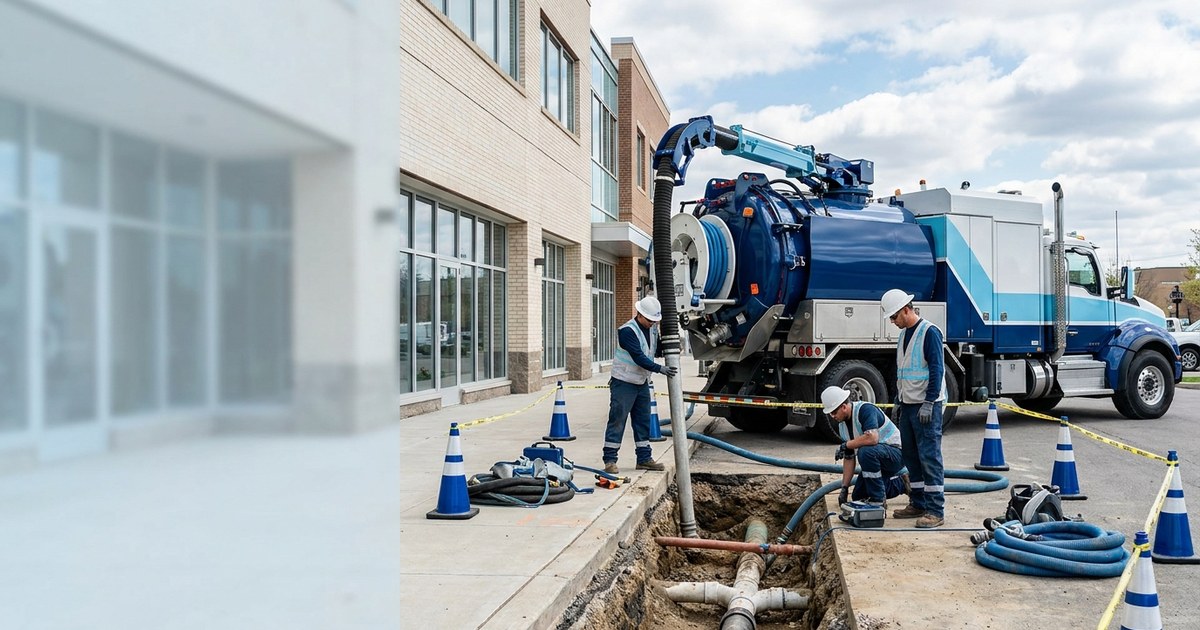
When a sewer line fails at a commercial property, every hour of downtime compounds. Facility managers who've navigated emergency repairs know the frustration: coordinating a plumbing contractor, then waiting for that contractor to book a third-party excavation crew, then managing handoffs between trades while tenants or operations sit idle. The question isn't whether excavation matters; it's whether the contractor you choose owns the excavation capability or farms it out.
What is the difference between in-house and subcontracted excavation? In-house excavation means the plumbing contractor owns and operates the excavation crew and equipment. Subcontracted excavation means the plumber hires a third-party excavation company to perform the work. In-house excavation contractors offer faster scheduling, clearer accountability, and better quality control because the same contractor manages both trades from start to finish.
This article breaks down the operational, quality, and accountability differences between in-house excavation contractors and those who subcontract the work, so you can evaluate bids with a clear understanding of what in-house capability delivers. Trusted plumbing services built on experience and accountability start with understanding how excavation capability shapes project outcomes.
In-house excavation means the in-house excavation contractor owns the excavation crew, equipment, and scheduling. When you hire a contractor with in-house capability, you're working with one team that manages both the plumbing repair and the physical excavation required to access underground infrastructure. That team controls the entire workflow, from camera inspection and hydro excavation to trenchless sewer replacement and final backfill.
The equipment involved isn't trivial. Hydro excavation trucks use high-pressure water and vacuum suction to expose underground utilities without damaging them. Trenchless sewer rigs allow pipe replacement with minimal surface disruption. Inspection cameras document pre-work conditions and post-repair integrity. Owning this equipment means a contractor can respond immediately when a facility manager in the Greater Columbus area calls with an emergency: no rental delays, no subcontractor availability gaps.
Subcontracted excavation flips this model. The plumbing contractor you hire doesn't own excavation equipment or employ excavation crews. Instead, they coordinate with a third-party excavation vendor who operates independently. The plumber manages the diagnosis and pipe work; the excavation subcontractor handles the digging, trenching, and site restoration. Two separate companies, two separate schedules, two separate accountability structures.
For routine residential work where excavation needs are infrequent, subcontracting makes sense. For commercial facilities where downtime has measurable cost and compliance deadlines are non-negotiable, the distinction becomes operationally significant.
Not every plumbing company that subcontracts excavation is cutting corners. The decision often comes down to capital allocation and business model. A hydro excavation truck costs upward of $300,000. Trenchless sewer replacement equipment adds another substantial investment. For contractors focused primarily on residential service calls or light commercial maintenance, that capital outlay doesn't pencil out when excavation jobs represent a small fraction of total revenue.
Licensing adds another layer. Excavation work in many municipalities requires separate permits, bonding, and operator certifications beyond standard plumbing licenses. A contractor who runs a lean operation may choose to partner with a specialized excavation vendor rather than build a second operational capability in-house.
The excavation subcontractor model works well when projects are planned months in advance, when scheduling flexibility exists, and when the facility manager has bandwidth to coordinate multiple vendors. It breaks down when a sewer line collapses on a Friday night, when a health inspection is Monday morning, or when a retail tenant's lease requires the landlord to restore service within 24 hours. Subcontracted excavation introduces scheduling dependencies that in-house excavation contractors don't face, and those dependencies translate directly into extended downtime.
Our proactive plumbing maintenance built for business continuity eliminates these dependencies by embedding excavation readiness into preventive service contracts, so facilities never wait for a third-party crew when time-sensitive work arises.
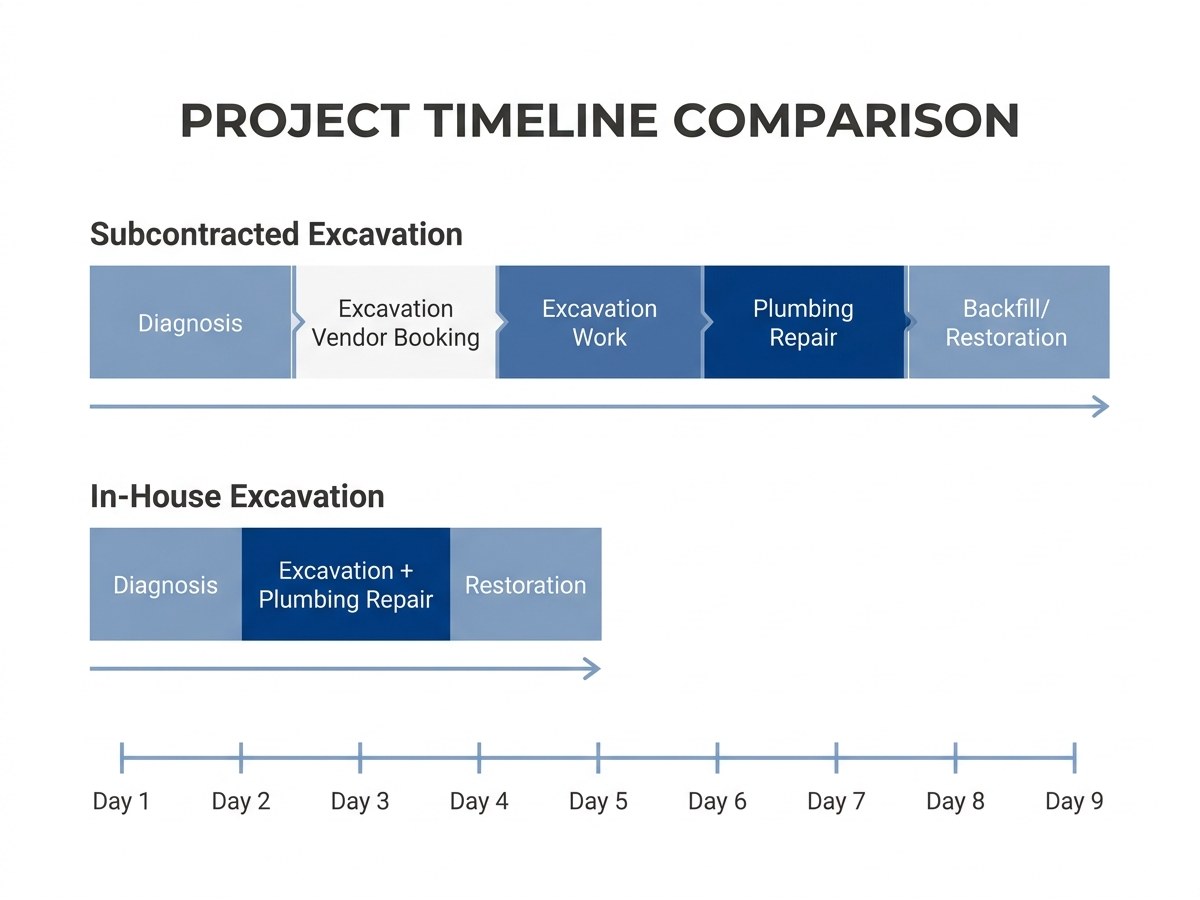
Scheduling friction is the silent cost of subcontracted excavation. A plumbing contractor diagnoses a collapsed sewer line on Monday. They call their excavation subcontractor, who quotes availability Thursday (weather permitting). Thursday's forecast shows rain, so excavation reschedules to the following Monday. The plumber can't start pipe work until the trench is open, so the facility sits idle for a week. Each handoff adds calendar days that a facility manager can't recover.
In-house excavation collapses that timeline. The same project manager who dispatches the camera inspection crew also controls the excavation schedule. When the diagnosis confirms a line replacement, the excavation team mobilizes the next morning: no vendor negotiation, no availability gaps. In our work with multi-unit property managers across Greater Columbus, we've reduced typical sewer line replacement timelines from 7 to 10 days (when subcontracted) to 3 to 5 days with our in-house excavation crew.
Emergency response amplifies this advantage. A grease interceptor backup at 2 a.m. on Saturday doesn't wait for a subcontractor's business hours. Facilities operating under health department regulations can't afford multi-day delays when leak detection requiring immediate response or line repair becomes urgent. In-house crews operate on the same 24/7 availability as the plumbing team because they are the plumbing team. No after-hours coordination penalty, no "we'll call our excavation partner Monday morning" delays.
Weather and permit logistics also compress. When rain delays excavation, an in-house crew reallocates to other facility work and returns to the trench as soon as conditions allow. Subcontractors juggle multiple clients; a one-day weather delay often becomes a three-day reschedule because the crew moved on to another job. Permit timelines stay tighter when one contractor submits a unified work plan rather than coordinating permit applications across two separate companies.
Sewer excavation quality failures surface months later, when backfill settles and pavement cracks, or when a utility line nicked during trenching causes a secondary failure. By then, the excavation subcontractor has moved on. The plumber points to the excavation vendor's workmanship. The excavation vendor points to the plumber's scope definition. The facility manager is left managing a warranty dispute between two companies, neither of whom wants to own the rework.
In-house excavation eliminates that finger-pointing. When the same contractor owns both the plumbing repair and the excavation, their license and reputation are on the line for the entire job. There's no ambiguity about who's responsible for proper backfill compaction, utility locate accuracy, or trench safety compliance. Our licensed in-house team operates under one quality standard because every phase of the work, from camera inspection through final restoration, reflects on the same company.
Documentation unifies under this model. Every excavation and plumbing phase is documented in ServiceTitan, giving facility managers a unified compliance record instead of juggling separate invoices from multiple vendors. When an auditor or inspector asks for proof of work, you hand over one file with timestamps, crew certifications, and photo documentation from start to finish. Subcontracted projects generate fragmented records: the plumber's invoice covers their scope, the excavation vendor's invoice covers theirs, and no single document ties the two together.
Training and standards consistency also matter. In-house excavation crews train alongside plumbing technicians, so they understand the tolerances and clearances plumbers need. An excavation subcontractor's crew may prioritize speed over the precise trench dimensions required for trenchless pipe bursting or proper pipe bedding. That misalignment shows up in callbacks and rework.
Liability coverage simplifies. One contractor carries one insurance policy covering excavation and plumbing work. If property damage occurs, the facility manager files one claim with one carrier. Subcontracted work splits liability: the plumber's policy may exclude excavation-related damage, pushing the facility manager to pursue the excavation vendor's insurance separately.
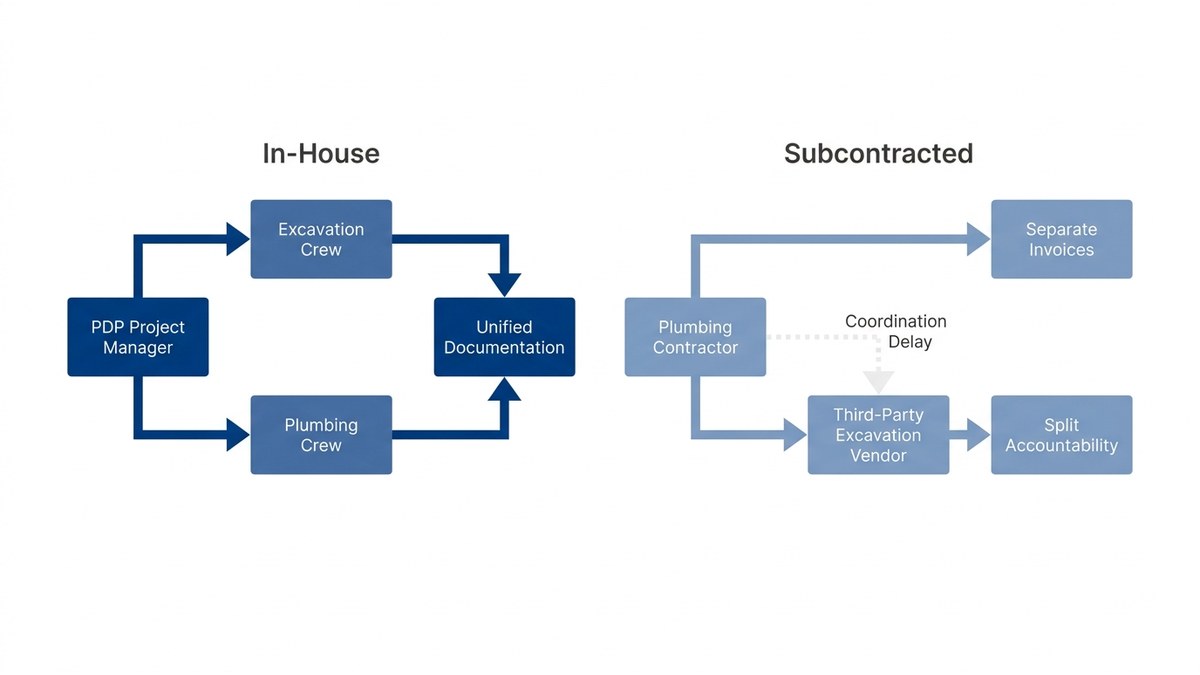
Subcontracted excavation pricing appears as a pass-through line item on the plumber's invoice: "Excavation services: $4,200 (subcontractor fee)." The facility manager sees a number but no breakdown of what that fee covers: hourly labor rates, equipment rental, disposal costs, or the markup the plumber added to the subcontractor's quote. If the excavation runs longer than estimated or hits unexpected conditions, change orders arrive with no transparent basis for the additional cost.
In-house pricing eliminates that opacity. The in-house excavation contractor quotes the full scope (plumbing repair plus excavation) with itemized labor, equipment, and materials. When site conditions change, the facility manager sees exactly what the additional work entails and what it costs. No hidden vendor fees, no markup on a subcontractor's markup. You're paying for the work, not for coordination overhead between two companies.
Cost control improves when real-time method decisions stay in-house. A trenchless pipe bursting approach costs more upfront than open-cut trenching but eliminates expensive surface restoration. If excavation is subcontracted, that decision requires renegotiating scope with the excavation vendor, delaying the project while the plumber waits for a revised quote. In-house crews make that call on-site, adjusting method based on actual conditions without scheduling a second vendor conversation.
Budget predictability matters most on preventive maintenance contracts. Facilities operating under scheduled service agreements need to know excavation availability and cost won't fluctuate based on a subcontractor's workload or equipment rental rates. In-house capability locks in pricing because the contractor's equipment and crew costs are fixed, not variable based on third-party availability.
Emergency sewer repairs top the list of scenarios where in-house excavation capability matters. A collapsed line during business hours already costs revenue; waiting three days for an excavation subcontractor to become available multiplies that loss. In-house crews respond within hours, not days, because excavation equipment and operators are on standby for exactly these calls.
Projects with compliance deadlines can't absorb subcontractor scheduling friction. A backflow prevention device replacement tied to a municipal inspection deadline, a grease interceptor repair required before a health permit renewal, or sewer line repairs mandated by local water infrastructure ordinances demand timeline certainty. Subcontracted excavation introduces variables the facility manager can't control.
Multi-phase property management work benefits from crew consistency. A facility manager overseeing a portfolio of commercial buildings schedules sewer line inspections across six properties over two months. With in-house excavation, the same crew that performs camera inspections also handles any repairs identified, maintaining continuity in workmanship, documentation, and institutional knowledge of each property's infrastructure. Subcontractors rotate based on availability; the crew that inspects Property A in week one may not be the crew that repairs Property B in week six.
High-downtime-cost facilities (healthcare, food service, data centers) cannot tolerate extended outages. A hospital can't wait five days for excavation to start on a sewer line serving a surgical wing. A restaurant loses thousands in daily revenue when a grease line repair stretches across a week because the plumber and excavation vendor can't synchronize schedules. In-house excavation compresses those timelines to the technical minimum.
Facilities operating in dense urban environments with limited access also gain advantage. Tight site conditions require excavation and plumbing crews to work in coordinated sequence: digging, piping, backfilling in carefully timed phases to minimize surface disruption and maintain pedestrian or vehicle access. Subcontracted excavation adds communication overhead to that coordination; in-house teams execute it as one unified operation because the project manager controls both crews directly.
Plumbing services across the Greater Columbus area require this level of coordination when site access is restricted or when multiple properties need service within a compressed timeline.
Facility managers evaluating bids for excavation-dependent plumbing work should ask specific questions that reveal whether a contractor's "excavation services" are genuinely in-house or subcontracted under a unified invoice. Start with ownership: Does the contractor own the excavation equipment, or do they rent or subcontract it? If they own it, ask what equipment types they operate (hydro excavation trucks, trenchless sewer rigs, vacuum excavation systems) and whether those assets are dedicated to their operation.
Licensing and insurance questions follow. Who carries the excavation crew's licensing and insurance coverage: the plumbing contractor or a third-party vendor? If excavation is subcontracted, does the subcontractor carry separate liability coverage, and is the facility manager named as an additional insured on both policies?
Documentation standards matter. Ask how excavation work is tracked and documented. Is it logged in the same project management system as the plumbing work, with unified timestamps and crew accountability? Or does excavation documentation arrive as a separate invoice with no integration into the plumbing contractor's records? Unified documentation simplifies compliance audits and warranty claims.
Timeline expectations need clarity. What is the typical start-to-finish timeline for a sewer line replacement or excavation-dependent repair? If the contractor subcontracts excavation, ask what their average scheduling lead time is for securing excavation crew availability. A vague "we coordinate with our excavation partners" answer is a red flag; an in-house excavation contractor quotes specific timelines because they control the schedule.
Method flexibility is another indicator. Can the contractor perform both hydro excavation (for precision utility locating) and trenchless pipe replacement (for minimal surface disruption), or do they rely on subcontractors to provide those capabilities? Contractors with owned equipment can offer method flexibility.
Emergency response capability reveals true in-house capacity. Ask whether the contractor provides 24/7 excavation response or whether emergency calls require waiting for a subcontractor's availability. If the answer involves "we'll contact our excavation partner and get back to you," that's subcontracted capability, not in-house readiness.
Finally, ask for references specific to excavation-dependent projects. A contractor's plumbing references don't tell you whether their excavation capability performed well. Request contacts from facility managers who've worked with the contractor on sewer line replacements, trenchless installations, or emergency excavation repairs.
Residential plumbing services for Greater Columbus homeowners and commercial facilities alike benefit when excavation capability is verified upfront rather than discovered mid-project.
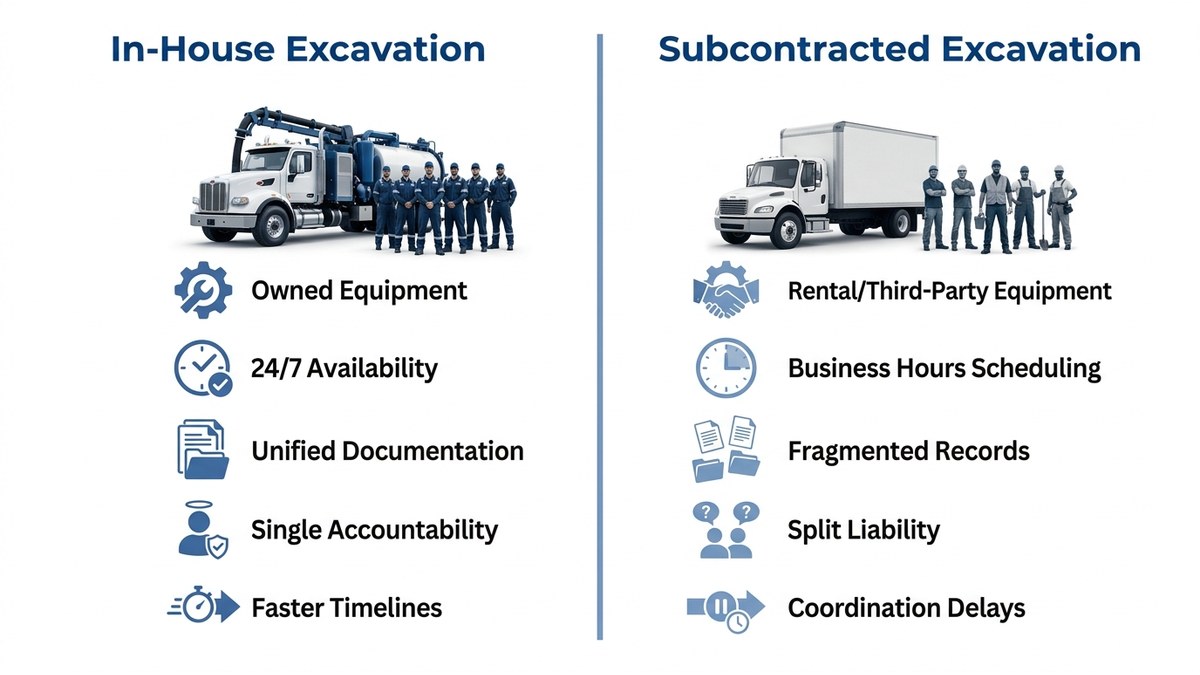
Facility managers choosing between in-house excavation contractors and those who subcontract the work are making a decision about operational control, not just service scope. In-house teams compress project timelines by eliminating coordination delays, unify quality standards by putting one contractor's reputation on the line for the entire job, and simplify accountability by consolidating documentation, licensing, and insurance under one entity.
Subcontracted excavation works when projects are planned far in advance and when scheduling flexibility exists. It fails when downtime has measurable cost, when compliance deadlines are non-negotiable, or when emergency response speed determines whether a facility stays operational. Commercial properties with high tenant expectations, regulatory requirements, or multi-phase infrastructure needs gain material advantage from contractors who own their excavation capability, not because in-house is inherently superior in every context, but because it eliminates the structural dependencies that subcontracted models introduce.
If you're evaluating plumbing contractors for an upcoming sewer repair, excavation project, or preventive maintenance program, ask about in-house excavation capability and request a transparent quote that covers the full scope, start to finish. Plumbing & Drain Professionals operates with owned excavation equipment, licensed in-house crews, and unified project documentation so facility managers get the timeline certainty and accountability commercial properties require.
Book an appointment with Plumbing & Drain Professionals to discuss how in-house excavation capability supports your facility's operational and compliance requirements.
Book a service request or consultation. We respond quickly and operate to professional service standards.
We’re Happy to Confirm
If your property is located in or around the Greater Columbus area and you don’t see your city listed, our team can quickly confirm coverage and service options.