2026-11-06
18
min read

It is 2 a.m. A restroom backs up in one of your buildings, and the plumber on your vendor list sends you to voicemail.
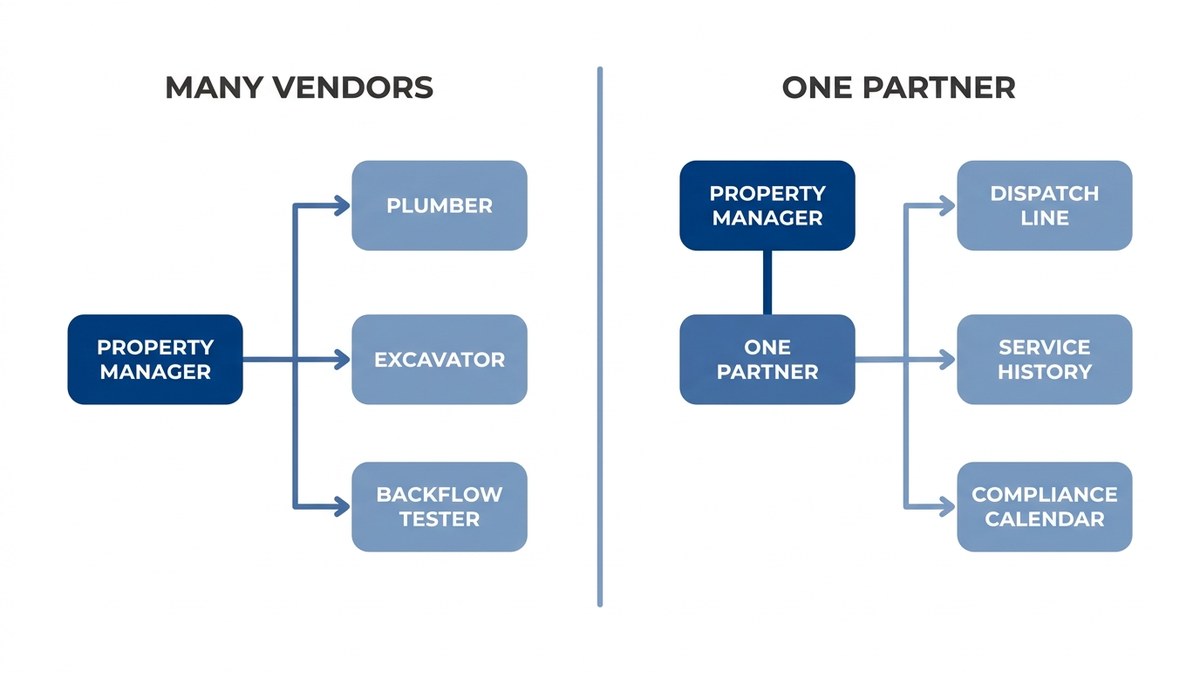
Why choose a property management single plumbing contractor? Because one accountable partner replaces separate plumber, excavation, and backflow vendors with one dispatch line, one service history, and one compliance calendar. That cuts coordination work, speeds emergency response, and keeps every building's records in one place.
Most commercial portfolios do not run on one plumber. They run on a plumber for service calls, an excavation contractor for underground lines, and a testing specialist for backflow. Each has its own phone number, invoice format, and records. When a building goes down, you are the one coordinating. That coordination is the hidden cost. A property management single plumbing contractor, backed by the PlumbGuard™ preventive maintenance program, removes most of it.
This guide is for property managers who oversee multi-unit or multi-building commercial portfolios in Greater Columbus. We are Plumbing & Drain Professionals (PDP), a founder-led, licensed and insured commercial plumbing company that has worked in Columbus for 11 years. We write from what we see in our work with commercial clients. We cover what a single partner is, why consolidation works, what it looks like day to day, and what to ask before you sign. We also cover the risks. Consolidation without guardrails only trades one problem for another.
A single plumbing partner is one licensed commercial contractor that handles routine service, emergencies, drain and sewer work, excavation, and compliance testing across your portfolio. You get one phone number, one set of documented records, and one team accountable for the result at every building.
The word "single" needs a clear scope. It does not mean one technician who does a bit of everything. It means one company that owns the whole chain: service calls, drain cleaning, sewer repair, excavation, testing, and the paperwork that proves the work happened. If any link in that chain is subcontracted, you are back to managing handoffs.
PDP is built around that model. We support businesses and property owners across the Columbus metro area with rapid response and scheduled service programs. We work on commercial properties only, and that focus shapes how we staff crews, plan service intervals, and write up each visit. We schedule and document work in ServiceTitan, so the history for each building sits in one record system instead of three inboxes.
One limit, stated plainly: a single partner is per market. We serve Greater Columbus. If your portfolio spans several metros, you will likely want one accountable partner in each. Inside our market, consolidation is realistic. For many managers, the practical starting point is a PlumbGuard™ preventive maintenance contract and how to enroll. It turns a vendor relationship into a scheduled program.
This answers the pain managers describe in nearly the same words every time: managing multiple contractors and compliance deadlines. That is property management plumbing vendor consolidation in practice, and it is what a property management single plumbing contractor should deliver: fewer phone numbers, fewer invoice formats, and fewer record sets.
Takeaway: A single partner means one company owning the full chain of plumbing work in your market, not one generalist doing everything.
Because plumbing problems rarely stay in one trade. A clog can become a sewer repair, then an excavation job, then a compliance record. A property management single plumbing contractor that owns every step removes the handoffs, cuts delay, and gives you one point of accountability when a building goes down.
We see five reasons come up most often with commercial clients.
The stakes are real. Drain failures disrupt operations, create safety risks, and lead to costly shutdowns in high-use systems such as restaurants, office buildings, and healthcare sites. In those settings, minutes of coordination delay matter more than the difference in an hourly rate.
Pricing is the second piece. Upfront pricing helps property owners and managers make informed decisions without hidden costs. It is also easier to hold one partner to that standard than to police it across several vendors. Cleanup is the third. We leave the space as clean or cleaner than we found it, and that matters in occupied buildings where tenants see the work.
Then there is the objection we hear most: "My current plumber is fine, and I like comparing bids." That is fair, and a good plumber is worth keeping in mind as a benchmark. But look at where the cost sits. It is rarely in the hourly rate. It is in the handoffs, the lost afternoon, and the compliance item that slipped. We will not put a dollar figure on that here, because it differs for every portfolio. Add up your own coordination hours for one quarter and you will have a number that matters.
Even tenant-facing work, such as shower and valve repair in multi-unit buildings, goes through the same dispatch line and the same records. Small jobs build the history that makes the big jobs faster. You can also see how a PDP service call runs from dispatch to documentation, so you know what the process looks like before you commit.
Takeaway: The case for one contractor rests on fewer handoffs, one accountable party, and one record, not on a lower hourly rate.
Multi-site plumbing coordination means scheduling routine service, tracking code deadlines like backflow testing and grease trap cleaning, dispatching emergencies, and keeping repair records for every building. With several vendors, you do that work yourself. With one partner, the contractor carries the calendar and the documentation.
Picture a normal week in a multi-vendor setup. Monday, a tenant reports slow drains on the first floor. Wednesday, a sewage odor shows up in a different building. Friday, you realize a backflow test at a third property is due. Who do you call for a backup, a collapsed line, or a failed backflow test? Which vendor has the last inspection report? Where do those records live? In many portfolios the honest answer is "in my email, and in the head of whoever has been here longest."
That is the real shape of multi-site plumbing coordination. It is a scheduling and records problem first and a plumbing problem second. A few tasks make up most of it:
Inspection belongs on that list too. Sewer lines can develop serious problems before obvious symptoms appear, so we recommend inspection even without a major backup. Waiting for the backup means you pay for the emergency and the repair together. The usual warning signs are frequent clogs, slow drains, foul odors, sewage backups, wet patches on the grounds, and gurgling from fixtures. Any one of them is a reason to call. A scheduled inspection catches the problem earlier than any of them.
Geography matters as well. Our coverage includes Reynoldsburg, Gahanna, Pickerington, Westerville, and Dublin, so one partner can serve a suburban spread of properties without a different vendor for each. If you manage commercial buildings in Dublin, how PlumbGuard maintenance plans work for Dublin-area commercial properties shows what a scheduled program looks like on the ground.
The same logic applies to everyday fixtures. Break rooms and kitchenettes generate steady small calls, and commercial sink repair for break rooms and kitchenettes is a good example. Handled through the same partner, those calls add to the service history instead of scattering across vendors.
The research on this topic points to one more gap: most contractor guides never address a manager running many properties. Their advice stops at one site. A portfolio needs a calendar, a dispatch rule, and a record system that work across all of them.
Takeaway: Coordination is the scheduling, deadline-tracking, and record-keeping that a property management single plumbing contractor takes off your desk.
Everything changes once the partner does its own digging. "Single partner" only works if the partner does not subcontract the hard jobs. When excavation, camera inspection, and trenchless work belong to the same company that took your call, the same team carries the job from diagnosis to documented completion. In our work with commercial clients, that is the biggest difference between a true property management single plumbing contractor and a coordinator who resells other vendors.
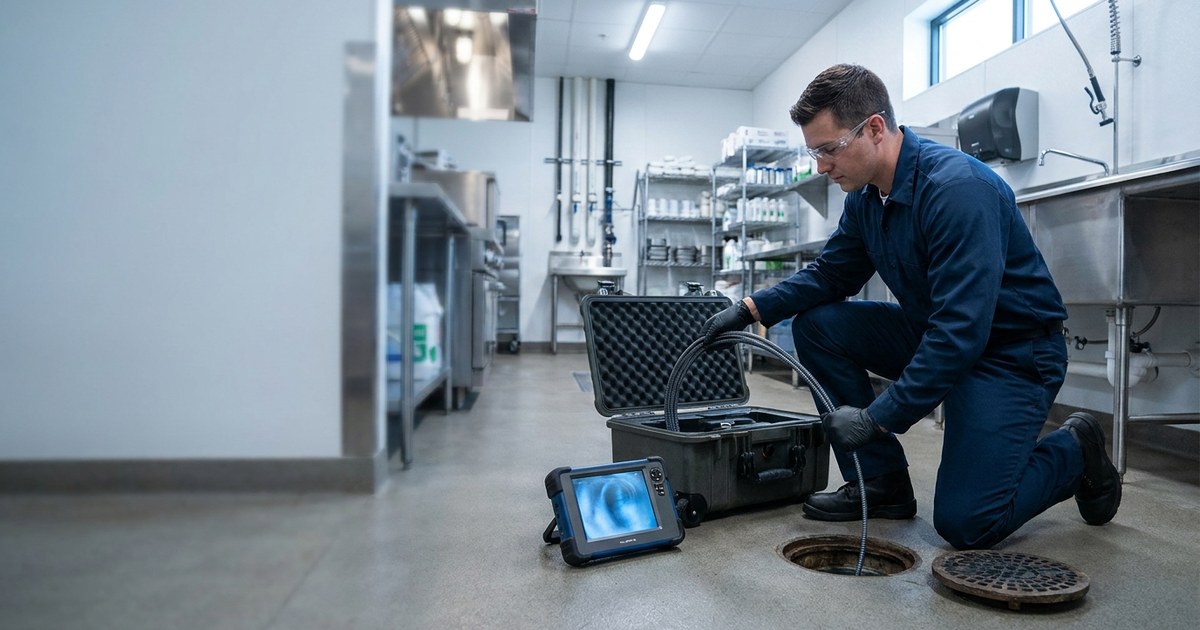
Our approach is simple. We own the hydro excavation truck, the pressure washers, the camera inspection equipment, and the trenchless sewer replacement capability. Sewer and excavation work is delivered by our owned team. There is no subcontractor to schedule and no wait while a third party fits you into a calendar.
Excavation is not routine, so it helps to know when it applies. It is usually needed when underground water or sewer lines are damaged in a way that cannot be repaired through surface access or less invasive methods. That often means collapse, severe deterioration, misalignment, or deep line failure. Common culprits include broken or collapsed pipes, corrosion, root intrusion, failed seals, soil-related pipe sinking, and major blockages that point to structural damage below ground. It applies to both underground water service lines and sewer lines.
Often there is a better option. We provide trenchless sewer replacement in Columbus for commercial properties that need a modern sewer line solution with less disruption. For an occupied building, less disruption means parking areas, entrances, and landscaping stay in use. Trenchless methods are generally considered reliable, and they reduce the amount of digging.
Speed matters when a line fails outright. We offer emergency sewer repair when backups, strong odors, or major drainage failures pose an immediate risk to the property. The crew that responds can also excavate if the camera inspection shows the line has collapsed. There is no gap between the diagnosis and the fix.
Managers always ask what it will cost, and we do not quote a price here. Sewer repair cost depends on the severity of the problem, the method required, and how accessible the damaged section is. A proper inspection comes before an accurate price, which is why upfront estimates matter. Treat any contractor who quotes a firm sewer number sight unseen with caution.
It also helps to know who is doing the work. The licensed commercial team behind the in-house crew is worth meeting before you need them.
Takeaway: A partner that owns its excavation and trenchless crew removes the subcontractor handoff, which is where multi-vendor setups lose the most time.
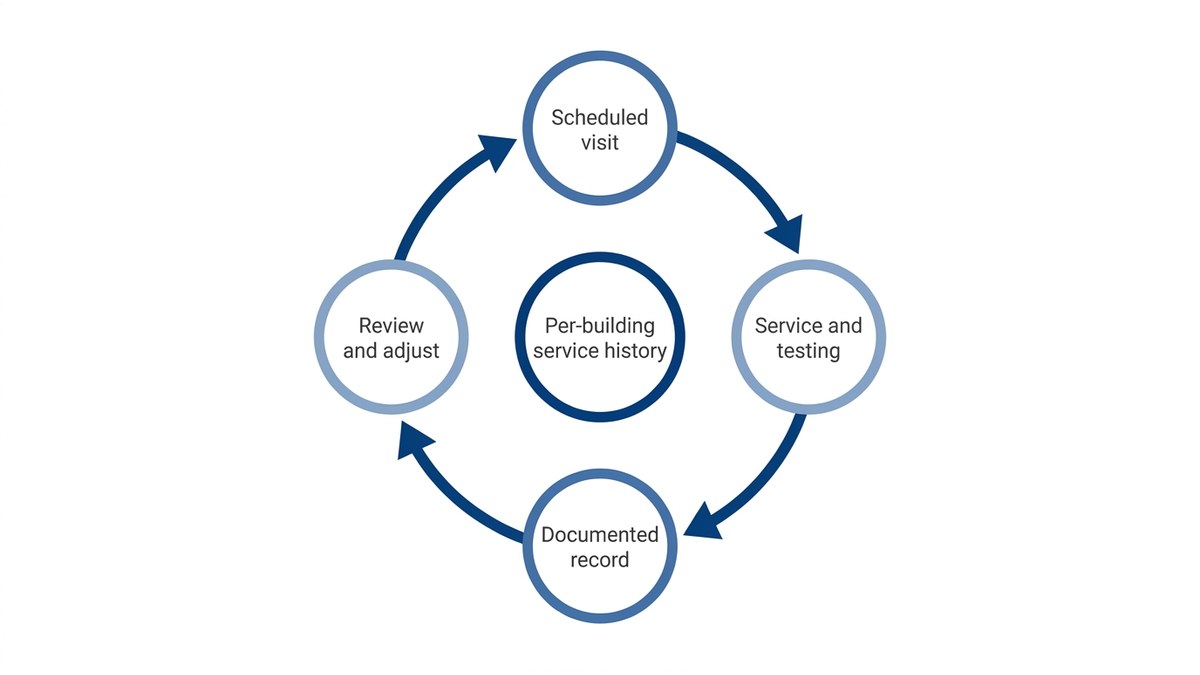
A preventive program sets scheduled service intervals for each building: drain and line jetting, grease trap cleanouts, backflow testing, and water heater, pump, and leak inspections. Visits are documented, so problems surface before they become emergencies, and the contractor builds a service history for each property.
That is how PlumbGuard™ works. Instead of waiting for the call, we schedule the visits. The typical program covers drain and line jetting, grease trap and interceptor cleanouts, backflow testing, water heater inspections, pipe and leak inspections, pump testing, and fixture inspections. Programs scale from a single location to a multi-site portfolio. The same intervals repeat, and the same record system logs each visit.
Drains show why intervals matter. Professional drain cleaning at least once a year is a sound baseline for many properties. Older systems, high-use buildings, and food-service facilities may need more frequent cleaning to prevent slow drainage, odors, grease buildup, and costly interruptions. Aging infrastructure and seasonal conditions make the problems worse, which is why proper diagnosis and preventive service matter. A restaurant tenant and a quiet office suite should not be on the same interval, and a scheduled program lets you set each one on its own.
Seasonal exposure is the other piece. We provide frozen pipe repair in Columbus for commercial properties that need fast response during severe winter conditions. A scheduled program does not make pipes immune to a deep freeze. It does reduce the exposure, because exposed piping and weak points are found and addressed before the cold arrives instead of during it.
This is where the pain of avoiding costly failures and code violations gets answered. A documented interval program means the grease trap was cleaned on a date, the backflow test passed on a date, and the pump was tested on a date. You can show those dates to an owner, an inspector, or an insurer. Missed items become visible early, not after a violation.
Leak detection deserves its own mention. Many managers install smart monitoring and still miss the basics. Common leak detection mistakes property managers make covers what to check so the technology actually protects the building.
If you want the financial argument in detail, the financial case for preventive plumbing maintenance walks through it. We do not repeat its figures here. Read it with your own repair history beside you.
What about the in-house maintenance team you may already have? A preventive program does not replace it. Your team handles daily tenant requests and knows the building. A partner covers what a small team should not carry alone: line jetting, excavation, testing, and the after-hours call. Many managers use both, and a property management single plumbing contractor is built to sit beside an in-house team rather than replace it.
Takeaway: A preventive program moves plumbing from reaction to a documented schedule, building by building.
At 2 a.m., one call reaches a crew that already knows your properties, and the hour does not change the price for PlumbGuard clients. That is the practical difference a property management single plumbing contractor makes in an emergency. Our 24/7 emergency line is 614-758-6237.
Let us be precise, because this is easy to overstate. PlumbGuard clients receive same-day service with no after-hours or weekend fees. That is a feature of the program, not a promise to every caller. If you are not enrolled, ask about emergency pricing before you need it. Better yet, settle it in writing ahead of time.
Here is how it plays out. A commercial facility customer reported that we were onsite within an hour during a clogged-bathroom emergency at a live auction. A restroom failure with a crowd on the premises is exactly the case where a manager has no time to make three phone calls. We cannot promise that response time for every call, and we have not measured a typical figure to publish. But it shows what a single dispatch line is built to do. A restroom outage like that starts with something as ordinary as commercial toilet repair when a restroom goes down.
Three things change when one partner owns the emergency:
The most severe cases are the ones where the property is at risk, and that is when the emergency sewer repair described earlier applies. In winter, we provide frozen pipe repair for commercial properties that need fast response during severe conditions. Both are cases where hours matter more than anything on the invoice.
Write your emergency protocol down now. Put the number in your tenant notice and in your on-site staff's phone. Agree who authorizes spending above routine thresholds at night. The best 2 a.m. response is the one you planned at 2 p.m.
Takeaway: One number, one familiar crew, and no after-hours fee for program clients is what a single partner changes at night.
Ask for specific, verifiable answers: which in-house crews and equipment will do the work, how emergencies are dispatched, what records you receive, and how code deadlines are tracked. Request comparable commercial projects, and expect a site walkthrough and a written scope before any large job is priced.
"Experienced" and "reliable" are not answers. Every contractor says both. Use this checklist with any property management single plumbing contractor you are considering, including us.
Credentials come next. Ask for proof of license and insurance. Ask who owns the company and who answers when something goes wrong. We are licensed and insured, founder-led, Columbus-based, and our documentation runs through ServiceTitan. Those are facts you can verify, which is the point of the checklist.
Many managers also ask whether a single partner is just a generalist. It should not be. Look for a commercial-only focus and a named service process. We work on commercial properties only, and our service call process is documented so you can see how it runs before you hire us.
Finally, judge the answers by how specific they are. A contractor who can tell you which truck, which crew, and which record system will serve your building is giving you something to verify. One who repeats "we do it all" is not.
If you want a concrete starting point, review scheduled plumbing maintenance programs for commercial properties and compare the scope against the checklist above. Then check the team page and the service call process page linked earlier in this guide. Those are the places to verify what we claim.
Takeaway: A good vetting question has an answer you can check, so ask for crews, records, scope, and dates instead of adjectives.
The main risks are dependence, capacity limits during surges, and losing price comparison. You manage them with a written scope, clear response expectations, transparent pricing, documented work you can take with you, and a defined exit path. A good partner welcomes those terms.
Let us take each risk in turn.
Dependence. If one company does everything, a bad quarter at that company becomes a bad quarter for you. Dependence shows up in small jobs first, in slower callbacks and thinner records. Even routine work, such as everyday fixture repairs like faucet repair in commercial restrooms, should come with a documented history you could hand to another contractor tomorrow.
Capacity during surges. A cold snap hits the whole region at once. Frozen pipes spread across many buildings, and every contractor's phone rings together. We provide frozen pipe repair for commercial properties during severe winter conditions, but we will not publish a capacity figure here that we cannot back up. Ask any partner, in writing, how it staffs a cold snap and how it prioritizes program clients. Then judge the answer.
In the meantime, give your on-site staff a simple standing instruction. At the first sign of freezing, shut off the water supply if possible and avoid open flames to thaw the pipe. If the frozen area is hard to reach or the line may already be damaged, professional repair is the safest next step. Insulation, stable indoor temperatures, and attention to exposed piping are the usual prevention measures, and a pipe that freezes can crack or burst as the ice expands.
Losing price comparison. This is the objection we respect most. Competitive bids keep vendors honest. Consolidation removes that routine check, so replace it with another. Benchmark your partner against its own service-history data: callback rates, time to completion, records delivered, and deadlines met. Compare those over a quarter instead of comparing one-off bids. Transparent upfront pricing helps too, because you can still check it against the market whenever you like.
Here are the guardrails to write into any agreement:
None of this is adversarial. A property management single plumbing contractor that is confident in its work will accept these terms without argument. If it pushes back on an exit clause or on records you can take with you, treat that as information.
Takeaway: Consolidation is safe when you replace bid-by-bid comparison with written terms, exportable records, and a quarterly review.
Consolidation buys three things: one dispatch line, one service history, and one compliance calendar. It does that by putting service, drains, sewer, excavation, testing, and records under one accountable commercial partner in your market. It works best when that partner owns its crews, writes down its scope, and lets you verify the work.
The next step is practical. Gather your property list, your current vendors, and the compliance deadlines you track. Note the last emergency where a handoff cost you time. Send us that list and we will scope a quote against it, building by building. You will see what a property management single plumbing contractor would cover, what it would not, and where your current vendors still fit.
Book a service request or consultation. We respond quickly and operate to professional service standards.
We’re Happy to Confirm
If your property is located in or around the Greater Columbus area and you don’t see your city listed, our team can quickly confirm coverage and service options.