2026-11-04
16
min read
A backup starts in a dining room, a clinic or a loaded dock, and the question comes fast: did we see this coming? That is the case for sewer camera inspection commercial facilities can schedule on their own terms.
A commercial sewer camera inspection sends a waterproof camera through your facility's sewer lines to record their actual condition. It finds cracks, roots, bellies, blockages and grease buildup without digging. Facility managers use the footage to prioritize repairs, schedule maintenance and avoid unplanned downtime.
We wrote this guide for facility and operations managers who own uptime, vendor accountability and compliance records. You may have inherited a building with little plumbing history. You may only know that the drains work today. This guide covers sewer camera inspection commercial managers can put to use: what an inspection is and what it finds, when to book one, how it runs in an occupied building and what happens next. If you want the service itself, see our commercial sewer camera inspection service.
Our stance is simple: inspect for the schedule, not the scare.
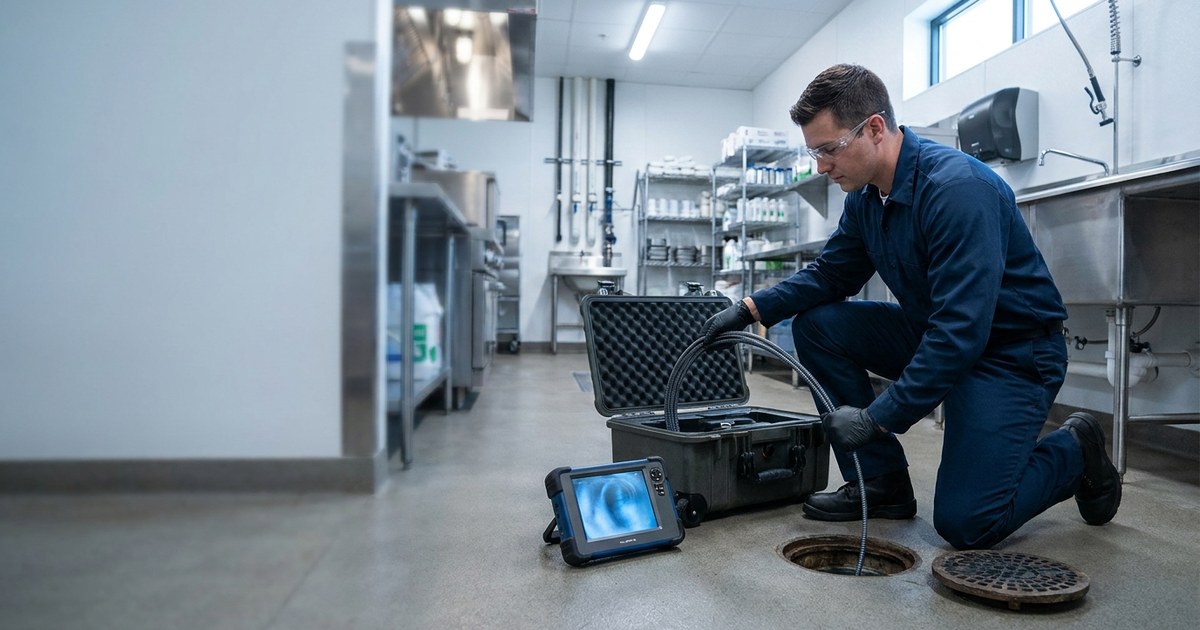
A commercial sewer camera inspection uses a waterproof, self-lit camera on a flexible line to video-record the inside of a facility's sewer and drain lines. The technician sees the pipe's real condition, locates defects by position and leaves you with footage you can act on and file.
That is the whole idea. Instead of guessing why a line backs up, you look at it.
The equipment is simple to describe. A small camera head sits on the end of a flexible line. It carries its own light. The technician feeds it into the line through a cleanout or other access point and watches a live monitor as it moves. The footage is recorded as it goes. When the camera reaches a defect, the technician notes where it sits in the line, so a repair crew can find the same spot later without opening up more ground than necessary.
This work belongs to our own crew, not a subcontractor. The inspection sits inside the same in-house capability that handles sewer work, excavation, hydro excavation and trenchless repair. That matters for a reason we return to later: the person who sees the problem works for the company that can fix it.
It also fits the way we think about commercial drain cleaning, hydro jetting and grease trap compliance. A camera shows what is actually in the line. Cleaning and jetting then respond to what the footage shows. Without the footage, cleaning is a routine. With it, cleaning is a decision.
The term you will see most often for this is sewer diagnostics. It means finding the cause of a problem instead of treating its symptom. A plunger or a cable clears a blockage. A camera tells you why the blockage formed.
Three things come out of every sewer camera inspection commercial teams order:
Keep that third item in mind. For a facility manager, the footage is as useful as the findings. It is the first document in a history many buildings never had.
Takeaway: A commercial sewer camera inspection replaces guessing with recorded evidence of what your lines actually look like.
Sewer defects grow out of sight and fail at the worst time. A camera inspection shows the problem while it is still a scheduled repair, not an emergency. It also gives you a documented baseline of line condition, which supports budgeting, compliance records and vendor accountability.
Start with the objection we hear most: "Our drains work, so why inspect?"
A drain that works today tells you the water is moving today. It does not tell you what the pipe looks like. A line can be cracked, partly rooted or coated with grease and still carry flow. Then one busy lunch service, one wet week or one more year of buildup tips it over. Working drains are not a diagnosis. They are the absence of a symptom.
Sewer lines also fail on the building's schedule, not yours. Nobody sees them. Nobody walks past a cracked joint under a slab. So the first sign is often the failure itself, and it lands when the building is fullest: a packed dining room, an open clinic, a loaded dock.
Downtime here is wider than a burst pipe. It is any period when a plumbing problem reduces your ability to operate. A kitchen that cannot run a full line is down. A restroom block taken out of service is down. A tenant who cannot use the space is a lease conversation waiting to happen. A camera inspection ahead of time turns that hidden risk into a line item you can plan.
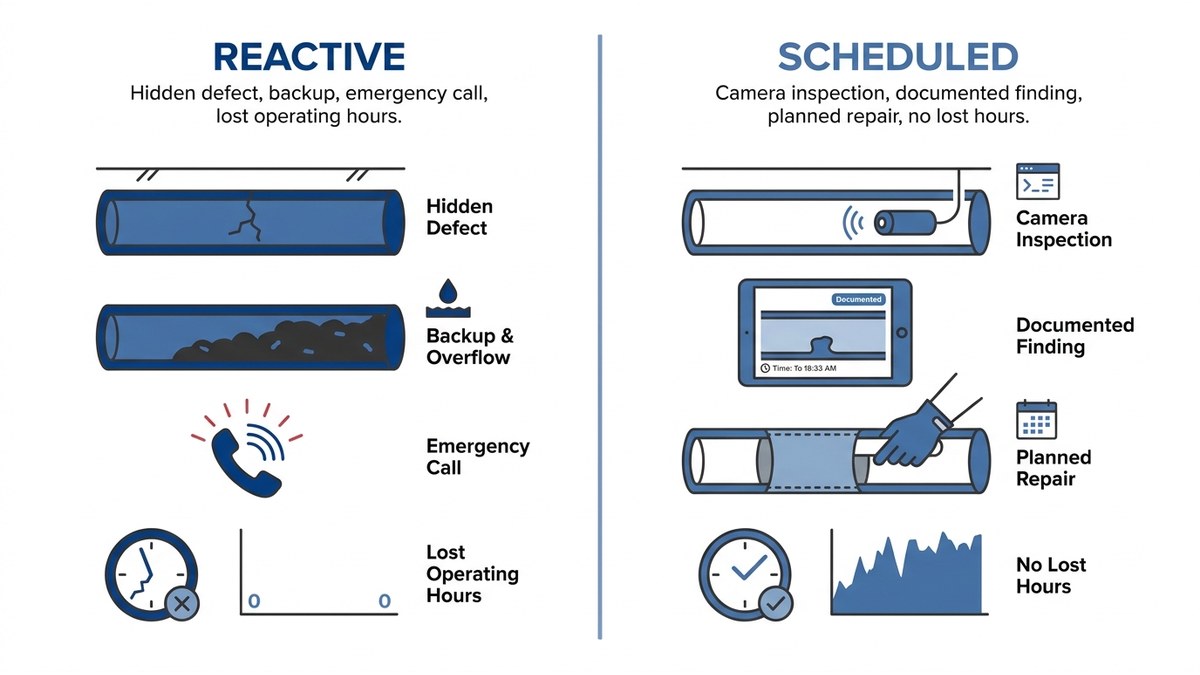
The benefits of a sewer camera inspection commercial facilities schedule show up in three places.
First, scheduling. A defect found early becomes a planned job, booked around your operating hours. We cover the money side in why preventive drain cleaning pays off over time.
Second, budgeting. Footage lets you rank repairs by condition instead of by whoever shouted loudest last quarter. If you want the broader numbers behind that approach, read the financial case for preventive plumbing maintenance.
Third, accountability. When a vendor says a line needs work, you can ask to see it. When you hire a new vendor, you can hand over the baseline instead of starting from nothing.
In our work with commercial facilities, the inspections that pay off most are the ones done before a problem. The footage becomes a baseline. Later budget talks and vendor conversations stay factual because everyone is looking at the same pipe. We track that documentation in ServiceTitan, so the record follows the building and not one technician's memory.
A sewer camera inspection commercial managers order is not a repair upsell. A clean inspection is a good result. It tells you the line is sound, gives you a dated record and lets you set the next check with confidence. A finding is a useful result too, because you learn it on your terms.
Portfolio managers get one more benefit. A consistent inspection record scales across sites. You can compare buildings on the same footing and spend maintenance budget where the footage points, not where habit points.
Takeaway: A working drain is not a diagnosis, and an inspection turns an unseen risk into a scheduled, documented decision.
A camera can show cracks, offset joints, root intrusion, bellies (low spots that hold water and waste), grease and scale buildup, partial blockages and failed repairs. It also shows pipe material and where lines connect, so repair decisions rest on evidence instead of guesses.
Each defect carries its own operational consequence. Here is what the footage tells you, defect by defect:
The footage also shows pipe material and where lines join. Those two facts decide what kind of repair makes sense. A clay line and a cast iron line behave differently. A tangled junction needs a different plan than a straight run. Without the picture, the repair plan is a guess.
Two links help here. Grease and scale respond to cleaning. Our hydro jetting for facilities and multi-unit properties scours the pipe wall, and the camera shows whether the pipe is clear afterward. That makes inspection and jetting a pair: one finds the buildup, the other removes it, and the next camera pass confirms the result.
The other link is the wider system. Sanitary lines do not exist on their own. Site drainage, storm lines and sanitary lines all affect each other, which is why we also point managers to storm drain and sanitary sewer maintenance when they plan a site-wide approach.
For a food-service operation, grease and scale deserve special attention. A kitchen produces fats and solids all day. A line that looked fine last year may be heavily coated now. A camera pass shows how fast the buildup returns, and that tells you how often cleaning should happen. That connects directly to commercial drain cleaning, hydro jetting and grease trap compliance as one program instead of three separate calls.
A quick note on limits. A sewer camera inspection commercial teams run shows what is inside the line the camera can reach. It does not show everything about the building. It does not replace a plan for the whole system. It is the fastest, least disruptive way to see inside the pipe, and that is what makes it the right first step.
Takeaway: Every defect the camera finds maps to a specific operational consequence, which is what makes the footage useful for planning.
Schedule one when you take over a building, before a lease or purchase, after repeated slow drains or backups, before major renovation, and as a recurring preventive check. How often depends on building age, pipe material and use. Food service and high-traffic sites usually warrant closer attention.
Think in triggers, not in a fixed calendar. These are the moments when an inspection earns its place:
We do not give a single interval for everyone, because there is not one. A newer office with modern pipe sits at one end. A busy restaurant with an older cast iron line sits at the other. A healthcare site has its own sensitivity to any interruption.
Our preventive-over-reactive philosophy shows up here. The goal is to prevent the 2 a.m. emergency. When inspection and cleaning run on a schedule, the late-night call becomes rare. That is the idea behind our PlumbGuard™ preventive maintenance contracts: the inspection cadence is set once, and the work shows up on the calendar instead of in a crisis.
If you are not sure whether your building has reached a trigger, check the symptoms. Slow drains, gurgling, odors, damp spots and repeat clogs all count. Our guide to the warning signs your commercial plumbing needs an inspection walks through them. If you see any of them, you are probably past the point where waiting is the cheap option.
One practical note for managers who answer to owners or boards. A preventive sewer camera inspection commercial managers schedule is easier to defend than a repair. It has a clear purpose, a clear deliverable and a clear record. It does not need a failure to justify it.
Takeaway: Tie inspections to defined triggers and a preventive cadence set by your building's age, pipe and use, not to a one-size calendar.
In an occupied building, access windows, shutdown coordination and tenant constraints drive the timeline more than the inspection work itself. Inspections can be scheduled around operating hours, so the camera goes in when your people and customers are least affected.
Managers worry about disruption, and they are right to ask. A sewer camera inspection commercial buildings can absorb is light work. The planning around it is what takes thought.
Here is what shapes the schedule:
In practice, these factors set the timeline more than the camera does. The footage itself is not slow. Getting clean access at the right time is the hard part, and that is why a good plan up front matters.
Different sites bring different sensitivities. A grease-heavy kitchen needs the work around prep and service. A healthcare site needs care around patient areas and any sensitive systems. A retail or office building needs to protect customers and tenants. We plan for each one.
Our 24/7 availability and no after-hours or weekend fee help here. An inspection can be scheduled around your operating hours without a premium for working off-hours. If the quiet window for your building is early morning or late night, that does not change the price.
Multi-site portfolios benefit most from this approach. One facility manager may oversee many buildings with different tenants and constraints. The method scales: set the access plan once per site, run the inspections on a consistent standard and keep every record in one place. For managers in the Dublin area, our overview of PlumbGuard™ maintenance plans for Dublin-area properties shows how a recurring plan fits a local portfolio.
We have worked in Columbus for 11 years. We know that commercial buildings do not stop for plumbing. The job is to fit the inspection into your operation, not the other way around.
Takeaway: Access and coordination set the pace in an occupied building, and we plan the inspection around your operating hours.
You receive the footage and findings, then choose the response: routine sewer cleaning or hydro jetting, a spot repair, trenchless replacement or excavation. With one in-house crew handling inspection through repair, there is no handoff between contractors and no gap in the record.
Most managers have lived the alternative. One contractor diagnoses. A second cleans. A third digs. Each one starts from scratch, each one has its own paperwork, and the building's history lives in three inboxes. That juggling is a real cost, in time and in accountability. When something goes wrong, nobody owns the whole picture.
Our approach to sewer camera inspection commercial work removes the handoff. The same crew that runs the camera can clean, jet, repair, replace or excavate. The findings do not get re-explained. The record stays continuous in ServiceTitan, from the first footage to the final repair.
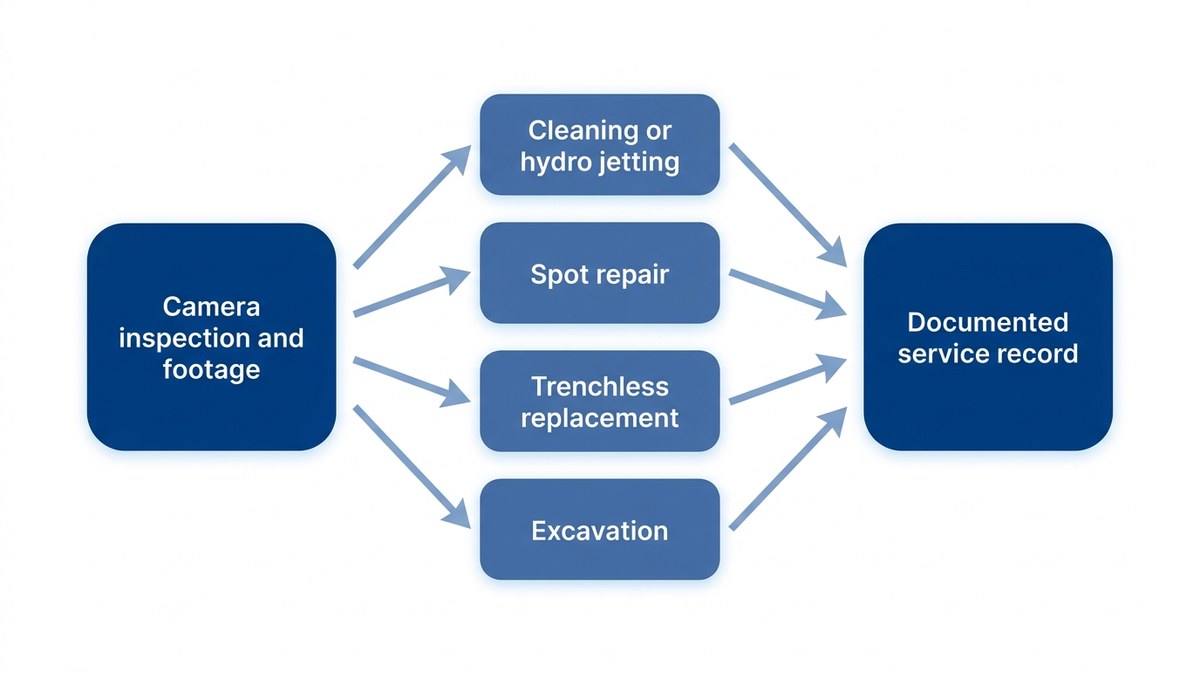
The response depends on what the footage shows:
You decide. The footage supports each option, so the choice is based on what is in the pipe and what your operation can absorb. If the best answer is "leave it for now and recheck on a schedule," that is a legitimate result too.
That recheck is where PlumbGuard™ comes in. A finding is only useful if it turns into a schedule. How PlumbGuard™ protects a facility explains how preventive maintenance contracts take the findings and set a recurring plan, so the building stays ahead of the next problem instead of waiting for it.
This is also where the footage pays off again. A later inspection can be compared with the first. You can see whether buildup returned, whether a defect has grown and whether a repair is holding. That is evidence, and it keeps vendor conversations factual.
Takeaway: One in-house crew carries the work from footage to repair, so findings turn into action without a handoff or a gap in the record.
A commercial inspection provider should be able to state who runs the camera, who performs any repair, what the written report includes, how records are kept, and what licensing and insurance cover the work. Clear answers to these five questions separate a diagnostic partner from a sales pitch.
Managers often worry that a sewer camera inspection commercial providers sell is a lead-in to a big repair quote. These questions protect you.
Our answers are on the record. Our crew is licensed and insured. The work is documented and code-compliant. We are founder-led, with 11 years in Columbus. Pricing and scope are quoted per facility.
If you are weighing a longer-term plan, setting up a commercial preventive maintenance contract covers what a recurring arrangement looks like. It is the follow-through that keeps a good inspection from becoming a one-time event.
Ask the same five questions of every provider you consider. Compare the answers, not the pitch.
Takeaway: Five questions about the camera, the repair, the report, the records and the coverage tell you whether a provider will be accountable.
A sewer line fails out of sight. That is why a sewer camera inspection commercial facilities schedule ahead of time changes the whole conversation. You stop asking whether a failure was coming. You already know what the pipe looks like.
To recap: a camera records the real condition of your lines. It finds cracks, roots, bellies, buildup and failed repairs. The right triggers are takeover, transaction, symptoms, renovation and a preventive cadence. In an occupied building, access and coordination set the pace, and we work around your operating hours. After the inspection, one in-house crew can clean, repair, replace or excavate, with no handoff and one continuous record.
The shift is from reacting to scheduling. A documented baseline is worth more than any single repair, because it makes every later decision factual. That is the point of inspecting for the schedule, not the scare.
Tell us about your facility and we will scope a camera inspection around your operating hours.
Book a service request or consultation. We respond quickly and operate to professional service standards.
We’re Happy to Confirm
If your property is located in or around the Greater Columbus area and you don’t see your city listed, our team can quickly confirm coverage and service options.