2026-11-11
11
min read

What is the right way to choose a plumbing partner for multi-location properties? Test five things: commercial-only experience, in-house crews that avoid subcontracting delays, 24/7 response with transparent after-hours pricing, documented work history for every site, and a scheduled maintenance program that scales across your portfolio. One accountable contractor replaces several local vendors.
Picture a Tuesday at 2 a.m. A main line backs up at one of your buildings. You have a different plumber for each site, three sets of pricing, and no shared service history. Nobody can tell you when that line was last jetted. That scramble, not a bad plumber, is the real failure in multi-site plumbing. This guide is a plumbing partner multi-location properties scorecard: it shows how to evaluate a partner on portfolio-level accountability. It also explains why a PlumbGuard™ preventive maintenance program is often the backbone of that relationship.
We are Plumbing & Drain Professionals (PDP), a commercial plumbing contractor serving Greater Columbus. The model below fits portfolios concentrated in the Columbus metro. It does not describe national coverage.
Score candidates at the portfolio level, not the site level. A contractor that is excellent at one building but inconsistent across five recreates the coordination problem you are trying to remove. Most guides say "compare quotes." Quotes tell you about price on one day. They say little about how a vendor behaves when five sites need attention in the same week.
Treat the plumbing partner multi-location properties decision as a vendor-accountability question. For a portfolio owner, accountability means one contact, one record and one standard of work. This is also why multi-site accounts are the most valuable relationships on both sides. They reward consistency over a low one-time price.
Use these five tests as your plumbing partner multi-location properties scorecard.
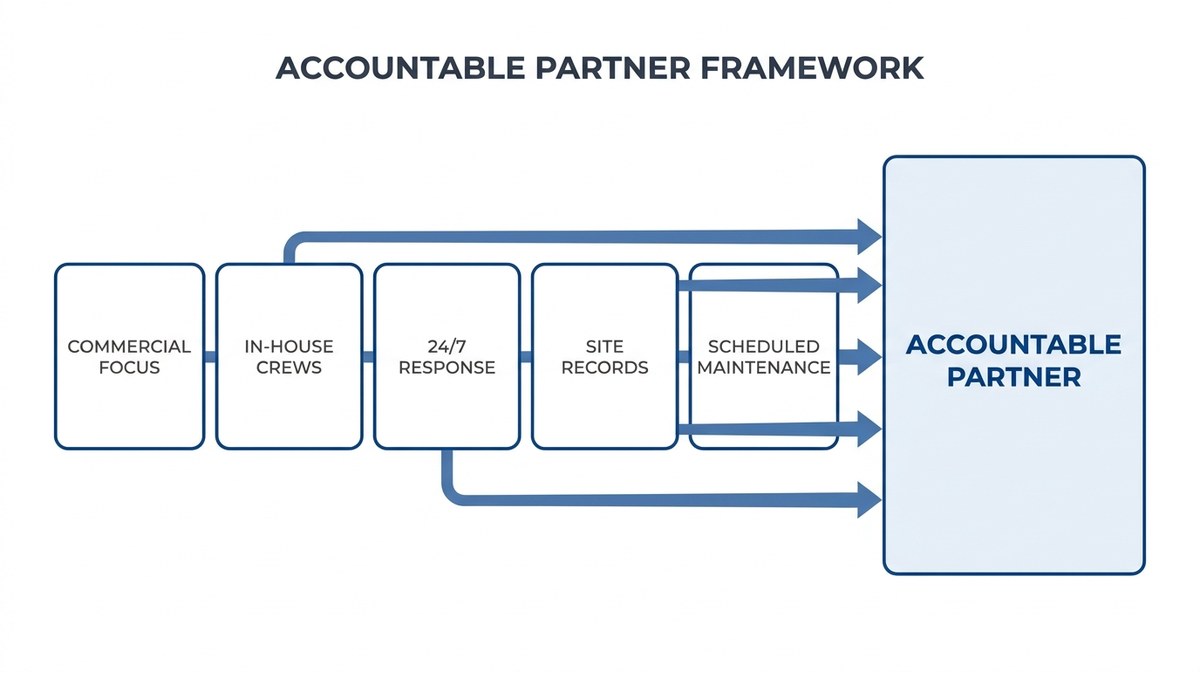
Ask whether the contractor works on commercial facilities daily. Downtime cost, tenant access and compliance dates shape every job. A crew that mostly serves households will not think in those terms.
Find out who owns the work that causes the longest delays. Subcontracted work puts your timeline in another company's hands.
Look for 24/7 dispatch and clear pricing. Ask whether a night or weekend call carries a surcharge.
Every visit at every site should leave a record you can retrieve by location. Without it, you rebuild each building's story from scratch.
A scheduled program should expand from one building to many without a new contract negotiation each time. For a worked example of how this looks in a contract, read how to get a PlumbGuard™ preventive maintenance contract.
Takeaway: In any plumbing partner multi-location properties search, score the partner on how consistently it performs across all your sites, not on how well it performs at one.
A single partner trades per-site shopping for consistent pricing, one service history and one accountable contact. A local vendor at each site can be convenient, but response, records and compliance tracking vary by building. The right choice depends on whether your sites sit in one service area. Treat it as a plumbing partner multi-location properties comparison, not a price contest.
The common objection is fair: "One partner means all my eggs in one basket, and a local specialist might be cheaper or closer." Do not dismiss it. Turn it into criteria the single partner must prove: in-house capacity, documented work and transparent pricing. If a partner cannot show those three, stay with local vendors. We have no price comparison to offer, and you should be wary of any vendor that quotes a savings figure before it has seen your buildings.
PDP supports businesses and property owners across the Columbus metro area with rapid response and scheduled service programs. When work is subcontracted, your timeline depends on another company's schedule. That is the structural reason consolidation can shorten recovery times, though it is not a guarantee. For the property management view, see why your property management company needs a single plumbing partner.
| Factor | Local vendor per site | Single commercial-only regional partner |
|---|---|---|
| Response | Varies by vendor and building | One dispatch process for all sites |
| Records | Separate files, often incomplete | One service history, searchable by location |
| Pricing consistency | Different rates and terms per site | One pricing approach across the portfolio |
| Compliance tracking | Each vendor tracks (or does not track) its own dates | Dates tracked in one place |
| Coordination effort | Many contacts, many invoices | One accountable contact |
| Best fit | Sites spread across distant regions | Sites concentrated in one metro area |
When a local vendor makes sense. If some of your properties sit outside one service area, a regional specialist near those sites may be the practical choice. Even then, ask each vendor the same scorecard questions and keep records in one format.
Takeaway: A single partner wins on consistency when your sites share a service area, and a local vendor wins when they do not.
Ask who owns the work that causes the longest delays: sewer and excavation, hydro jetting, camera inspection and trenchless repair. If a multi-site plumbing contractor subcontracts those, your downtime depends on someone else's calendar. In-house crews and owned equipment mean one party answers for the outcome.
PDP owns and operates its hydro excavation truck, pressure washers, camera inspection tools and trenchless sewer replacement equipment. We do not subcontract that work. The point is not the equipment list. It is that one company owns the diagnosis, the repair and the documentation.
Excavation is a good test case. It is usually needed when an underground water or sewer line has collapsed, deteriorated badly, shifted out of alignment or failed at depth, and surface access or less invasive methods will not fix it. If that work is handed to another company, your site waits on that company's schedule while a restroom or kitchen stays out of service. Ask any candidate how it handles that scenario and who shows up.
Routine restroom work matters too, because it is what tenants notice first. Fixture problems such as commercial restroom faucet repair are small jobs that become tenant complaints fast when no one owns them. A partner that handles both the dramatic and the routine work gives you one vendor to call for either.
You can also see who will actually be on site. Meet the licensed commercial crew behind the work to see what a licensed, insured in-house team looks like.
Takeaway: In-house capacity is the clearest sign that one company, not a chain of subcontractors, answers for your downtime.
Expect 24/7 dispatch, transparent pricing and no after-hours or weekend surcharge, so a night or weekend failure carries no financial penalty. Then ask how the contractor prioritizes sites, how it records each call and what its response looks like in practice, not just in a brochure.
Our emergency line is 614-758-6237, and PDP does not add after-hours or weekend fees. Upfront pricing also helps managers decide quickly without worrying about hidden costs. That matters when you are approving work at midnight for a building you are not standing in.
Triage across sites is the part most vendors skip. When two properties call in the same hour, ask these questions:
You want a vendor with a stated answer. Ask for it before you sign.
Here is what response can look like. In our work with commercial clients, one facility reported that our team was onsite within an hour during a clogged-main emergency. Another customer described the same speed during a clogged-bathroom emergency at a live auction, where the crew restored the restroom. These are individual customer experiences, not a response-time guarantee. They do show the kind of proof to ask any candidate for.
Clogs in public restrooms are the most common version of this call. A partner that treats commercial toilet repair and clog response as a core service, rather than a side job, is usually set up for it.
Takeaway: Judge emergency readiness by pricing terms, triage rules and real customer accounts, not by a promise on a web page.
Centralized plumbing management means one scheduling system, one set of service records and one point of accountability for every site. Each visit is documented, compliance dates are tracked, and you see history by location without chasing separate vendors.
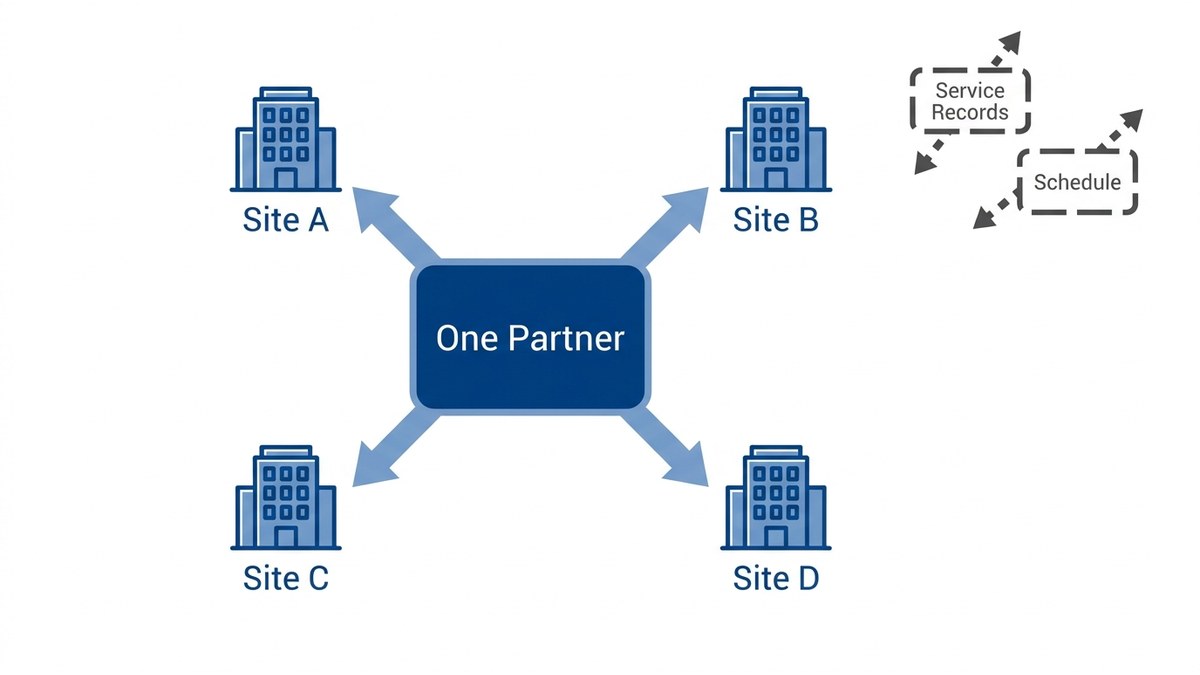
On a Monday morning, this is what multi-facility coordination should mean for you. You open the week knowing which sites have service due, which had calls over the weekend and what was done. You do not make three phone calls to find out whether a drain was cleaned last month.
At PDP, scheduling runs through ServiceTitan, workmanship is documented, and compliance tracking is part of the process. Our crews are licensed and insured, and we keep that documentation ready for audit requests. We are not describing a client portal or a specific report format here, because the right level of visibility depends on your portfolio. Ask any candidate exactly what you would be able to see and in what form.
Documentation also improves diagnosis. Leaks often come from aging pipes, seasonal expansion and contraction, high water pressure, hidden wear or drainage blockages that stress the system. Non-invasive methods such as infrared thermal imaging can locate hidden moisture behind walls and under floors without opening surfaces unnecessarily. When each building's history is on file, patterns show up sooner, and repeat problems at one site are not mistaken for new ones.
This is also where routine service earns its place. Scheduled plumbing maintenance and inspection programs generate the records that make centralized management useful, because every visit adds to the building's file.
Takeaway: Centralization is only real if you can see history, schedules and compliance dates for every site in one place.
A preventive program sets scheduled service intervals for each site: drain and line jetting, grease trap cleanouts, backflow testing, water heater and pump checks. Frequency is customized per building, so older or high-use sites get more attention than newer ones.
PlumbGuard™ is our program for this. It covers drain and line jetting, grease trap and interceptor cleanouts, backflow testing, water heater inspections, pipe and leak inspections, pump testing and fixture inspections. It scales from a single site to a portfolio.
Here is the operating insight that makes it work across many buildings: intervals are set per site, not per contract. A food-service tenant with heavy grease loads needs a different cadence than a quiet office floor. As a general baseline, commercial plumbing maintenance is scheduled at least once a year, and older systems or hard-water properties may benefit from service twice a year. Professional drain cleaning once a year is a reasonable starting point. High-use buildings and food-service facilities often need it more often to prevent slow drainage, odors, grease buildup and costly interruptions. Your own site audit should set the final schedule.
The business reason is simple. Scheduled work is planned, priced and done on your terms. Emergency work happens on the failure's terms. Preventive service helps avoid costly repairs, extends system life and reduces water damage from hidden problems. For the numbers behind that argument, see the ROI of preventive plumbing maintenance. To see how a plan protects a building between failures, read how PlumbGuard protects a facility between emergencies.
When you evaluate a program, ask whether you get one master agreement with a schedule for each site or separate contracts per site. Ask how a new building gets added. The answer shows whether the program is built for portfolios or only for single sites.
Takeaway: Portfolio maintenance works when each building gets its own interval under one accountable program.
Use these questions with every plumbing partner multi-location properties candidate. Write down the answers and compare them side by side.
If you manage properties around Dublin, see what a maintenance plan looks like for Dublin-area commercial properties. Treat a vague answer to any question as information. A partner that can answer all ten plainly is usually one that works the same way across every site.
Takeaway: Ten plain questions will reveal whether a vendor is built for portfolios or for single jobs.
Choose a plumbing partner for multi-location properties on the failure mode that actually hurts you: inconsistent response, records and pricing across buildings. Score candidates on commercial focus, in-house capability, emergency terms, documentation and scalable maintenance. If your sites sit in the Columbus metro, one accountable plumbing partner multi-location properties can rely on can replace a patchwork of vendors.
Managing plumbing across several Columbus-area properties? Tell us about your portfolio and we will outline a plan.
Book a service request or consultation. We respond quickly and operate to professional service standards.
We’re Happy to Confirm
If your property is located in or around the Greater Columbus area and you don’t see your city listed, our team can quickly confirm coverage and service options.


