2026-11-09
15
min read

24/7 commercial plumbing response means an emergency line open around the clock, a licensed crew dispatched at any hour, and pricing that does not jump for nights or weekends. For a facility, it limits downtime when a main clogs, a pipe freezes or a drain backs up, because the repair starts while the problem is still small.
Picture a Friday evening. The doors are open, the waiting area is full, and a main line starts backing up. Nobody on site can fix it, and the vendor list in the office drawer leads to voicemail. This is the call every facility manager dreads, and it rarely comes at a convenient hour. What plumbing downtime costs a commercial facility adds up fast: lost service hours, closed restrooms, and staff who cannot do their jobs.
This guide is written for facility managers across Greater Columbus. It defines what real 24/7 commercial plumbing response looks like and what an after-hours failure costs a commercial site. It covers the emergencies that cannot wait until morning, how an in-house crew changes the pace of a repair, and how to test a provider's promise before you need it. It closes with a checklist for the minutes before a crew arrives.
It means someone answers an emergency line at any hour and a licensed crew is dispatched to your site, not a voicemail and a next-day callback. Real 24/7 response covers nights, weekends and holidays with the same crew, equipment and pricing you get during the day.
That definition has four working parts. Each one is something a facility manager can check before a failure happens.
A page that promises emergency plumbing availability is describing a phone line. 24/7 commercial plumbing response describes what happens after the line is answered: who is dispatched, what they bring, and how soon the repair starts. Some providers advertise round-the-clock service while their contact page promises a reply within a business day. Those two statements cannot both be true, and a facility manager should ask which one applies at 2 a.m.

Plumbing & Drain Professionals supports businesses and property owners across the Columbus metro area with rapid response and scheduled service programs. Customers have told us what that looks like in practice. One commercial customer reported that our team was onsite within an hour during a facility clog emergency and restored the bathroom. That is a customer-reported experience, not a guaranteed arrival time. It does show what the model is built to do.
If your site is in the northern suburbs, our write-up on how 24/7 response works for commercial facilities in Worthington shows how the same process applies locally.
Takeaway: A real 24/7 promise is an answered line, a dispatched crew and a price that does not change with the clock.
Far more than the repair. Downtime is any period when a plumbing problem limits your ability to serve customers, keep staff on site or meet hygiene and safety expectations. One blocked drain or leak can take several rooms out of service and force closures.
The repair invoice is the smallest number in the story. Consider what stops when a main line backs up in an occupied building. Restrooms close. A kitchen cannot operate. Staff are sent home or stand idle. Visitors leave and do not come back that day. In healthcare and food service, hygiene and safety obligations make the pressure higher, because the site cannot simply carry on while the problem is "managed."
Without 24/7 commercial plumbing response, a failure that starts at 6 p.m. on a Friday can sit unattended until Monday morning. Every one of those hours is an hour the affected space stays closed, and the damage to floors, fixtures and finishes can grow while nobody is on site.
Customer-facing sites feel it fastest. A retail floor or lobby with closed restrooms loses visitors in minutes, and the damage to the visit outlasts the repair. Our guide on how retail sites limit plumbing disruption during business hours covers how scheduling and containment keep the doors open.
Smaller failures count too. A sink that will not drain in a staff restroom or break room can leave a shared space unusable. A fast commercial sink repair and drainage fix after hours keeps a minor fault from turning into a closure the next morning.
Plumbing is also a much bigger part of the economy than most facility budgets suggest. Trade-press coverage such as PHCP Pros on studies of the plumbing industry's economic impact shows how much commerce depends on working water and drainage systems. A single-site failure is a small version of the same dependency. When the system stops, the work around it stops.
In our work with Columbus facilities, we hear the same detail repeatedly. Customers have reported our team reaching their site within an hour during a clogged-main emergency. Another described a clogged bathroom at a live event, where service was restored quickly. In both cases, the cost that mattered was the time the facility could not use the space. We treat those accounts as what customers told us, not as a promised response time. What they show is that the first hour is where downtime is won or lost.
Diagnosis matters in that first hour too. For buried sewer problems, an inspection is usually needed before accurate pricing can be given. That is why we explain estimates up front and get your approval before work begins.
Takeaway: The cost of an after-hours failure is measured in closed rooms and lost service hours, and the first hour decides how many you lose.
Any plumbing failure that stops a facility from operating, exposes people to wastewater or threatens property justifies an immediate call. Main-line clogs, sewage backups, burst or frozen pipes, sump pump failures, grease trap overflows and water heater failures all disrupt operations, and none of them gets better overnight.
Here is what each one looks like at a commercial site:
Not every urgent call is a flood. In locker rooms, healthcare settings and hospitality sites, a failed fixture can take a high-use space out of service. Our shower and tub repair for commercial properties exists for that reason.
Each item on this list is a reason to have 24/7 commercial plumbing response arranged before the failure, rather than starting a vendor search in the middle of it. The facilities that recover fastest are the ones that already know who they are calling.
Aging infrastructure and seasonal conditions make several of these problems worse. That is why diagnosis and preventive service matter, and we return to that below.
Takeaway: If a failure closes a room, exposes people to wastewater or keeps releasing water, it is an after-hours call.
Because nothing waits on a subcontractor. When the same company owns the dispatch, the camera inspection, the hydro excavation and the trenchless repair, the job moves from diagnosis to fix without handoffs. Fewer handoffs mean fewer delays and clearer accountability.
Rapid response plumbing is only rapid if the whole job is fast, not just the arrival. 24/7 commercial plumbing response is only as quick as its slowest handoff. Think about how a buried line failure unfolds at 1 a.m. Someone has to find the fault, confirm it, expose the pipe and repair it. If each step belongs to a different company, each handoff becomes a phone call, a scheduling window and a chance for the job to stall until morning. When one crew handles diagnosis, camera inspection, excavation and repair, the job avoids those handoffs.
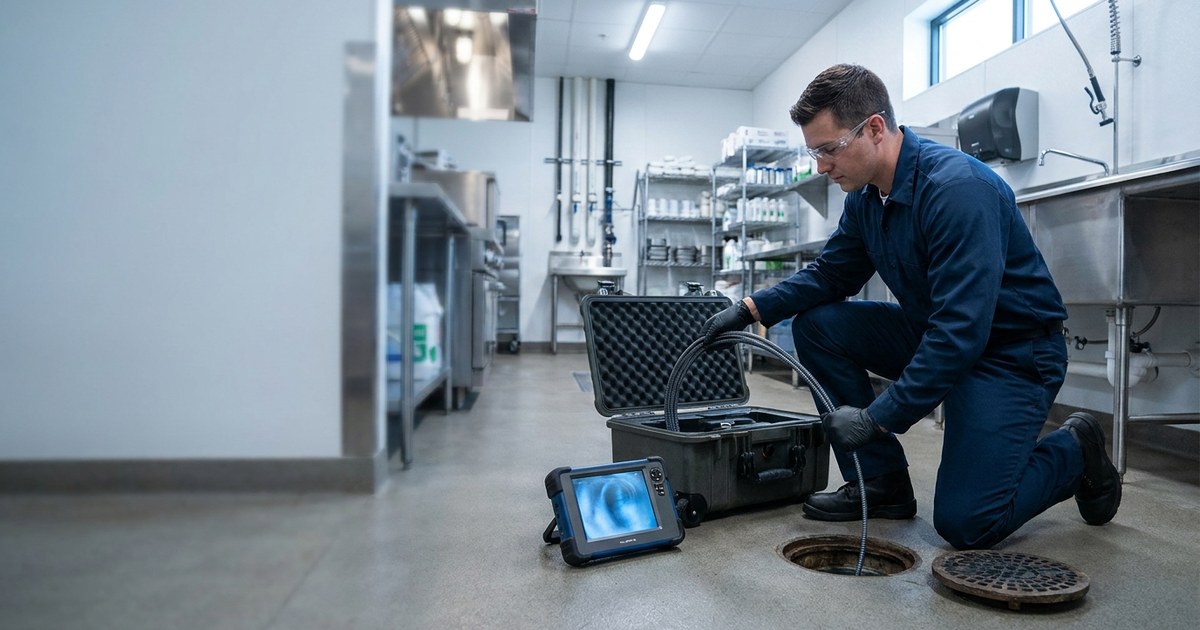
Our crew works with its own capabilities: camera inspection to see inside the line, hydro excavation to expose it, pressure washing, and trenchless methods where they apply. Trenchless sewer repair is often preferred because it reduces the need for extensive digging. That matters when the line runs under a parking lot, a dock or a lobby. When a buried sanitary line does need direct access, excavation support is part of the service.
The same logic applies to our rapid response and scheduled service programs across the metro. Every job is documented in ServiceTitan, so the service history of a building stays in one place. Our 24/7 emergency plumbing service in Columbus page lays out how that dispatch works.
We put it simply: we own the process, we own the team, we own the outcomes. For a facility manager, that means one accountable vendor to call instead of a chain to manage.
Takeaway: Fewer handoffs between diagnosis and repair is the clearest way to shorten an after-hours job.
It often does with other providers, but it should not have to. We do not charge after-hours or weekend fees, and pricing is explained up front with your approval before work begins. Ask any provider to put their after-hours terms in writing before you need them.
A maintenance and emergency budget is built on assumptions. A surcharge for nights, weekends or holidays breaks those assumptions exactly when the facility has the least room to negotiate. Nobody compares quotes at 2 a.m. with a backed-up main.
Our position is simple: no after-hours or weekend fees, and transparent pricing. We explain the work and the cost, and we wait for your approval before we begin. Upfront pricing helps managers make informed decisions without hidden costs. Where the scope depends on what is underground, such as a sewer line, a proper inspection comes first so the estimate reflects what is actually wrong.
That sequence is the same on a Tuesday afternoon and a Sunday night. Our write-up of how a PDP service call runs from first call to closeout walks through it step by step.
Price transparency is part of any 24/7 commercial plumbing response worth buying. A crew that arrives at midnight but bills a premium for the hour has solved the repair and created a budget problem.
We do not run coupons or discount offers, and we are not asking you to shop on price. We are asking you to compare terms. Predictable emergency cost is part of what a vendor sells, as much as the repair itself. Before you sign with any after-hours plumbing service, ask three things:
Written answers to those three questions tell you more than any advertisement.
Takeaway: A 2 a.m. invoice should hold no surprises, and the only way to know is to ask for the terms in writing first.
Ask who answers the phone, what response you can expect, whether the crew is commercial-focused and in-house, what is licensed and insured, and whether the work is documented. A real 24/7 provider answers all of these plainly, before you are in an emergency.
This is vendor accountability, and it belongs in your vendor file, not in your memory. A provider's 24/7 commercial plumbing response should be something you can test and write down, not something you take on faith. The questions below can go straight into an RFP or an annual vendor review.
Here is how we answer them. We are commercial-only, with an in-house crew and excavation team. We are licensed and insured, we document our work in ServiceTitan, and we have served Columbus facilities for 11 years. On response, customers have reported our arrival within an hour in clog emergencies. Treat that as customer-reported experience, and ask us about your specific site.
For a deeper look at what a commercial provider should be able to show you, see our guide to what to expect from a commercial emergency plumber.
Test the claim against the season too. A provider should be able to describe how it handles winter, including frozen pipe repair during severe cold, because that is when after-hours demand peaks. A vendor that cannot explain its January plan is not ready for your January.
Takeaway: A real 24/7 claim survives eight plain questions, and the best time to ask them is before the call.
Scheduled service catches the slow failures that become 2 a.m. calls: grease buildup, aging drain lines, failing backflow assemblies, tired pumps and water heaters. Maintenance does not remove every emergency, but it makes downtime planned and predictable instead of sudden.
Response and prevention are two halves of one uptime plan. Prevention does not replace 24/7 commercial plumbing response; it reduces how often you need it. PlumbGuard™ is our preventive program for commercial facilities. It covers drain and line jetting, grease trap and interceptor cleanouts (an interceptor catches grease and solids before they reach the drain line), and backflow testing. It also covers water heater inspections, pipe and leak inspections, pump testing and fixture inspections. It scales from a single site to a multi-site portfolio.
Facility managers already schedule fire panel tests, generator runs and HVAC service. Plumbing deserves the same service interval. A documented schedule also gives you records for compliance reviews and a clear view of which assets are aging. Fixture inspections often turn up a worn or leaking tap, and a planned commercial faucet repair during business hours costs far less in disruption than a failed one at night.
For many properties, professional drain cleaning at least once a year is a good baseline. Older systems, high-use buildings and food-service facilities may need it more often to prevent slow drainage, odors, grease buildup and costly interruptions. Aging infrastructure and seasonal conditions make these problems worse, which is why proper diagnosis and preventive service matter.
Commercial drain cleaning, hydro jetting (high-pressure water that scours the inside of a line) and grease trap compliance sit at the center of this work. On the sanitary side, inspection and maintenance of the wastewater system help catch repeated blockages and odors before they become a backup. Our overview of common commercial plumbing problems and their fixes shows how each of these problems starts and what addresses it.
Because each visit is documented, an emergency call starts with the building's service history instead of a blank page. The logic is straightforward. Fewer neglected assets means fewer surprise failures, and the failures that remain are caught earlier.

Takeaway: Prevention turns emergencies into scheduled visits, and 24/7 response covers whatever prevention cannot.
Stop using the affected fixtures, limit water use in the area, keep people clear, then call the emergency line. The goal is to contain the problem and protect people and property until a licensed crew takes over. This is facility-operations guidance, not a repair guide.
The checklist works alongside 24/7 commercial plumbing response. The crew handles the repair, and your team handles containment, communication and access in the minutes before and after arrival.

When the crew arrives, expect to be kept informed and to have the work explained. We leave your space as clean or cleaner than we found it. Once the site is stable, ask about scheduled plumbing maintenance programs so the next failure becomes a planned visit.
Takeaway: The first minutes are about containment and access, and a short written checklist keeps everyone on site doing the right things.
24/7 commercial plumbing response is operational infrastructure. It works the way a generator or a fire panel does: you hope not to need it, and you plan as though you will. The logic holds together. An answered line and a dispatched crew limit the damage of the failures you cannot predict. Transparent pricing keeps the emergency budget stable. Documented prevention shrinks the number of failures that become emergencies at all.
For a Columbus facility manager, that adds up to downtime that is smaller, shorter and easier to explain. It also means one accountable partner instead of several contractors to juggle at midnight. Securing 24/7 commercial plumbing response before the next failure is the difference between a short, documented repair and a long night of phone calls.
If you are comparing coverage options or planning for PlumbGuard™, Request a Quote and tell us about your site.
Book a service request or consultation. We respond quickly and operate to professional service standards.
We’re Happy to Confirm
If your property is located in or around the Greater Columbus area and you don’t see your city listed, our team can quickly confirm coverage and service options.