2026-11-13
16
min read
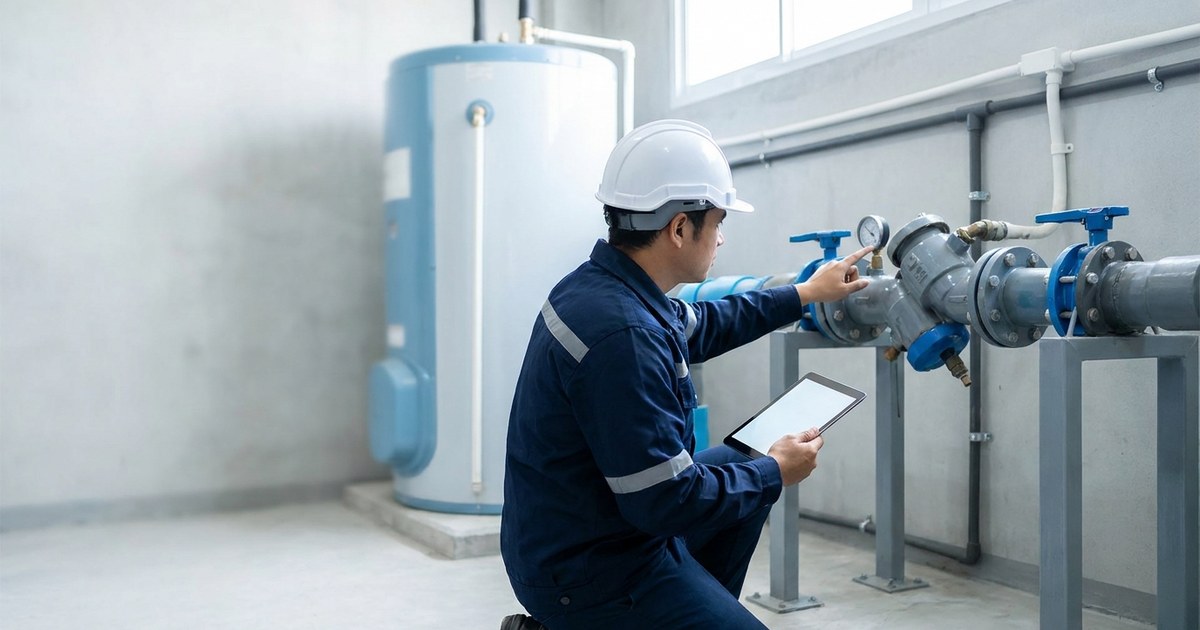
What is preventive maintenance for commercial plumbing? Preventive maintenance for commercial plumbing is a scheduled program of inspections, cleaning, testing, and minor repairs that catches wear before it causes a failure. Each visit is documented, so a facility builds a service history, plans costs ahead, and avoids emergency calls, closures, and compliance gaps.
The call comes at 2 a.m. A water heater has failed, or a sewer line has backed up into a tenant space. You own uptime, so you are the one holding the phone.
The repair is only the start. Unplanned labor premiums arrive first. Then come business interruption, tenant complaints, and an invoice that lands weeks later with costs nobody planned for. Most commercial facilities live this way by default, not by choice.
This guide makes the case for the alternative: scheduled plumbing maintenance for Columbus commercial facilities. We cover what a program includes, how often to run it, how it works across a portfolio, and why the maintenance log matters as much as the work. We treat preventive maintenance commercial plumbing as an operating schedule, not a repair category. We close with a four-step framework for taking the case to ownership. It is written for facility managers and property managers who answer for uptime, the maintenance budget, and vendor accountability.
It is a documented schedule of inspections, drain and line cleaning, equipment testing, and small repairs. The aim is to find degradation early. A facility fixes a worn seal or a slow drain on its own timeline instead of in the middle of the business day.
A preventive maintenance commercial plumbing program is not a vague service subscription. It is a set of dated intervals, each with a defined task, and each recorded in a facilities maintenance log. That log is the core deliverable. The plumbing work matters, but the record is what you can hand to an insurer, an auditor, a lender, or the next facility manager.
Our PlumbGuard™ program is built this way. It is a documented preventive maintenance program designed for facility uptime and code compliance across Greater Columbus. It turns reactive emergency firefighting into scheduled operations. If you want to see how the agreement is structured, read about a PlumbGuard™ preventive maintenance contract.
Preventive, reactive, and "inspect when we notice." Most facilities run a mix of the last two. Your staff walks the building and sees what is visible: a stain, a drip, a slow drain. Much of what fails is not visible. Corroded fittings, worn seals inside a pump, grease building in a main line, and a backflow assembly that no longer tests properly all give little warning.
Walkthroughs also leave no dated record. The knowledge sits in one person's head and leaves when that person does. Staff walks are valuable, and a good program does not replace them. It adds the testing, cleaning, and documentation that a walkthrough cannot provide.
Downtime is broader than a burst pipe. Downtime is any period when a plumbing issue reduces normal operations. A slow drain, low pressure, or a closed restroom all count. Commercial plumbing problems rarely stay in one room, and they can force a temporary closure.
Pump systems show how this plays out. Maintenance on a pump prevents seal failures and motor burnout. A pump that never receives scheduled inspection tends to end in a replacement, which is a capital expense. A water heater follows the same pattern. An early, small service call is cheaper than replacing the unit after it fails.
Takeaway: A commercial preventive program is a documented interval schedule, and the maintenance log it produces is as valuable as the work itself.
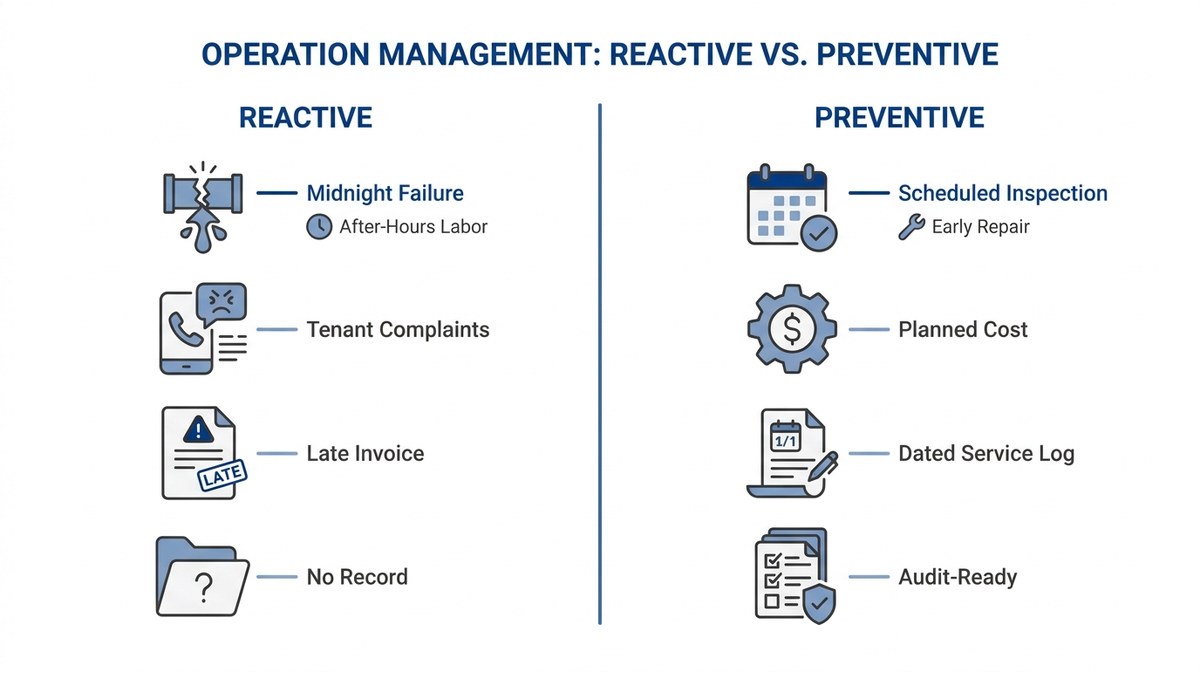
The reactive model waits for systems to fail and then scrambles to fix them. It feels cheaper because nothing is spent until something breaks. In practice it is a budget trap that most commercial facilities fall into by default. The hidden costs sit outside the repair invoice, and they are the part nobody forecasts.
Consider what a single failure triggers. A water heater dies at midnight, and you pay unplanned labor premiums to get it fixed. Tenants lose hot water and call you before they call anyone else. Your team spends the next day on damage control instead of planned work. The invoice then arrives, and it never matches the budget line you set for plumbing.
Unplanned downtime is often the largest hidden cost of waiting. Picture a sewer line backing up and forcing a restaurant to close. The lost revenue and the reputational damage far exceed the repair invoice. The pipe gets fixed in an afternoon, but the customers who saw the mess do not forget it as quickly.
Fast response softens a bad day, but it does not make it a good one. A commercial customer told us our team was onsite within an hour during a clogged-bathroom emergency at a live event. That response mattered to them. It also shows the limit of the reactive model: the problem was already happening in front of guests. We can respond quickly through 24/7 commercial plumbing repair and emergency response. A scheduled program exists so you call that line less often.
The compounding effect. Failures in a commercial building rarely stay contained. One backup can shut down a restroom bank, a prep area, or a floor. Deferred work also stacks up. A slow drain ignored this quarter becomes a main line stoppage next year. What deferred maintenance does to a commercial building is worth reading if you need to show a colleague how small skipped tasks turn into large ones.
The honest objection. A maintenance program is one more recurring line item, and it is fair to ask why you shouldn't just pay when something breaks. The answer is not that service costs nothing. The answer is that you pay either way. A preventive maintenance commercial plumbing program moves spending into a predictable schedule you control. The reactive model puts it into emergencies you do not. We do not publish a price here because scope depends on the facility, and we route cost questions to a quote.
Takeaway: Reactive plumbing does not avoid cost; it hides it in premiums, interruptions, and invoices you cannot forecast.
The core scope is drain and line jetting, grease trap and interceptor cleanouts, backflow prevention testing, water heater inspections, pump system testing, pipe and leak inspections, and fixture inspections. Each interval is logged, so the facility has a dated record of what was checked. We provide sanitary system services in Columbus for commercial properties that need dependable wastewater removal, system inspection, repair, and ongoing maintenance.
The scope below is the baseline for preventive maintenance commercial plumbing. Real programs are customized per facility type and risk profile, so a kitchen, a clinic, and a warehouse will not look the same.
Jetting clears the grease, scale, and debris that narrow a line over time. A narrowed line drains slowly, then stops. Hydro jetting for commercial drain lines scours the pipe wall rather than punching a hole through a blockage. It is the interval task that most directly prevents the Saturday backup.
For food service, this is both an operations task and a compliance task. A trap that is not cleaned on schedule sends grease downstream and invites a violation. We handle grease trap and interceptor cleaning on set intervals and log each one.
Backflow assemblies protect the potable water supply. A lapse in testing raises no alarm. It is often found only when a notice arrives or a building changes hands. Healthcare and food service facilities in particular should treat backflow testing as a calendar item, not something to remember.
These inspections catch failing seals, scale buildup, worn components, and early motor strain. They are where the gap between a small service call and a capital replacement is widest.
Slow leaks, worn seals, and corroded fittings fail at the worst time if nobody looks. A scheduled check covers visible and accessible piping, fixtures, and water pressure. Small fixes happen on the visit, and larger ones get flagged with a record of when they were found.
When a line behaves strangely, guessing is expensive. In-house sewer camera inspection shows what is inside the pipe, so recommendations rest on what the camera found. Because the same company owns the camera, the jetting equipment, and the repair crew, findings turn into action without a handoff.
What each task prevents:
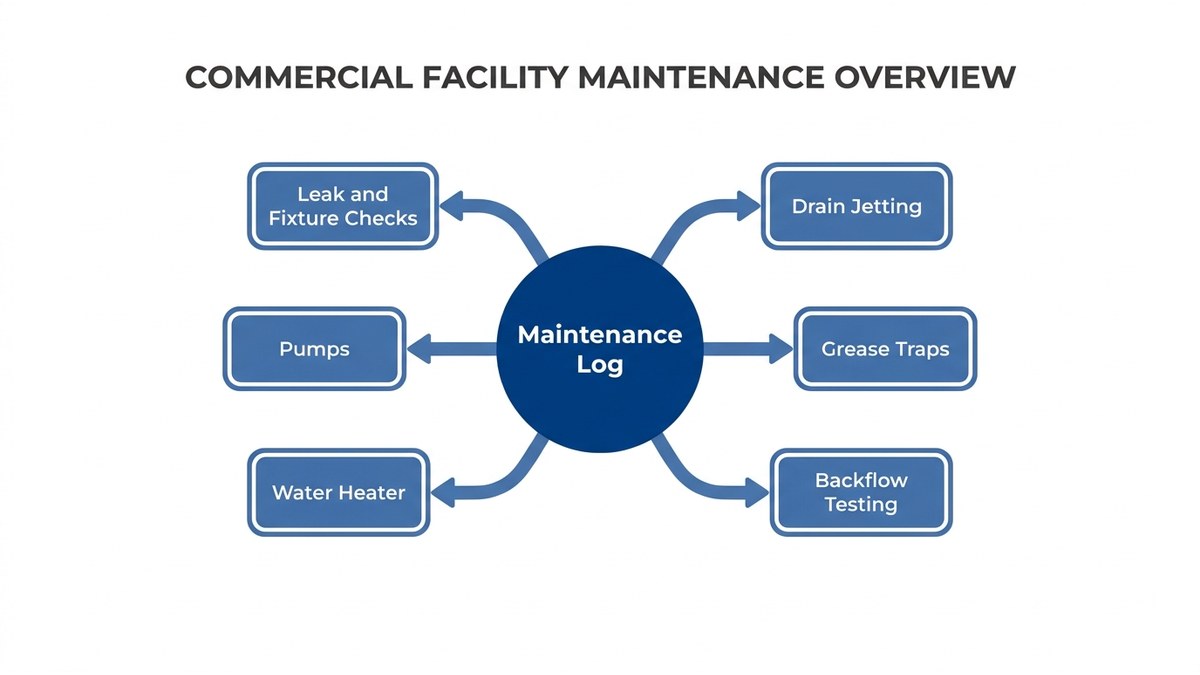
Takeaway: A complete program covers drains, grease, backflow, heaters, pumps, and leaks, and every interval ends up in one dated log.
Most commercial systems need service at least once a year. Older or hard-water properties may benefit from twice-yearly visits. The actual cadence depends on facility type and risk. A high-volume kitchen needs far more frequent drain and grease service than an office floor.
That annual baseline matches what we see in our work with commercial facilities in Columbus. It is a starting point, not a ceiling. You can read more about how we structure plumbing maintenance across commercial properties in Columbus, and service frequency is customized per facility type and risk profile.
Three things set your preventive maintenance commercial plumbing cadence:
Cadence by facility type. These are directional, not fixed schedules. Your service intervals should be set after a site assessment.
| Facility type | What drives risk | Cadence logic |
|---|---|---|
| Food service | Grease, organic debris, health inspections | Shortest drain and grease intervals, with backflow on the calendar |
| Healthcare | Water quality, backflow, continuity of care | Annual baseline or tighter, with strong emphasis on testing and records |
| Retail and office | Restroom use, tenant expectations, access windows | Annual baseline, twice yearly if the building is older or has hard water |
| Industrial and warehouse | Large drain runs, pumps, heavy-use equipment | Baseline plus focused pump and line checks |
| Multi-unit and mixed-use | Many tenants, shared lines, claims exposure | Per-building schedule with a service history for each property |
The deli example. Here is a typical scenario, not a named client. A grocery store with a high-volume deli produces steady grease and organic debris. Without scheduled service, that material builds in the main drain line for months. Then a Saturday afternoon backup floods the prep area and forces a partial closure. Customers see the mess, a health department violation follows, and the store loses a day of peak weekend revenue while emergency crews clear and sanitize the area.
With a preventive maintenance commercial plumbing schedule, quarterly drain jetting clears the line before the buildup reaches that point. The task itself is ordinary. What changes is that it happens on a schedule instead of after the failure. For the money side of this logic, see why scheduled drain cleaning costs less than emergency clearing.
Takeaway: Set an annual baseline for preventive maintenance commercial plumbing, tighten it for age, hard water, and load, and let risk to operations decide the rest.
A program sets scheduled service intervals for each building, then documents every visit. Problems surface before they become emergencies, and the contractor builds a service history per property. One partner and one standard replace a patchwork of vendors across the portfolio.
For a property manager, the value of preventive maintenance commercial plumbing is consistency. Each building gets its own schedule of drain and line jetting, grease trap cleanouts, backflow testing, and water heater, pump, and leak inspections. The schedule reflects that building's age, use, and tenants. The service history stays attached to the property, not to whoever happens to manage it that year.
One service history per property. A portfolio without it looks like this. One vendor has the records for Building A. Another did the work on Building B and kept nothing useful. A third shows up on emergencies only. When ownership asks which buildings have the most plumbing exposure, you cannot answer from a record. A single history per property lets you compare buildings, plan capital, and show what was done and when.
No subcontractor handoff. Multi-vendor setups lose the most time at the handoff, when the inspector finds a problem and a different company has to schedule the repair. A partner that owns its excavation and trenchless crew, along with its inspection and jetting teams, removes that step. The finding and the fix sit under one accountability line. It is worth meeting the licensed commercial team behind that in-house crew before you need them.
Programs scale across single locations and multi-site portfolios. We support businesses and property owners across the Columbus metro area with rapid response and scheduled service programs. For one example of how this is packaged locally, see PlumbGuard plans for Dublin-area commercial properties. We also serve Reynoldsburg, Gahanna, Pickerington, and Westerville, so a portfolio spread across the metro does not need a different vendor in each suburb.
The staff objection, again. Your in-house team is the first line of defense, and they should keep doing walkthroughs. A multi-property program gives them something to work from: a schedule, a log, and a contractor who tests what they cannot see. That also protects you when a key person leaves, because the history stays with the properties.
Takeaway: For a portfolio, the program's value is a per-building schedule, one service history per property, and one partner who owns both inspection and repair.
Yes. Dated inspection reports and service logs show a facility exercised reasonable care. They help in insurance claims, audits, refinancing, and property sales, and they reduce due-diligence friction for a buyer or lender. This is the angle most preventive maintenance commercial plumbing content skips. The log is not paperwork for its own sake. It is an asset.
PlumbGuard™ is built around this idea. How PlumbGuard™ preventive maintenance protects your facility goes deeper on the program. The summary is simple: the maintenance happens on schedule, the documentation proves it happened, and the facility manager focuses on operations instead of plumbing crises.
When a plumbing failure damages tenant property or creates a safety hazard, the question becomes whether the facility took reasonable care. Documented preventive maintenance creates a defensible position. You can show dated inspections, testing, and cleaning, rather than asserting that someone walked the building. That can reduce claim severity and improve how an insurer views the risk. We work in Columbus and document our work in ServiceTitan, so the record exists before anyone asks for it.
Backflow and grease are the two areas where compliance depends on routine, not on events. With backflow, the calendar date is the only warning you get, because a missed test makes no noise. Grease interceptors, if not cleaned on schedule, can become a health department issue. A log with dated entries for each test and cleanout turns both into a calendar you can defend. Requirements vary by jurisdiction, so confirm the specific rules and test frequencies that apply to your facility with your local authority.
Audit readiness matters most for facilities under corporate ownership or institutional management. When a property sale, refinancing, or insurance renewal calls for a facility condition assessment, a documented maintenance history helps. Dated inspection reports and service logs increase asset value and reduce buyer due-diligence risk. A building with no history gets assessed on what an inspector can find in a day, usually with a cautious eye.
Takeaway: The maintenance log turns plumbing work into evidence for insurers, auditors, lenders, and buyers.
You do not need invented numbers to convince ownership. You need your own facility's history, organized the right way. The framework below works in order, and you can start it Monday morning. Use it to build the case for preventive maintenance commercial plumbing from your own records.
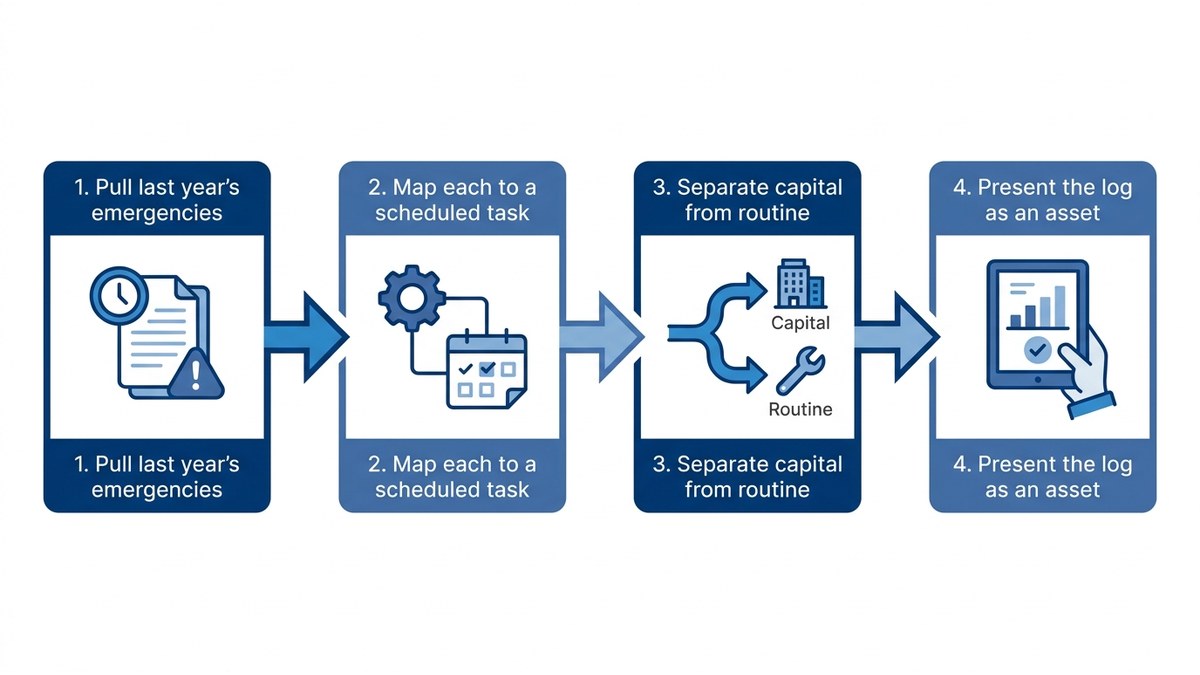
Step 1: Pull the last year's emergency calls, after-hours charges, and tenant complaints. Gather every unplanned plumbing event from the past twelve months. Include the labor premiums, any closures or restricted areas, and every complaint a tenant sent. This is your baseline, and it comes from your own records.
Step 2: Map each one to the scheduled task that would have caught it. For each event, ask what interval task would have found it earlier. A main line backup maps to drain jetting. A water heater failure maps to a heater inspection. A violation notice maps to a grease or backflow task. Some events will not map to anything, and that is fine. Be honest about which ones would have been caught and which would not.
Step 3: Separate capital replacement exposure from routine service. List the equipment that, if it fails, becomes a capital request: water heaters, pumps, and similar units. Then list the routine service that would extend or protect them. Leadership usually reacts differently to a replacement request than to a service line, and showing both side by side makes the tradeoff clear.
Step 4: Present the maintenance log as an audit and insurance asset. Frame the program as a financial and risk document, not a plumbing one. Explain that dated inspection reports support insurance claims, audits, refinancing, and sale. This is the point that moves the conversation from "another recurring cost" to "a record we need."
You will have a table of real events, the tasks that would have caught them, and the exposure you carry today. You fill in the dollar values from your own invoices. For the financial detail behind this logic, read the financial case for preventive plumbing maintenance. Facility managers who accept the case in principle still have to present it to leadership, and this framework gives them a structure to do it.
If ownership asks for a cost, tell them it depends on the facility's size, systems, and risk profile, and request a scoped quote rather than guessing.
Takeaway: Build the case from your own emergency history, map it to scheduled tasks, and present the log as a risk asset.
Start with who does the work. A partner for preventive maintenance commercial plumbing should use its own in-house crew, not subcontractors. That keeps inspection and repair under one line of accountability, which matters most when something is found mid-visit.
Look for these criteria:
Also ask the partner what they would look for first. A good one will point to the tasks facilities tend to skip, such as the overlooked maintenance tasks that commercial facilities miss, rather than reciting a generic list. Our goal is simple: qualified commercial facility manager inquiries that turn into recurring PlumbGuard™ agreements because the program does what it says.
Takeaway: Choose a partner that owns its crew, documents every visit, prices upfront, and answers the phone at any hour.
The maintenance plan benefits come down to three things.
First, proactive maintenance replaces emergencies with intervals, so cost, labor, and downtime are planned instead of imposed. Second, the scheduled plumbing service you run on each building leaves a dated history that supports insurance, audit, refinancing, and sale. Third, one in-house partner owns inspection and repair, so findings become fixes without a handoff.
Preventive maintenance commercial plumbing programs do not make a facility immune to failure. They make failure less frequent, less surprising, and easier to defend. Pricing depends on your facility, so the next step is a scoped conversation, not a guess.
Tell us about your facility and we will scope a scheduled service program for it. Request a Quote.
Book a service request or consultation. We respond quickly and operate to professional service standards.
We’re Happy to Confirm
If your property is located in or around the Greater Columbus area and you don’t see your city listed, our team can quickly confirm coverage and service options.